

Knowing how to recognize genuine Egyptian jewelry requires a precise understanding of its cultural and artisanal heritage. Authentic creations are directly inspired by the traditions of ancient Egypt while respecting specific symbolic codes.
Today, the market is flooded with imitations, which is why knowing reliable criteria is important. In this article, you will discover how to identify an authentic piece with method and rigor.
Understanding the historical origin of ancient Egyptian jewelry
Jewelry in ancient Egyptian civilization was not just decorative accessories. It represented power, divine protection, and social status. Under iconic reigns like that of Tutankhamun, funerary adornments demonstrated exceptional refinement and advanced mastery of goldsmithing.
Wide collars, known as usekh, and royal pectorals were designed to accompany the deceased into the afterlife.
Artisans worked with gold as a sacred metal associated with the sun and the god Ra, a symbol of immortality and divine perfection. Silver, which was rarer in ancient Egypt, was also highly valued for its unique luster.
Semi-precious stones such as lapis lazuli, turquoise, and carnelian were imported and selected as much for their spiritual significance as for their radiance.
A genuine Egyptian piece of jewelry respects this cultural and religious logic. It reflects a social hierarchy, a ritual function, or a specific belief.
Understanding this historical background allows you to evaluate whether a current creation is truly rooted in tradition or simply exploiting an exotic aesthetic without any symbolic foundation.
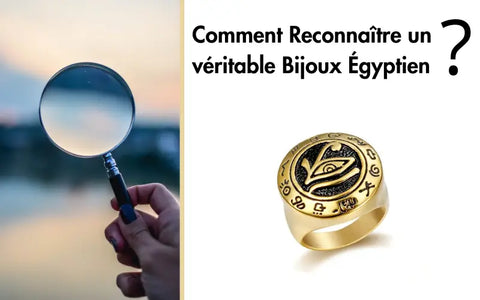
Essential sacred symbols to identify
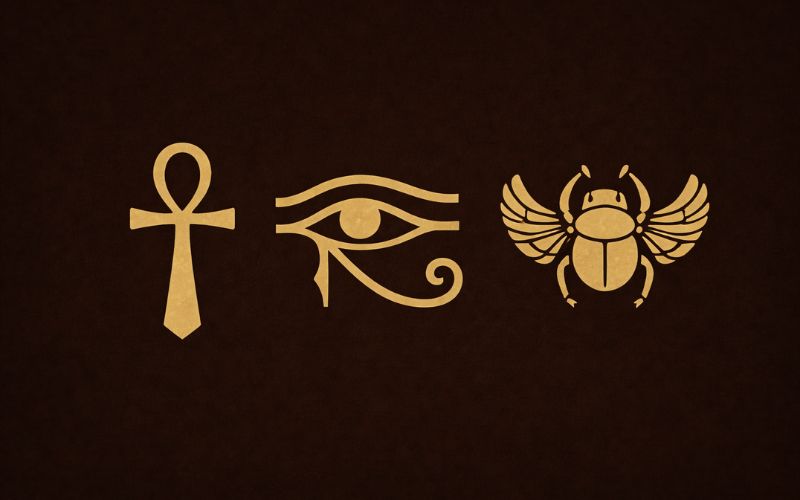
Noble materials used in authentic Egyptian jewelry
One of the major criteria for recognizing authentic Egyptian jewelry lies in the rigorous selection of materials. In antiquity, gold was considered the flesh of the gods, particularly associated with the solar cult and immortality.
Its resistance to oxidation made it a perfect symbol of eternity and divine power. Silver, which was rarer on Egyptian territory and often imported, was reserved for prestige pieces or high-ranking ornaments.
Natural stones were never selected at random. Their color, their origin, and their symbolism played a fundamental role in the design of the jewelry:
-
Lapis lazuli: wisdom, royalty, and celestial protection
-
Turquoise: luck and defense against negative forces
-
Carnelian: vitality and solar energy
-
Amethyst: spiritual balance
Jewelry truly inspired by Egyptian tradition favors durable and authentic materials rather than low-quality alloys or synthetic imitations.
Also check for the presence of a hallmark attesting to the gold or silver content. The total absence of information regarding the metallic composition is a significant red flag before any serious purchase.
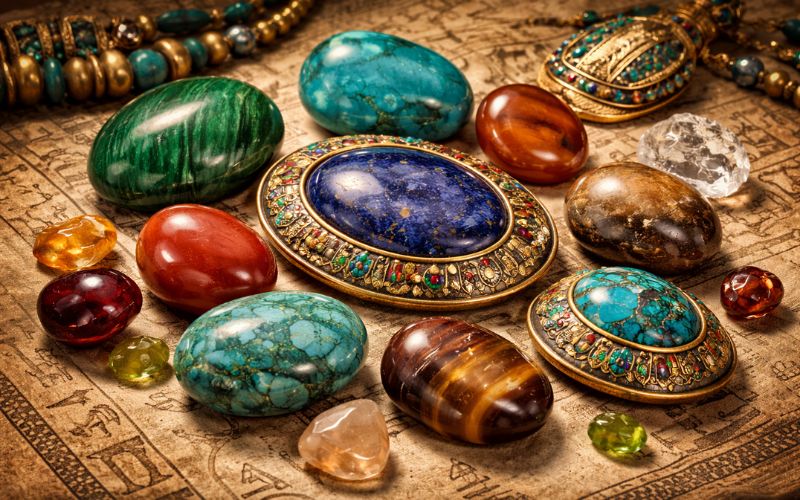
Design and traditional artisanal techniques
The aesthetic of a genuine Egyptian piece of jewelry relies on strict visual balance and advanced artisanal mastery. Ancient artisans used sophisticated methods such as cloisonné, a technique consisting of creating thin metal partitions to insert stones or colored pastes.
This approach ensured a solid structure while highlighting the chromatic richness of the materials.
Symmetry held a central place in the design. Every motif reflected a harmonious vision of the universe, inspired by cosmic and religious principles. Lines were sharp, proportions calculated, and details meticulously handcrafted.
Techniques that respect tradition include:
-
Structured cloisonné
-
Regular hieroglyphic engravings
-
Balanced geometric compositions
Conversely, industrial jewelry often features imprecise reliefs, uneven surfaces, or approximate finishes.
Examining the sharpness of the contours, the regularity of the motifs, and the quality of the assembly makes it possible to distinguish a faithful artisanal piece from quick production lacking cultural standards.
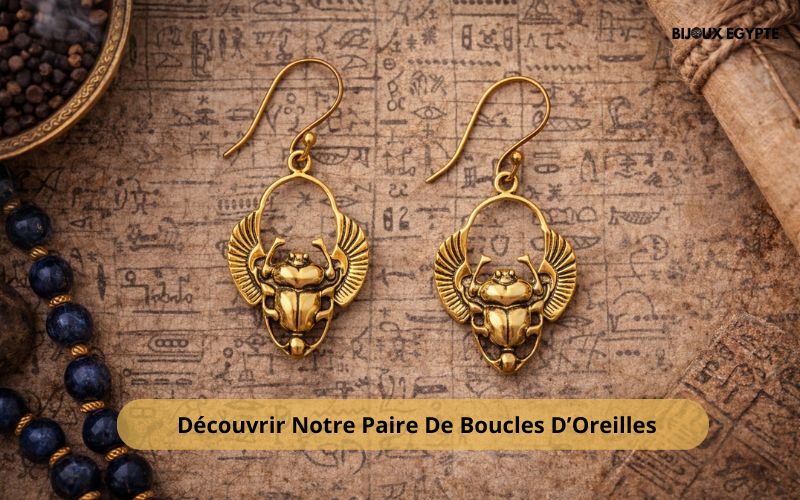
The importance of provenance and certifications
Purchasing an authentic Egyptian piece of jewelry implies carefully checking its origin and manufacturing framework. Provenance is a key indicator of credibility because it allows you to understand the context in which the piece was created.
A boutique specializing in art, history, or jewelry inspired by ancient Egypt generally offers more guarantees than a generalist seller without specific cultural expertise.
Certificates of authenticity or detailed descriptive sheets must clearly state the materials used, the type of manufacturing, and the historical source of inspiration.
When you buy online, check several essential elements:
-
Reasoned and consistent customer reviews
-
Clear photographs showing the actual details
-
Precise information about the composition
-
The return policies and guarantees offered
A serious professional contextualizes the creation by explaining its symbolism, its aesthetic universe, and its design process. Transparency regarding the workshop, the manufacturing, or the selection of materials strengthens trust.
Conversely, a site that remains vague, without concrete information or in-depth descriptions, may indicate simple standardized production devoid of real cultural or artisanal value.
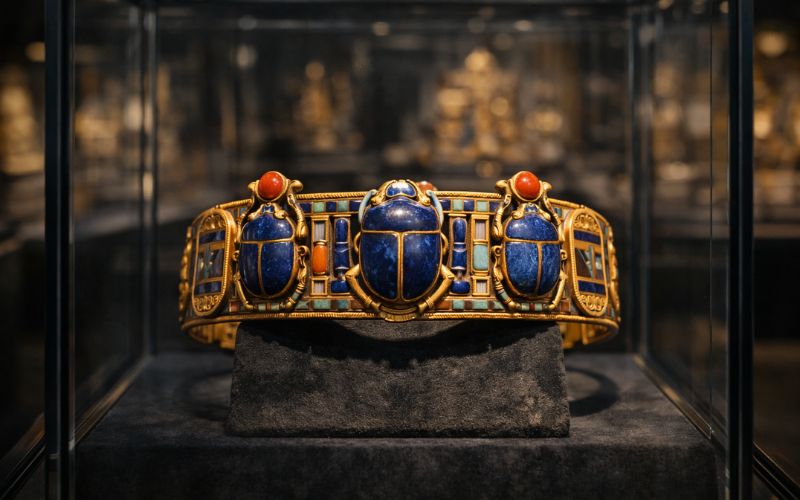
Difference between antique jewelry, reproductions, and modern inspiration
Distinguishing an original antique piece of jewelry from a reproduction or a contemporary creation is fundamental to avoiding any confusion. Authentic antique jewelry is an archaeological or historical item that actually dates back to ancient Egypt.
These items are extremely rare on the legal market and are found mainly in recognized cultural institutions such as the Egyptian Museum in Cairo or in strictly regulated private collections.
Faithful reproductions, on the other hand, are made from documented historical models. They respect known forms, proportions, and iconographic references, without claiming to be ancient.
Modern inspired creations rely on the Egyptian aesthetic while incorporating stylistic adjustments adapted to current trends.
To avoid any ambiguity:
-
Analyze the mentioned dating
-
Check the clarity of the descriptions
-
Look for transparency regarding the manufacturing
-
Examine the stated historical consistency
A serious seller always specifies whether it is a reproduction or a contemporary creation.
The clear distinction between ancient, reproduction, and inspiration constitutes a major indicator of credibility and professionalism.
Common mistakes when buying Egyptian jewelry
When buying Egyptian jewelry, certain mistakes can compromise the quality and real value of the piece. Many buyers focus solely on the overall aesthetic without analyzing the structural details or cultural consistency.
An attractive appearance does not guarantee durability or faithfulness to historical references.
The most common traps include:
-
Ignoring the seller's reputation
-
Not asking for precise technical information
-
Confusing exotic marketing with cultural heritage
-
Neglecting the quality of the finishes
It is also risky to rely solely on the displayed promotional price. An overly attractive offer may mask standardized industrial manufacturing.
Authenticity is based on a balanced combination of craftsmanship, materials, artistic consistency, and commercial transparency.
Taking the time to analyze these elements allows you to avoid impulse purchases and invest in a truly significant piece.
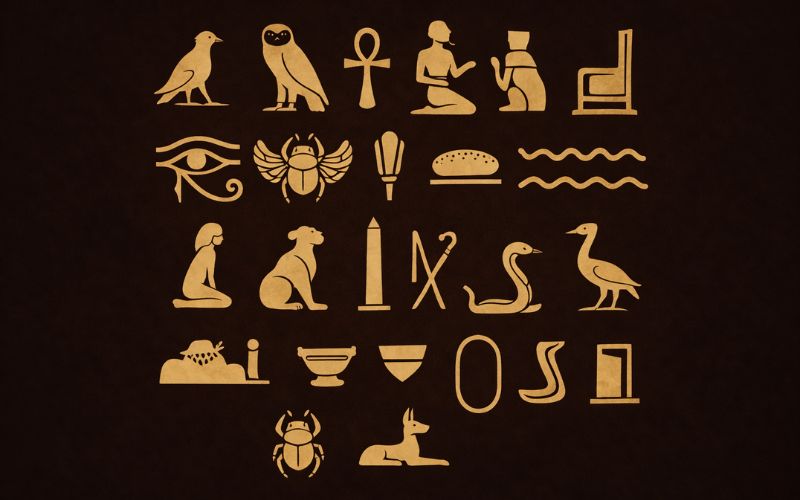
How to analyze hieroglyphs and inscriptions on an Egyptian piece of jewelry
Analyzing hieroglyphs is a criterion often overlooked when evaluating Egyptian jewelry. Yet, in ancient tradition, sacred writing was never purely decorative. Inscriptions could invoke divine protection, represent a royal name, or contain a precise ritual formula.
Understanding this dimension allows one to go beyond aesthetics and engage in a deeper cultural reading.
A first element to observe concerns graphic coherence. Hieroglyphs follow strict rules of alignment and orientation. Human or animal figures generally indicate the direction of reading, and their arbitrary inversion can signal an approximate reproduction.
It is also advisable to check the harmony between the chosen symbols and the overall theme of the jewelry.
The quality of engraving is just as decisive. An authentically inspired inscription features clean, regular, and proportionate lines. A superficial or irregular engraving often reveals rapid industrial manufacturing.
Finally, the presence of a cartouche must be credible: a random assembly of signs without identifiable meaning is a frequent indicator of commercial imitation lacking historical rigor.
How to evaluate the overall quality and durability of an Egyptian piece of jewelry
Beyond symbols and cultural references, the structural quality of an Egyptian piece of jewelry represents a determining factor in judging its authenticity and value.
A true piece of jewelry inspired by ancient Egypt must combine aesthetics, sturdiness, and technical coherence. The attention paid to manufacturing details often reveals the seriousness of the craftsmanship.
Start by examining the assembly points. Clasps must be robust, and welds must be discreet and perfectly integrated into the whole. A fragile or poorly adjusted closure system can indicate standardized production without high standards for durability.
The regularity of the contours and the uniformity of the finishes are also revealing of the special care taken in the design.
Weight is another relevant indicator. Precious metals have a perceptible density, unlike light alloys or poor-quality hollow pieces.
Finally, observe the general resistance: a well-designed piece of jewelry has no burrs, sharp edges, or visible irregularities. Balanced and durable manufacturing reflects a true respect for the Egyptian artistic and artisanal heritage.
FAQ on How to Recognize Authentic Egyptian Jewelry
Before buying a piece inspired by ancient Egypt, many questions may arise.
Between modern reproductions, artisanal creations, and historical references, it sometimes becomes difficult to distinguish between cultural authenticity and what is simply a current aesthetic trend.
Internet users today are looking for clear and concrete answers to avoid purchasing errors and to understand the true symbolic value of Egyptian jewelry.
This FAQ section on how to recognize authentic Egyptian jewelry brings together the most frequently asked questions regarding authenticity, materials, symbols, and quality criteria.
The goal is to provide precise insights, without unnecessary complexity, to help you make an informed choice.
Whether you are a collector, a history enthusiast, or simply attracted by the symbolic power of Egyptian jewelry, these answers will allow you to deepen your knowledge and avoid the most common misunderstandings.
How do I know if Egyptian jewelry is authentic?
Check for the presence of precious metals such as gold or silver, the fineness of the engravings, and the consistency of the symbols. Authentic jewelry respects traditional codes and comes with detailed information about its cultural inspiration.
What are the most common symbols?
The most sought-after symbols are the Eye of Horus, the scarab, the ankh, and the lotus. Each has a precise spiritual meaning related to protection, rebirth, or eternal life.
Can modern Egyptian jewelry be authentic?
Yes, if it respects noble materials and traditional symbolic codes. Authenticity does not necessarily mean ancient, but rather cultural fidelity.
Is Egyptian jewelry always made of gold?
No, it can be made of silver or incorporate natural stones. However, the materials must remain durable and consistent with the historical aesthetic.
Can you buy authentic Egyptian jewelry online?
Yes, provided you choose specialized and transparent shops. Check detailed descriptions and customer reviews.
How do I recognize an imitation?
An imitation often features imprecise engravings, synthetic materials, and a lack of symbolic explanation. An excessively low price is also an indicator.
Do hieroglyphs guarantee authenticity?
No, they must be correctly reproduced. A transcription error or inconsistent placement can reveal an approximate reproduction.
Conclusion on How to Recognize Authentic Egyptian Jewelry
Recognizing authentic Egyptian jewelry relies above all on a methodical and informed approach. It is not enough for a piece of jewelry to feature an ancient symbol to be authentic; it must respect historical, cultural, and artisanal coherence.
The analysis of materials is a first essential filter: the presence of gold, silver, or quality natural stones reflects a desire to be part of the tradition.
Then, examining the symbols and their meaning makes it possible to verify that the piece is not limited to a simple decorative reproduction, but that it maintains a spiritual logic faithful to ancient Egypt.
Design and execution quality also play a determining role. A piece crafted with precision, with balanced proportions and neat finishes, testifies to true craftsmanship.
Finally, the seller's transparency, the clarity of descriptions, and the clearly indicated provenance reinforce the credibility of the purchase. By combining these criteria, you can distinguish an authentic creation from a superficial imitation.
Thus, answering the question of how to recognize authentic Egyptian jewelry means intersecting history, symbolism, material quality, and artisanal standards in an informed approach.