
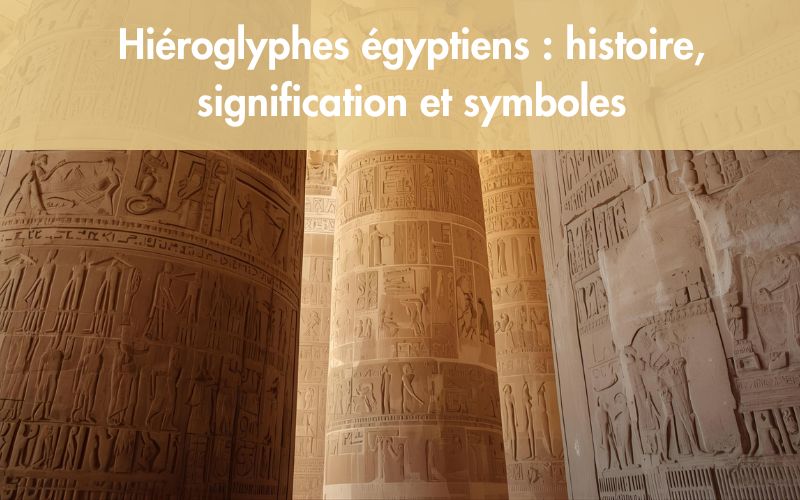
Egyptian hieroglyphs represent much more than a simple script: they are the reflection of a fascinating civilization where each sign carried a sacred meaning. Born in the heart of ancient Egypt, these symbols told the beliefs, prayers, and daily lives of the pharaohs. Each hieroglyph blended art and spirituality, creating a unique visual language that continues to amaze history enthusiasts. Even today, the hieroglyphs of Egypt inspire artists, travelers, and jewelry designers seeking an authentic connection with this eternal culture.
Why Egyptian hieroglyphs still fascinate today
The Egyptian hieroglyphs continue to captivate the modern world, from history buffs to lovers of sacred art. This ancient Egyptian script was not just a means of communication, but a gateway between the divine and the human. Each symbol carried a spiritual meaning, a vibration that connected the people to their gods. Their visual beauty and timeless mystery make them, even today, one of the most studied and admired Egyptian symbols.
A sacred and artistic script
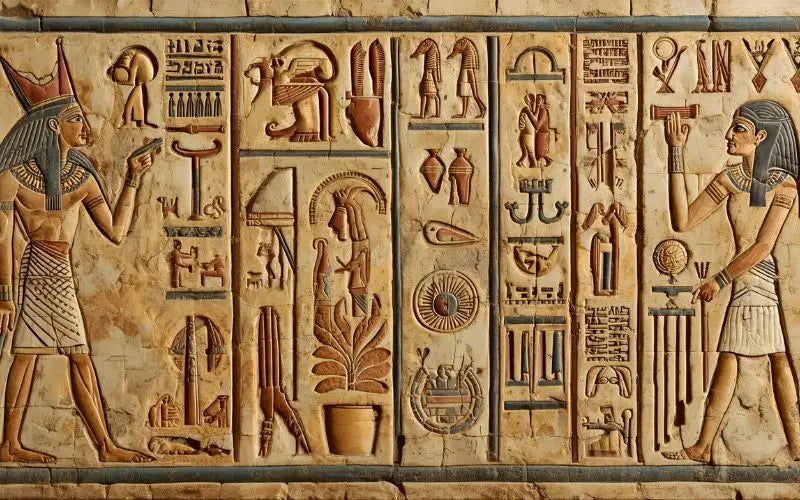
The Egyptians considered their sacred hieroglyphs a gift from the gods. Carved on the walls of Egyptian temples, painted on sarcophagi, or inscribed on papyrus, these signs blended art and spirituality.
-
Each stroke was designed to reflect divine perfection.
-
The colors used held precise symbolism: green for rebirth, blue for the sky, red for power.
-
Scribes, trained from childhood, were respected as priests of the written word.
The signs carved in stone were therefore not merely texts, but silent prayers addressed to the gods.
A language that is both symbolic and phonetic
Contrary to what is often thought, Egyptian hieroglyphs did not represent images alone. They formed a complex hieroglyphic alphabet where each symbol could designate a sound, an idea, or an action.
-
Some signs expressed a single consonant, others multiple sounds.
-
The language of the pharaohs made it possible to transcribe stories, laws, or prayers.
-
The meaning of the signs depended on the context, which made reading subtle and coded.
This duality between the visual and the audible made hieroglyphs a living language, both poetic and scholarly.
A lasting influence in modern culture
Thousands of years after their creation, Egyptian hieroglyphs continue to inspire contemporary culture.
-
We find them in art, fashion, tattoos, or even architecture.
-
Creators use their mysterious symbols to express strength, protection, or spirituality.
-
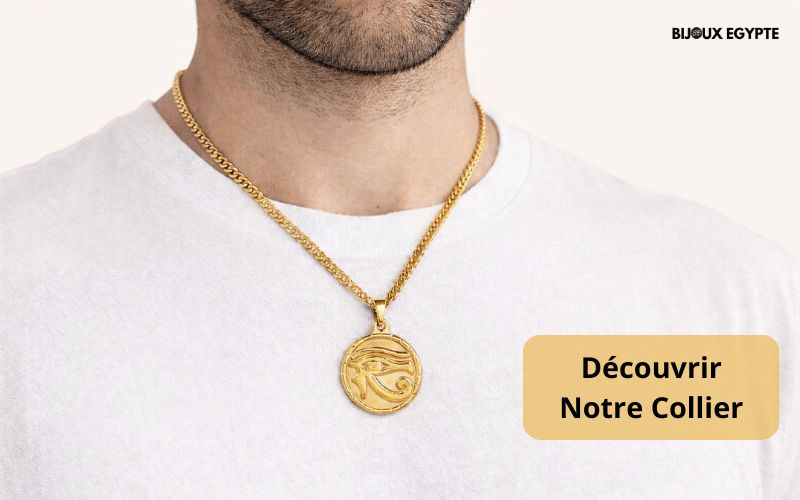
In jewelry, symbolic Egyptian jewelry still evokes the power of the gods and the eternal beauty of pharaonic civilization.
These hieroglyphs are no longer just ancient relics, but sources of inspiration that bridge the past and present, mystery and modernity.
The origins of Egyptian hieroglyphs
The Egyptian hieroglyphs mark the birth of ancient Egyptian script, long before the era of the pharaohs. The earliest Egyptians were already engraving sacred symbols to represent the world surrounding them. These signs became the foundations of a divine language that shaped the entire civilization of ancient Egypt.
The first known traces
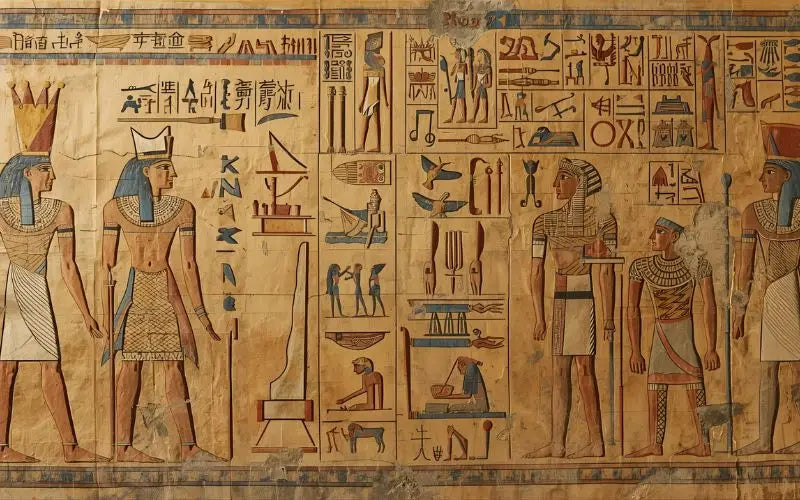
The first hieroglyphs date back over 5,000 years, to the Predynastic period. Archaeologists have discovered inscriptions on the Narmer palettes, considered one of the earliest representations of royal power.
-
These carved signs were used to recount military victories and religious rites.
-
Primitive Egyptian script already associated forms, sounds, and symbols, foreshadowing the future complexity of the hieroglyphic system.
-
Each drawing, carefully carved into stone, carried a divine or political message.
These early traces mark the birth of a unique language: a mix of art, faith, and intellectual structure that would influence the entire ancient Mediterranean.
The role of hieroglyphs in administration and religion
In ancient Egypt, Egyptian scribes were the guardians of knowledge. Their role went beyond that of a mere writer: they were intermediaries between the gods and men.
-
Religious inscriptions adorned the walls of temples, tombs, and sarcophagi.
-
Administrative texts contained records of taxes, harvests, and offerings.
-
Sacred texts told the story of the creation of the world, prayers, and divine judgments.
Egyptian hieroglyphs thus formed an essential tool for the management of the kingdom and the transmission of beliefs. Each symbol played a part in maintaining the balance between the world of the living and that of the gods.
The evolution of the script toward Hieratic and Demotic
Over time, Egyptian society evolved, and so did its writing. To meet the needs of commerce and administration, the Egyptians developed a simplified version of Egyptian hieroglyphs: Hieratic script.
-
Faster to trace, it allowed for writing on papyrus instead of carving on stone.
-
It remained reserved for priests and religious documents.
-
Later, the Demotic alphabet appeared, even more fluid and used by the common people.
This transition of hieroglyphs toward more practical forms testifies to the intelligence of a civilization that knew how to combine tradition and innovation. Despite these changes, Egyptian hieroglyphs always remained the sacred language of temples and gods.
How to read and understand hieroglyphs
Learning Egyptian hieroglyphs means exploring a coded language where each sign carries multiple meanings. This ancient Egyptian script blended art, symbolism, and logic in perfect harmony. Hieroglyphic reading reveals the profound thought and worldview of the ancient Egyptians.
The different types of signs (phonetic, ideograms, determinatives)
Egyptian hieroglyphs rely on three major categories of signs. Each type plays a specific role in the sentence and gives a unique dimension to the text:
-
Phonetic signs represent sounds, a bit like our alphabet. Some symbols express a single consonant, others combine several.
-
Ideograms directly designate an object or an idea: a bird can represent a bird, but also freedom or the sky.
-
Determinatives appear at the end of words to clarify their meaning (person, place, action, etc.).
This Egyptian symbolic language is incredibly rich. Each word becomes an image, and each image a message, a bridge between the visible and the invisible.
Direction of reading and layout
Unlike our modern scripts, reading hieroglyphs does not follow a single direction.
-
They can be read from right to left, left to right, or even from top to bottom.
-
The direction depends on the gaze of the symbols: if a bird or character is looking toward the right, the reading begins from that side.
-
Texts in temples or tombs were often arranged for aesthetic and spiritual reasons, not just practical ones.
This freedom of hieroglyphic layout makes deciphering fascinating. It is a living puzzle where each sign finds its place according to the sacred logic of the priest-scribes.
Frequent mistakes to avoid
Learning Egyptian hieroglyphs can be confusing. Some symbols look similar, but their meaning changes completely depending on the context.
Here are the most common mistakes to avoid:
-
Confusing phonetic and ideographic signs, which distorts the translation.
-
Reading in the wrong direction, without spotting the orientation of the figures.
-
Relying on fake decorative hieroglyphs, often used on modern objects without real meaning.
For a true decryption of symbols, one must rely on reliable sources and understand that each hieroglyph is a piece of a system that is both artistic and spiritual.
Learn to Read Hieroglyphs
Champollion and the deciphering of the Rosetta Stone
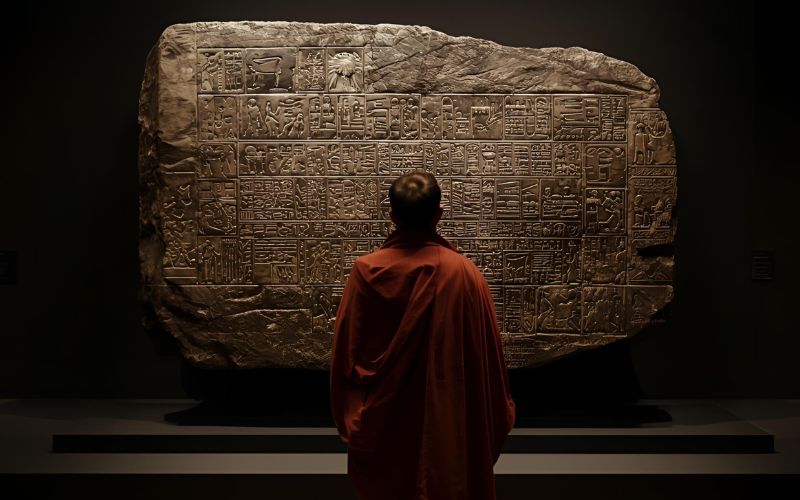
The story of Egyptian hieroglyphs could have remained a mystery without the discovery of the famous Rosetta Stone. Found in 1799 by a French soldier during the Egyptian campaign, this stone would become the key to the rebirth of modern Egyptology. Engraved with three scripts—Greek, Demotic, and hieroglyphic—it finally allowed Egyptian symbols to be connected to known sounds and words. It is thanks to the genius of Jean-François Champollion that this code was broken, paving the way for the understanding of the entire pharaonic civilization.
A decisive discovery for Egyptology
At a time when hieroglyphs were considered magical drawings, Jean-François Champollion changed the world's scientific perspective forever. Passionate about ancient languages from a very young age, he dedicated his life to the deciphering of hieroglyphs.
-
The Rosetta Stone, now displayed at the Louvre Museum, became his preferred field of study.
-
Thanks to his mastery of Coptic and Ancient Greek, he understood that Egyptian symbols represented sounds, not just ideas.
-
This breakthrough marked the birth of modern Egyptian archaeology, allowing temples and tombs that had remained silent for millennia to speak again.
His work transformed hieroglyphs into a truly decipherable language, giving birth to the science we now call Egyptology.
How the Rosetta Stone revealed the secret of the signs
The Rosetta Stone was engraved with the same text repeated in three languages: hieroglyphs, Hieratic script, and Ancient Greek. This triple message allowed researchers to make precise comparisons.
-
By observing the correspondences between the Greek words and the symbols, Champollion understood the phonetic logic of the language.
-
He identified royal signs, notably the names of Ptolemy and Cleopatra, engraved in cartouches.
-
The trilingual system revealed that hieroglyphs combined sounds and symbols, a true linguistic puzzle.
Thanks to this method, the deciphering of Egyptian hieroglyphs became a reality. The sacred language of the pharaohs came back to life, offering a new understanding of the history of ancient Egypt.
The most well-known hieroglyphic symbols and their meaning
Egyptian symbols are not mere decorations: they are the reflection of a spiritual vision of the world. Each Egyptian hieroglyph possessed a precise function, a sacred role in the communication between men and the gods. These energy-carrying signs were often engraved on Egyptian amulets, worn to protect, bless, or empower the wearer.
The Eye of Horus: a symbol of protection and healing
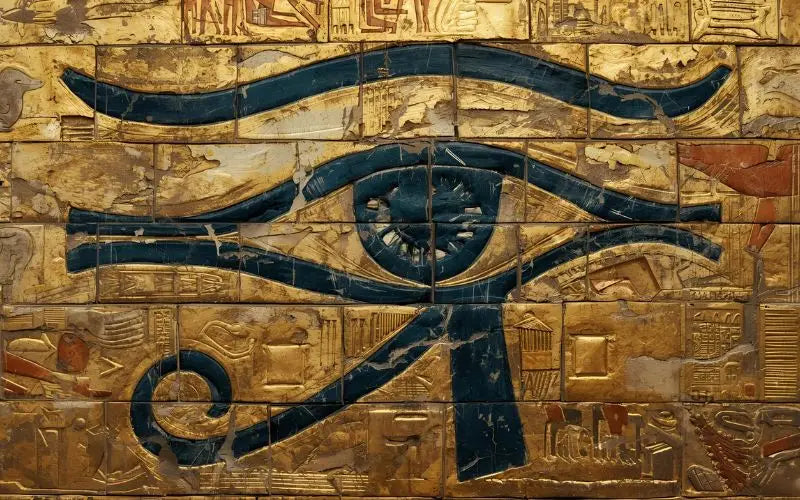
A symbol of protection and healing, the Eye of Horus embodies the victory of light over chaos. According to the legend, the lost eye of Horus was restored by Thoth, becoming a sign of restoration and balance. Even today, it is worn as a protective amulet bringing clarity, health, and spiritual strength.
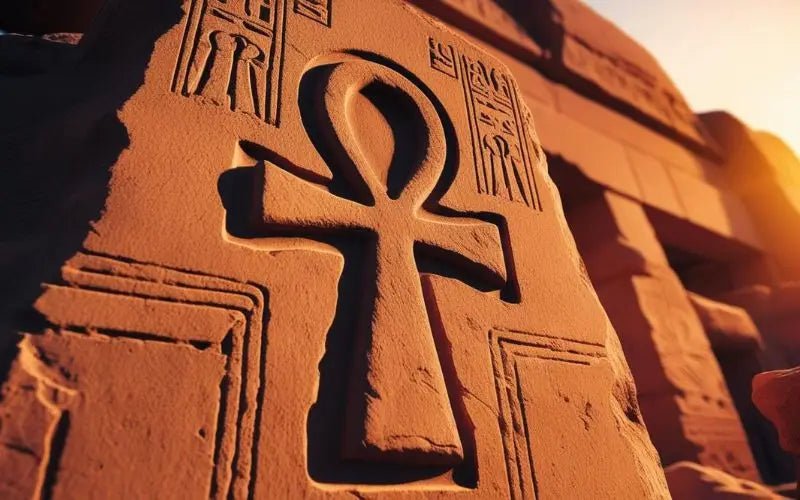
The Ankh cross: a symbol of life and vital energy
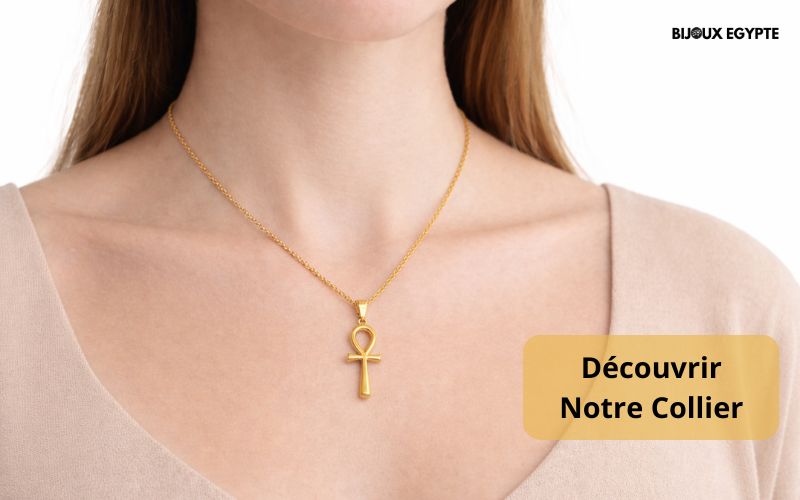
A symbol of eternal life, the Ankh cross is one of the most sacred emblems of Ancient Egypt. Carried by the gods, it represents the key of life and the union between heaven and earth. Its shape evokes the rising sun and the vital breath, a promise of rebirth and immortality.
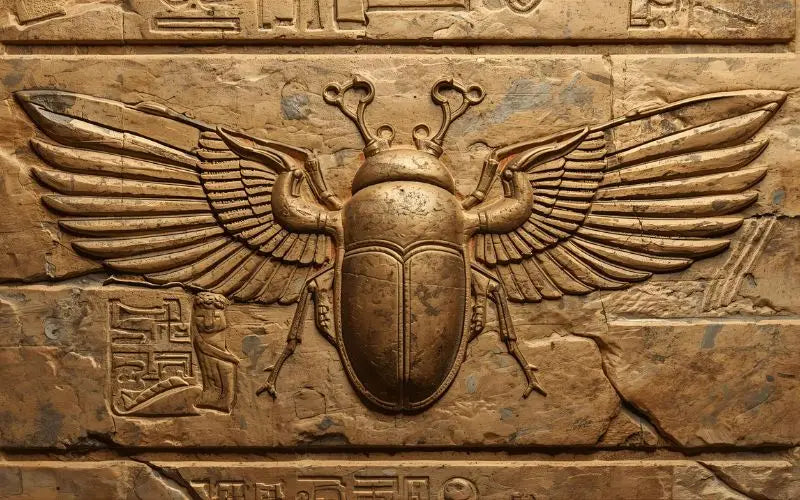
The scarab: a symbol of rebirth and transformation
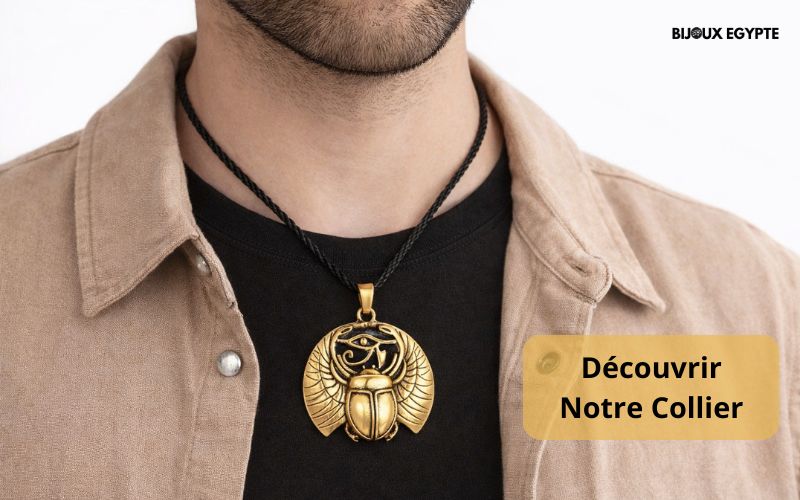
A symbol of rebirth and transformation, the Egyptian scarab is associated with the god Khepri and the rising sun. It embodies the infinite cycle of life and renewal. Worn as a protective amulet, it attracts good luck and guides the soul toward eternal light.
The legacy of hieroglyphs in fashion and jewelry
Egyptian hieroglyphs are no longer confined to temple walls or pharaonic sarcophagi: they live on through modern fashion and jewelry. These timeless symbols have traveled through the centuries to become elements of style, spirituality, and identity. Wearing a hieroglyphic piece of jewelry is much more than an aesthetic choice; it is a way to express one's connection to the wisdom, strength, and protection of the ancient Egyptian gods.
FAQ: Frequently asked questions about Egyptian hieroglyphs
Who discovered hieroglyphs and in what year?
Egyptian hieroglyphs were deciphered in 1822 by Jean-François Champollion, thanks to the Rosetta Stone. This discovery marked the birth of modern Egyptology.
How do you read a text in hieroglyphs?
Hieroglyphs are read from right to left or left to right, depending on the orientation of the signs. They combine sounds, words, and symbols to create a script that is both phonetic and spiritual.
Can you write your name in hieroglyphs?
Yes, it is possible to write your name in hieroglyphs thanks to the phonetic transliteration used in the ancient Egyptian alphabet, just as the pharaohs did in their cartouches.
What is the difference between hieroglyphic and hieratic?
Hieroglyphic script was engraved on sacred monuments, while hieratic script was used for administrative and daily life. They share the same linguistic roots.
What does the Eye of Horus symbolize?
The Eye of Horus symbolizes protection, healing, and clairvoyance. It represents the victory of good over evil and was often worn as an amulet.
When did writing appear in Egypt?
Ancient Egyptian writing appeared around 3200 B.C., at the beginning of the Predynastic period. It was used to record exchanges, rituals, and religious texts.
Why were hieroglyphs invented?
The Egyptians created hieroglyphs to communicate with the gods, record history, and organize the administration. It was a sacred script, a symbol of power and knowledge.
What is a hieroglyph?
A hieroglyph is a visual sign representing a sound, a word, or an idea. It can be figurative (bird, eye, hand) or symbolic (life, protection, power). It is a form of art and writing.
Where and when do hieroglyphs appear?
The first hieroglyphs appeared on the tombs and tablets of Ancient Egypt over 5,000 years ago. They are notably found on the Narmer Palette, a symbol of the country's unification.
Why did hieroglyphs disappear?
They disappeared around the 4th century A.D. with the banning of Egyptian cults and the rise of Christianity. The Coptic script and Greek replaced this sacred language.
What is the secret of hieroglyphs?
The secret of Egyptian hieroglyphs lies in their dual nature: both artistic and phonetic. Each sign had an aesthetic, religious, and sonic value, linking the visible to the divine.