
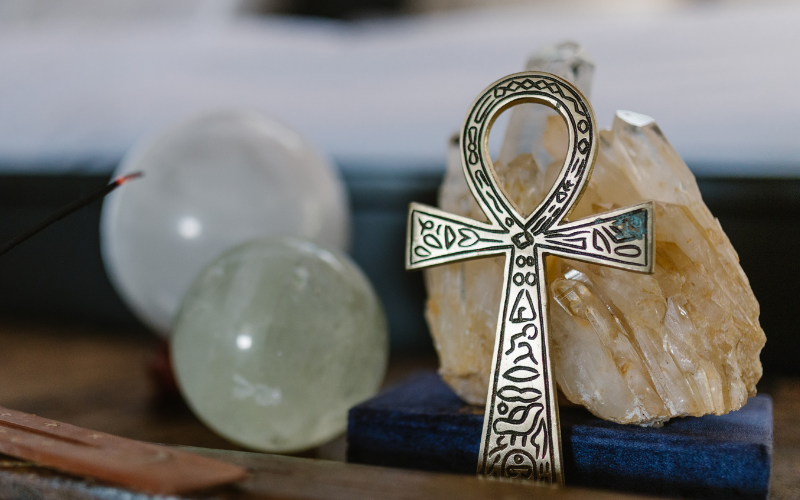
The Ankh symbol finds its roots in ancient Egyptian mythology, where it was a fundamental sign linked to life. The Ankh cross represents both physical and spiritual life, as well as rebirth and immortality. In temples, it was often seen in the hands of the gods, who used it during rituals to grant eternal life to the souls of the deceased. Through its geometric simplicity, the symbol embodies the idea of an endless existence, connecting the earthly world to the invisible.
What is the ankh?
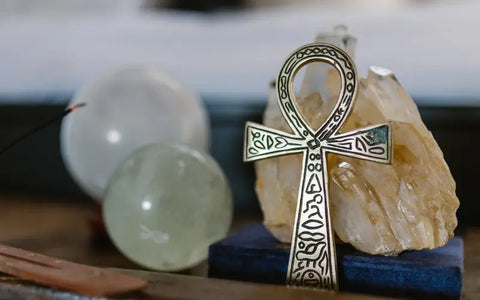
The ankh is an Egyptian cross-shaped symbol topped with an oval loop. In hieroglyphs, it corresponds to the word "ˁnḫ," generally translated as "life." This translation is simple, but it does not tell the whole story: in a civilization where cosmic order, solar rebirth, and the survival of the soul structure thought, "life" means existence in a biological, spiritual, and continuous sense.
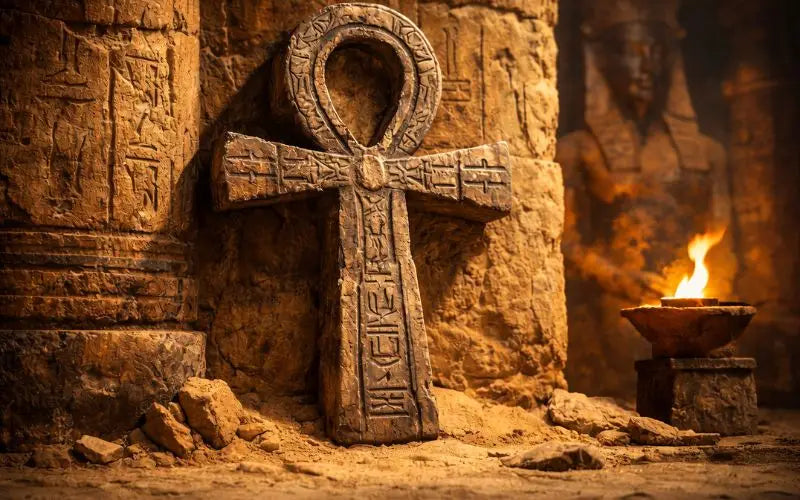
The ankh is not an isolated object: it is a sign that appears everywhere—on temple walls, in tombs, on sarcophagi, on amulets, and on jewelry. It is therefore a cross-disciplinary symbol, used as much in the world of the living as in the world of the dead.
A cross that is not one in the Christian sense
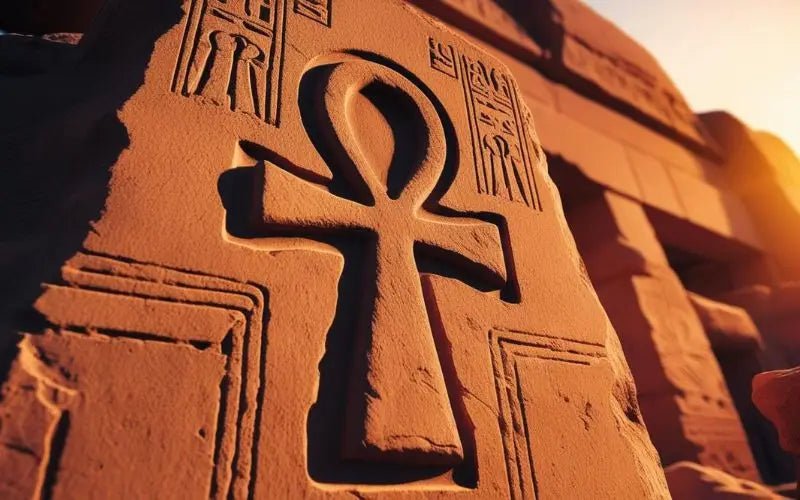
Even though the visual comparison is immediate, the ankh predates the Christian cross by a long way and does not share the same origin. The modern association comes primarily from its silhouette. In Ancient Egypt, its reading is primarily linked to vitality, the gods, and protection, with no connection to Christian symbolism.
A hieroglyph turned universal symbol
The ankh is one of the rare hieroglyphs that has become a global icon in its own right. It left the realm of writing to become an independent form, recognizable even by people who have never studied ancient Egypt. This ability to live outside its original context proves just how strong and intuitive its message is.
Origins and appearance in Egyptian history
The ankh cross is found very early in pharaonic history, particularly from the Old Kingdom onwards, and especially during periods when religious iconography became established and widespread (Middle Kingdom and New Kingdom). It appears on bas-reliefs, stelae, sarcophagi, funerary paintings, and cult objects.
This symbol is part of a civilization that constantly thinks in terms of continuity. Ancient Egypt is not just a culture of stone and monuments: it is a culture of cycles. Every day, the sun is reborn. Every year, the Nile returns to fertilize the land. Every generation transmits power, rites, and traditions. The ankh thus becomes a logical emblem: it represents that which must endure.
An official presence in temples
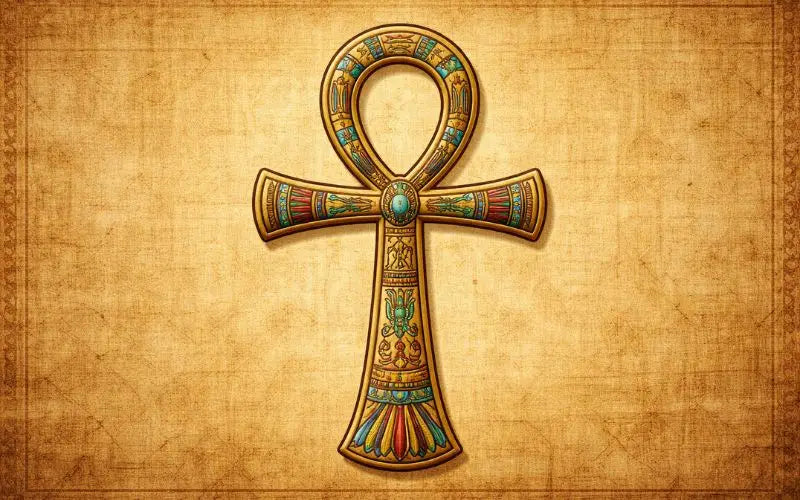
In temples, the cross of life appears in scenes of offerings and rituals. The gods are often depicted holding the ankh, sometimes accompanied by other attributes such as the was-scepter or the djed pillar. This shows that the symbol is integrated into the official sacred language: it is not a “popular” motif, but a central sign.
A presence in the funerary universe
It is also found in tombs, on walls, on papyri, and on objects placed with the deceased. This reinforces a fundamental idea: the ankh speaks not only of earthly life but also of life after death and the continuity of being.
Mythological origin of the ankh cross
Ancient Egypt never fully separates the symbol from the narrative. Many sacred objects exist because they are conceived in a world where gods structure reality. The ankh cross fits into this framework: it is a sign that materializes the idea that life is of divine origin and that it circulates between the visible world (humans) and the invisible world (the gods).
The ankh and creation: giving life, maintaining life
In many temple scenes, we see deities holding the ankh as an instrument of transmission, sometimes placed near the pharaoh's face. On a mythological level, this points to a key idea: the gods do not just create life; they renew it constantly.
Creation, in Egypt, is not a unique act: it is an action that is repeated and maintained. If the gods cease to act, chaos returns. The ankh therefore symbolizes this "sacred maintenance": it is the sign that the order of the world is fueled.
A symbol linked to the cycle: rebirth, order, continuity
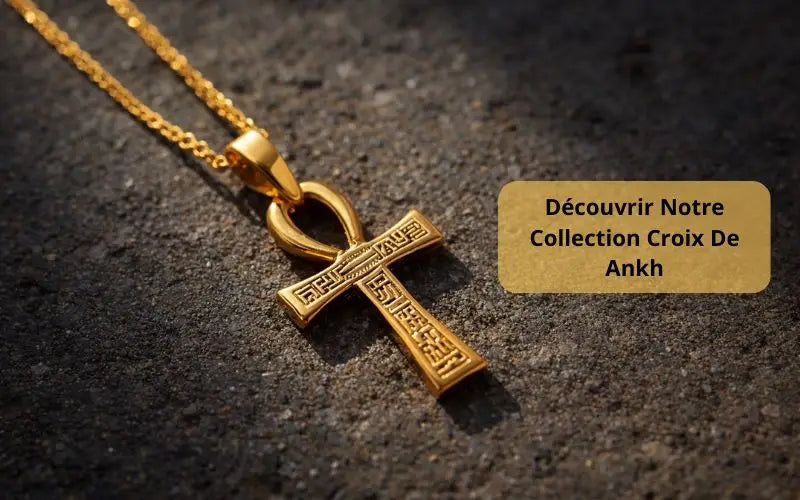
Egyptian mythology emphasizes cycles: the sun, the Nile, death, and rebirth. The ankh is therefore understood as the graphic signature of this system: life is not reduced to a biological birth; it extends into a cosmic order where every cycle is a new beginning.
The ankh and the idea of eternal life
It must also be understood that Egyptian eternity is not necessarily a static eternity. It is a living eternity: a continuity in which one is reborn, transformed, and traverses stages. The Egyptian cross of life becomes the perfect symbol of this idea: life continues in other forms.
The Ankh: a divine symbol
The ankh is rarely depicted alone. It is almost always associated with the gods, the pharaoh, and rituals. This detail indicates that the symbol is not just decorative, but deeply sacred.
Life as energy held by the gods
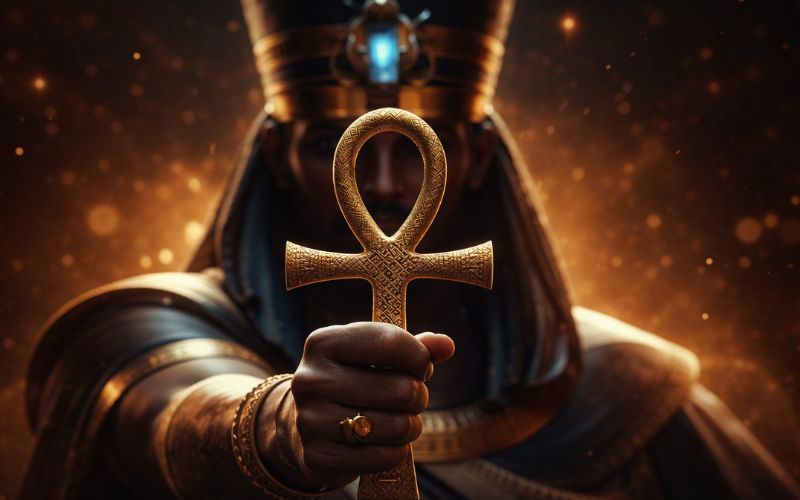
In iconography, the Egyptian cross of life often appears in the hand of a deity. Visually, the message is clear: life is a force that the divine possesses and can grant.
This also means that life is hierarchical: the god gives, and the human receives. But the pharaoh receives more: he is the intermediary between heaven and earth.
The gesture near the nose: breath, respiration, vitality
One motif recurs frequently: the cross of life is placed near the nose or mouth of the pharaoh, as if one were giving him breath. This detail is powerful: in the Egyptian imagination, breath is the proof of life, but also a sign of divine presence.
In this gesture, we can read several levels:
-
the ankh as a gift of life
-
the ankh as sacred breath
-
the ankh as a connection between the human and the divine.
The Egyptian cross of life with other sacred attributes
It is often seen with:
-
the was-scepter (power),
-
the djed pillar (stability),
-
signs of protection.
Together, they form a language: life + power + stability, at the heart of sacred royalty.
The Ankh and male fertility
In ancient Egypt, fertility is a cosmic power: it touches the land, the Nile, the family, and also the continuity of royalty. The Ankh cross is sometimes interpreted as a symbol linked to fecundity, partly because its primary meaning ("life") encompasses the capacity for regeneration.
A symbolic reading: creation, fecundity, continuity
Some modern interpretations see the loop and the vertical bar as an evocation of creative union or generative power. We must be clear: Egyptian sources do not always describe the ankh as a direct sexual symbol, but the idea of fertility is consistent with the general usage of the sign: producing life, extending the lineage, and maintaining the cycle.
Virility, power, and royalty
Male fertility is not just a private matter in ancient Egypt: it is political. Dynastic continuity is essential. Having heirs, maintaining the royal lineage, and guaranteeing the stability of the country—all of this gives fertility a sacred dimension.
In this logic, the ankh can be understood as an affirmation:
-
of continuity,
-
of vital power,
-
of transmission.
Fertility and nature: the Nile in the background
Fertility in Egypt is inseparable from the Nile. And the ankh, often understood as a sign of life, can also be read as an abstraction of this principle: life circulates, fertilizes, and renews. The symbol almost becomes a summary: without the Nile, no crops; without life, no order; without order, no civilization.
Ankh jewelry: power and protection
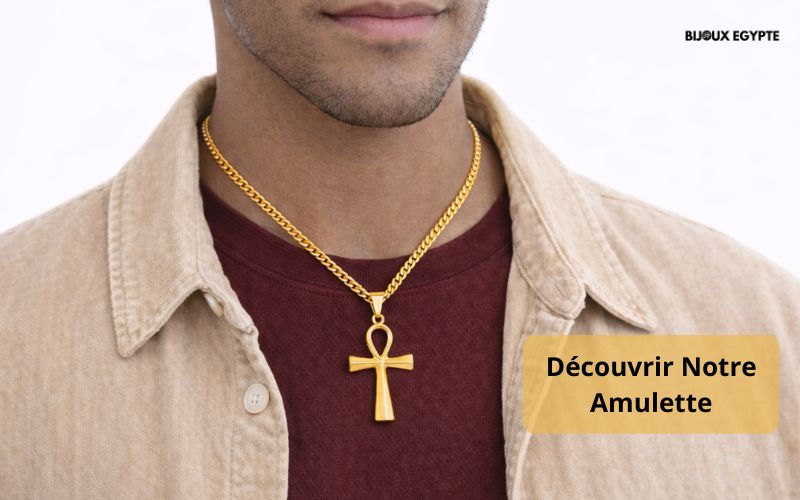
Wearing a symbol in ancient Egypt is not a neutral act. Jewelry is a language: it shows social rank, identity, and also spiritual intention. The ankh, as a symbol of life, logically becomes a strong motif for amulets and ornaments.
Why does the ankh protect?
In the Egyptian logic, that which embodies life repels chaos. An ankh amulet can therefore be seen as:
-
a reminder of vitality (holding on, enduring),
-
a sign of protection against disruption (illness, danger, disorder),
-
a spiritual “anchor” linked to the divine.
A positive power: life, endurance, stability
The ankh is not an aggressive symbol: its power is that of continuity. It expresses endurance, inner solidity, and the ability to go through trials while maintaining stable energy.
The ankh cross in daily practices
What is fascinating is that the ankh cross is not reserved for kings. It is also found on more accessible objects. This means that the idea of life and protection is not solely royal: it concerns everyone. In a civilization where danger (illness, the desert, accidents, mortality) is present, wearing a protective symbol becomes a way to secure one's existence.
Today: a piece of jewelry that keeps its meaning
In the modern world, ankh jewelry is worn for various reasons:
-
passion for ancient Egypt,
-
strong, minimalist aesthetics,
-
the search for a symbol of protection and strength.
What works well is that the message remains readable: life, power, protection.
Spiritual and artistic importance of the ankh cross
The ankh is both a religious sign and an artistic motif. This is one of the reasons it has endured for centuries: it is simple, balanced, immediately recognizable, and charged with meaning.
A central spiritual symbol
Spiritually, the Egyptian cross of life condenses several fundamental ideas of ancient Egypt:
-
life as a divine force,
-
continuity after death,
-
cosmic order (Maat),
-
the eternal cycle (rebirth).
It is not just "living"; it is being maintained within a sacred order. In this framework, the ankh acts as a marker: it reminds us that existence is precious, fragile, but supported by higher forces.
A perfectly Egyptian graphic motif
Artistically, the ankh is a masterpiece of symbolic design:
-
clean lines, symmetry, readability,
-
memorable shape,
-
ease of integration into frescoes, reliefs, and jewelry.
It adapts without losing its identity: engraved on a stele, painted on a wall, or sculpted on a pendant, it remains immediately recognizable.
The ankh as a visual signature of a civilization
When we think of ancient Egypt, we imagine pyramids, hieroglyphs, and colossal statues. The ankh cross is among those symbols that summarize an entire civilization in one form. It is a “signature,” as if Egypt had condensed its philosophy into a single sign.
The cross of life and the afterlife: tombs, rituals, and protection
While the cross of life is everywhere in temples, it is also everywhere in the funerary universe. In ancient Egypt, the tomb is not a mere place of mourning: it is a space of continuity, where texts, images, and rituals aim to ensure the survival of the deceased.
The tomb: a door toward continuity
In Egyptian thought, dying does not mean disappearing. It means changing state. The deceased must be protected, guided, and symbolically reconstructed to continue their existence.
The ankh, in this context, acts as a seal: it affirms that life remains possible, even after death.
The ankh and rebirth rituals
Certain funerary rites aim to restore the deceased's capabilities: seeing, breathing, speaking, walking. In this framework, the ankh, associated with breath, takes on an even stronger meaning: it is the sign that the deceased "returns to life" in a spiritual form.
Protection against chaos
Chaos, in Egypt, is not just an abstract concept. It is a real threat: disorder, destruction, oblivion. The ankh cross, as a symbol of life, is also a symbol of order. It protects against erasure, against rupture, and against forgetting.
Interpretations: key of life, Nile, union of forces
Historians and Egyptologists have proposed several interpretations regarding the exact origin of the shape. There is no single certainty, but rather several coherent hypotheses.
The ankh as the key of life
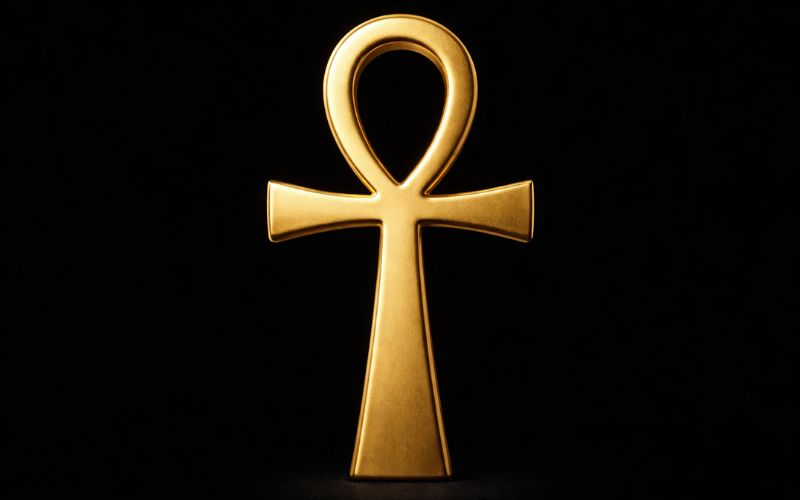
In popular culture, it is often called the "key of life." This is not a literal translation, but a powerful metaphor: the loop could be a handle, the cross a shaft. In iconography, the gods do indeed hold it like an object that could be grasped and transmitted.
This idea works well symbolically: if life is a mystery, the ankh would be the key that opens the door to continuity.
Union of complementary forces
Another interpretation sees the shape as a union of complementary principles, evoking creation and fecundity. This reading is consistent with Egyptian thought, which values the balance of opposing forces: day/night, desert/Nile, order/chaos.
The Nile, the horizon, and sacred geography
Some researchers have proposed a geographical/cosmic interpretation: the loop as the solar disk on the horizon, or the shape as a stylized representation of the Nile and its delta, and thus the source of life in Egypt. This link is logical: the Nile is the material condition of life, and the ankh is its visual abstraction.
From Egyptomania to the Modern World
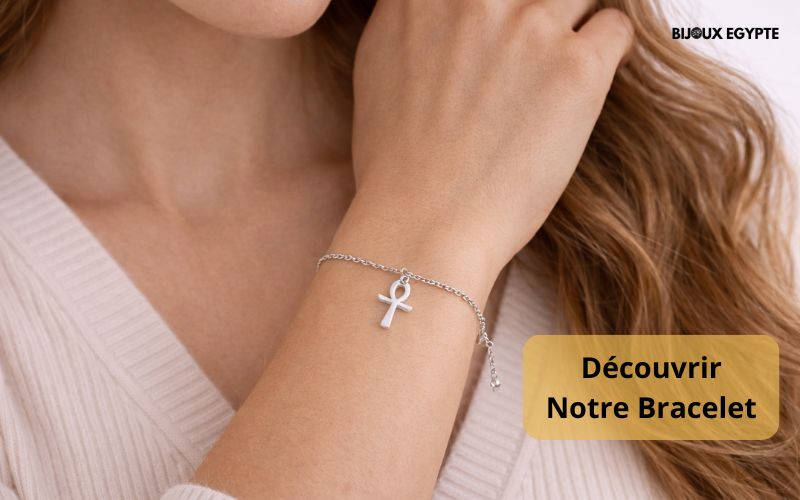
Beginning with the great waves of Egyptomania, Egyptian symbols were exported: architecture, decoration, jewelry, and art. The ankh cross became an international sign of "life," sometimes disconnected from its original ritual contexts, but always powerful.
Today, it lives on in pop culture, fashion, jewelry, and modern spiritual circles. And despite the reinterpretations, its central message remains surprisingly stable: to continue, to endure, to protect life.
What does wearing an ankh cross mean today?
Wearing an ankh today can mean several things, depending on the person's intention. That is precisely what makes this symbol's strength: it is both ancient and adaptable.
A personal reminder: vitality, protection, rebirth
For some, the ankh is an anchor: a reminder to choose oneself, to rise again, to protect one's energy. The idea of rebirth naturally attaches to the symbol because it is linked to cycles.
A cultural and aesthetic sign
For others, it is an aesthetic marker: a way to display a passion for ancient Egypt, its art, its mystery, and its iconic forms. The ankh cross works very well graphically: minimalist, recognizable, and timeless.
A symbol to be worn with respect
As with any ancient symbol, the most important thing is to know its meaning and to avoid reducing it to a simple "decoration." Understanding the ankh is already a way of doing it justice. It is also acknowledging the spiritual and cultural heritage it has represented for millennia.
FAQ about the Ankh Symbol
Does the ankh really mean "life"?
Yes. In hieroglyphics, the ankh corresponds to the word linked to the idea of life. In Egyptian thought, this includes vitality, breath, and continuity.
Why is the ankh associated with the gods?
Because Egyptian iconography shows life as a force transmitted by the divine. The god who holds the ankh affirms that they possess and grant vital energy.
Is the ankh a symbol of protection?
Yes, in the logic of amulets: what embodies life and order repels chaos. Wearing or depicting the ankh is often intended to strengthen continuity and stability.
Why do we see the ankh in tombs?
Because it expresses survival and continuity in the afterlife. It asserts that death is not an end, but a passage.
What is the origin of the Ankh symbol?
The Ankh symbol derives its origin from Egyptian mythology. It represents life, rebirth, and immortality, and is often associated with Egyptian gods in sacred rituals.
Why is the Ankh considered a symbol of fertility?
The Ankh has a phallic dimension, and its shape can symbolize the union between the sexes. This makes it a symbol of fertility, vitality, and creation in Egyptian culture.
Who wore Ankh jewelry in ancient Egypt?
Pharaohs and powerful men wore Ankh amulets to protect themselves and ensure their longevity. These pieces of jewelry were often made of precious metals like gold or silver.
What is the spiritual significance of the Ankh?
The Ankh is a sacred symbol representing divine power and the connection between the world of the living and the dead. It was also used in funeral rites to ensure the immortality of the soul.
Why is the Ankh popular today?
The Ankh is a universal symbol of life and spirituality, often used in modern jewelry and works of art. It attracts those seeking a connection with ancient Egyptian culture or a timeless symbol of vitality and renewal.