

Origin and evolution of amulets in ancient Egypt
Amulets appeared very early in the history of ancient Egypt and accompanied the civilization for several millennia. From the Predynastic period, around 4000 BC, the Egyptians manufactured protective objects intended to ward off disease and invisible forces. These talismans were often made of stone, bone, or clay and already bore religious symbols linked to early spiritual beliefs. These objects testify to the significant importance the Egyptians placed on supernatural forces and divine protection in their daily lives.
With the development of the great dynasties, the use of amulets spread throughout society. They gradually became objects associated with deities and religious rituals. Priests began using incantations and blessings to strengthen their mystical power and integrate them into the sacred ceremonies held in temples. Amulets thus became essential elements of religious practice.
During the New Kingdom, amulets experienced a real boom. They were worn by all social classes and also appeared in royal regalia. Pharaohs used these objects to symbolize their bond with the gods and assert their divine authority. Some amulets were also offered in temples as votive objects to thank the deities or to seek their protection.
The first protective amulets
The first Egyptian amulets were simple in appearance but already possessed a strong spiritual dimension. Artisans used natural materials such as stone or clay to create these protective talismans. These objects often represented sacred animals or forms linked to the forces of nature.
Egyptians wore these amulets around their necks or attached them to their clothing to ward off disease and evil spirits. Their main role was to ensure the protection of the wearer and maintain the balance between the world of men and that of the deities.
Amulets in sacred texts
Amulets are also mentioned in the religious texts of ancient Egypt. The Book of the Dead describes several talismans intended to protect the soul of the deceased in the afterlife. These texts specify the placement of certain amulets on the mummy's body.
Priests recited sacred formulas to activate their power. These rituals reinforced the spiritual power of the amulets and ensured that the soul could navigate the trials of the world of the dead.
Sacred materials used in amulets
Egyptian amulets were crafted from materials carefully chosen for their symbolic and spiritual properties. The Egyptians believed that each material possessed a particular energy capable of enhancing the protective power of the object. The choice of material was therefore never left to chance: it depended on the symbol represented, the god invoked, and the goal sought by the wearer of the amulet.
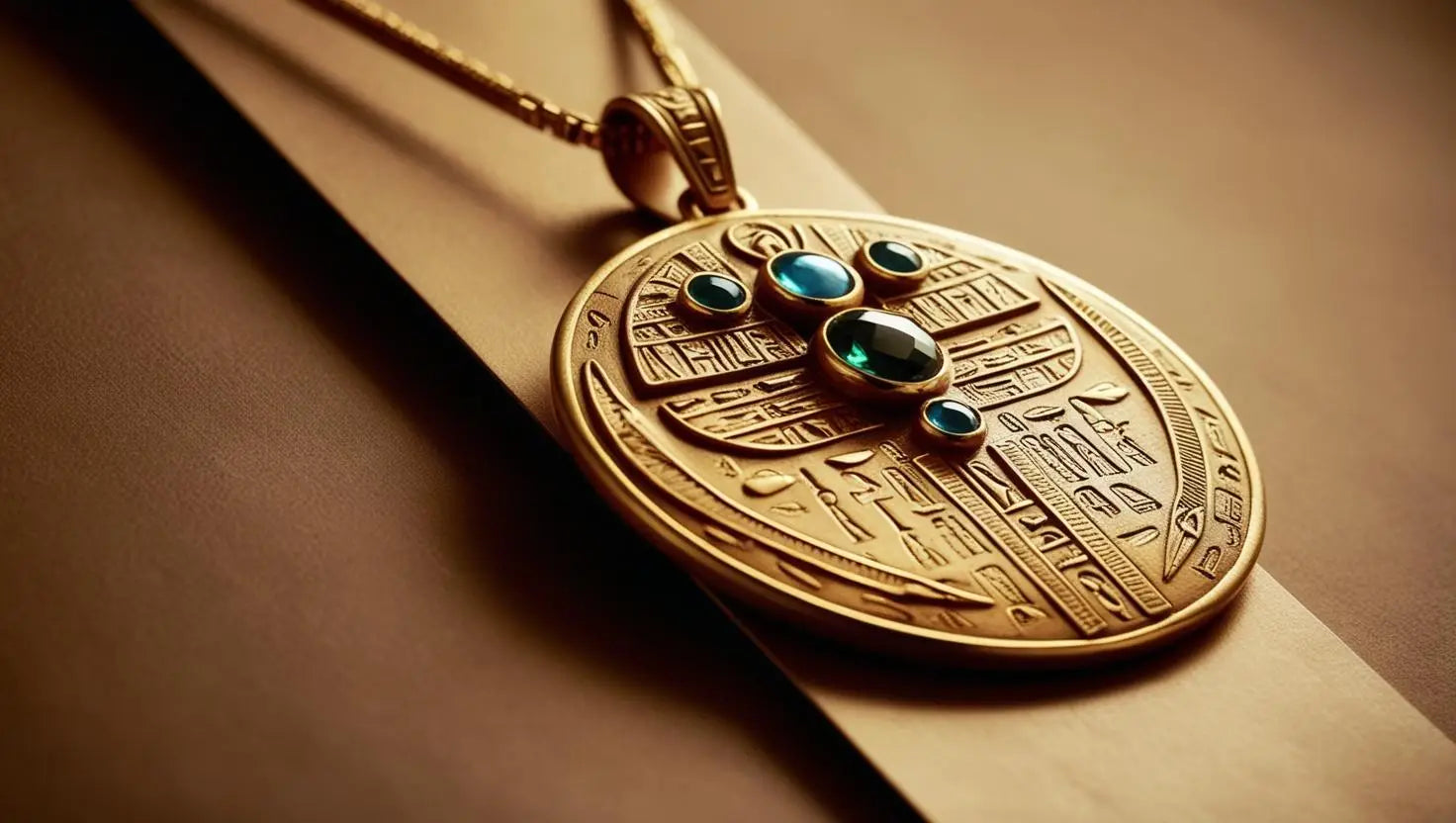
Gold held a central place in these creations. Considered the flesh of the gods, it symbolized immortality, solar light, and divine power. Gold amulets were often reserved for pharaohs, priests, or funerary objects intended for the elite of society. This precious metal did not deteriorate over time, which reinforced its association with eternity.
Blue faience was also widely used in the manufacture of amulets. Its color evoked the Nile and the sky, two essential elements in Egyptian cosmology. It symbolized regeneration, fertility, and divine protection. Artisans also used various precious and semi-precious stones to give the amulets an additional mystical dimension and strengthen their spiritual role.
The most frequently used sacred stones
Certain stones were particularly sought after for the making of amulets. Their color and symbolism reinforced the spiritual power of the object.
Among the most used stones:
-
lapis lazuli, symbol of wisdom and royalty
-
carnelian, associated with courage and protection
-
turquoise, linked to healing and luck
-
red jasper, representing vitality
These stones were carved in the shape of religious symbols to amplify their power.
The role of rituals in activating amulets
Religious rituals played an important role in the use of amulets. Before being worn, some amulets were blessed in temples by priests. These ceremonies included prayers and incantations intended to activate their mystical power.
Egyptians believed these rituals helped to strengthen the protection offered by the amulet. The force of these objects therefore depended simultaneously on the symbol, the material, and the religious rites that accompanied them.

Protective amulets in Egyptian culture
Protective amulets occupied an essential place in the culture of ancient Egypt. The Egyptians believed that these sacred objects possessed a spiritual force capable of warding off dangers, whether physical or invisible. Talismans were used to protect against illness, curses, or evil spirits. They were also considered objects capable of attracting luck and prosperity in daily life.
These amulets were worn by all segments of the population. Children, adults, and even sovereigns could wear these protective objects in the form of pendants, rings, or small talismans attached to clothing. The symbols depicted on these amulets were often linked to the protective deities of the Egyptian pantheon.
These objects also possessed an important religious dimension. Egyptians believed that the gods could transmit their protection through certain sacred symbols. Thus, wearing an amulet was equivalent to invoking divine protection and maintaining balance between the world of humans and that of spiritual forces.
The Eye of Horus and its meaning
The Eye of Horus is one of the most famous amulets of ancient Egypt. This symbol represents healing, protection, and the restoration of order. It is associated with the god Horus, whose eye was said to have been healed after a mythological battle.
The Egyptians wore this symbol to protect themselves against illness and curses. The Eye of Horus also appeared on funerary objects to ensure the protection of the deceased.
The most popular protective amulets
Certain amulets were particularly widespread in the daily lives of Egyptians and were among the most used spiritual objects. They were worn as talismans to attract divine protection, ward off negative forces, and ensure luck or stability in the wearer's life.
Among the best known:
-
the Eye of Horus for protection
-
the scarab for rebirth
-
the Djed pillar for stability
-
the Ankh for eternal life

Amulets of renewal and transformation
Amulets linked to renewal occupied an important place in the spirituality of ancient Egypt. They symbolized transformation, rebirth, and the eternal cycle of life. In Egyptian religious thought, the world operated according to a balance between death and rebirth, represented notably by the movement of the sun. The Egyptians believed that the sun was reborn each morning after passing through the underworld during the night.
Wearing an amulet of renewal therefore allowed one to attract vital energy and encourage cycles of transformation in daily life. These talismans were supposed to promote prosperity, luck, and spiritual regeneration. They also served as a reminder that death was not an end, but a step toward a new existence in the afterlife.
These symbols were often associated with solar deities and religious myths describing the rebirth of the world. The Egyptians used these amulets in daily life, but also in funerary rites, where their role was to accompany the soul of the deceased toward a new form of existence.

The scarab as a symbol of rebirth
The scarab is one of the most iconic amulets of ancient Egypt and one of the most well-known symbols of this civilization. It is associated with the god Khepri, who represented the rising sun and the birth of a new day. Egyptians observed the scarab rolling a ball of earth and saw in it a symbolic image of the sun crossing the sky.
For this reason, this insect became a powerful symbol of transformation and rebirth. Amulet scarabs were worn to attract luck, promote spiritual renewal, and recall the eternal cycle of life.
The heart scarab in funerary rites
The heart scarab was a particularly important funerary amulet in the rites of ancient Egypt. It was placed on the chest of the mummy to protect the heart of the deceased during their judgment in the afterlife. This amulet was often engraved with excerpts from the Book of the Dead.
Its role was to prevent the heart of the deceased from testifying against them before the god Osiris during the weighing of the heart. This spiritual protection thus guaranteed a peaceful transition to eternal life in the realm of the dead.

Amulets in funeral rites
Amulets occupied an essential place in the funeral rites of ancient Egypt. The Egyptians believed that death was merely a step toward a new existence in the afterlife. To cross this threshold safely, the deceased had to be protected by sacred symbols and objects imbued with spiritual power. Priests therefore placed numerous amulets on the mummy to ensure the protection of the soul during its journey into the realm of the dead.
Each amulet possessed a specific function and was associated with a particular deity or religious symbol. Some served to protect the heart, considered the seat of consciousness, while others were intended to ensure the rebirth or stability of the soul. These objects were an integral part of funeral ceremonies and accompanied the sacred texts recited by the priests.
The presence of these amulets reflected the deep belief the Egyptians held in life after death. They helped guide the deceased on their spiritual journey and ensured their protection against the dangers of the underworld. Thus, these talismans represented an indispensable element for guaranteeing access to eternal life.
Amulets placed on the mummy
Amulets were arranged on different parts of the mummy's body according to a precise ritual followed by priests during funeral ceremonies. Each symbol was placed in a specific location to ensure its spiritual function and to protect certain parts of the deceased's body. This arrangement was part of the religious traditions linked to the soul's journey into the afterlife.
For example:
-
scarab on the chest
-
Djed pillar on the spine
-
Ankh near the heart
This arrangement followed very strict religious rules.
Symbols of immortality
Certain symbols present on amulets were directly linked to immortality and eternal life in the Egyptian religion. The Ankh, for example, represented eternal life and the divine energy transmitted by the gods to humans.
In Egyptian iconography, deities are often depicted holding this symbol in front of pharaohs or the deceased in order to transmit life and divine protection to them. Amulets bearing this symbol were therefore used to guarantee the rebirth of the soul in the afterlife and ensure the continuity of life.

FAQ about Egyptian Amulets: Protection and Power
Egyptian amulets still raise many questions today. These mysterious objects were ubiquitous in the daily life and religious rituals of ancient Egypt. Their symbolism, materials, and spiritual role fascinate historians and archaeology enthusiasts alike.
The Egyptians viewed these objects as talismans capable of influencing destiny, providing divine protection, and guiding the soul in the afterlife. Their meaning depended on the symbol used, the material chosen, and the religious ritual that accompanied their creation.
The following section answers the most frequent questions about Egyptian amulets and their role in the civilization of ancient Egypt.

What were Egyptian amulets used for?
Amulets were used to protect their wearer against physical and spiritual dangers. The Egyptians believed they could ward off disease, attract good luck, and strengthen divine protection.
What is the most famous amulet?
The Eye of Horus is one of the best-known amulets. It symbolizes protection, healing, and the restoration of order.
Who wore amulets in ancient Egypt?
Amulets were worn by all social classes, from pharaohs to ordinary citizens. They were a part of daily life.
Were amulets used in tombs?
Yes, many amulets were placed on mummies to protect the soul of the deceased in the afterlife.
What materials were used?
Amulets were made of gold, faience, lapis lazuli, or carnelian, depending on their symbolism.

Conclusion on Egyptian Amulets: Protection and Power
Egyptian amulets represented much more than simple decorative objects. They embodied a true system of beliefs based on spiritual protection, the relationship with the gods, and the pursuit of balance in the universe. Each amulet possessed a specific function and was integrated into the religious worldview developed by the Egyptians.
Symbols like the Eye of Horus, the Ankh, or the scarab perfectly illustrate this concept. They were associated with divine forces capable of influencing the lives of men and ensuring their rebirth in the afterlife.
The materials used in their creation also reinforced their spiritual significance. Gold, faience, or certain precious stones were chosen for their symbolic properties and their connection to the deities.
Thus, Egyptian amulets were at once objects of protection, religious symbols, and manifestations of divine power. They still testify today to the spiritual and cultural richness of ancient Egypt.