
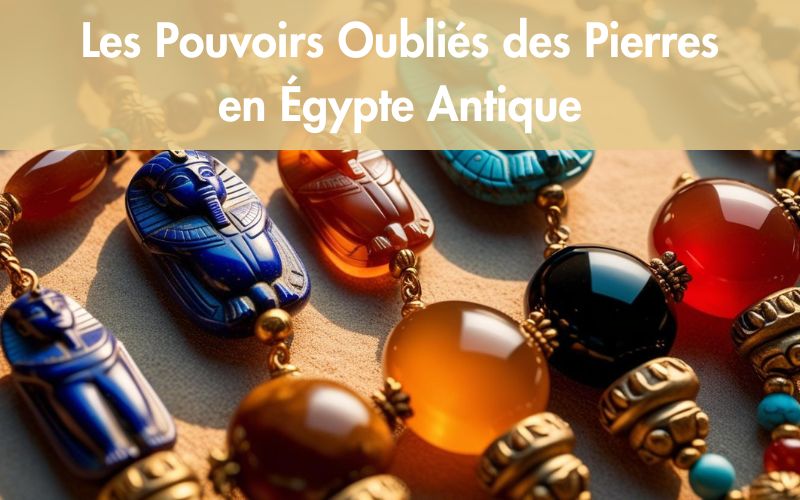
In Ancient Egypt, stones held an essential place in spirituality and daily life. They were perceived as sources of energy and protection. Their use went far beyond aesthetics; they embodied a deep connection between humans and invisible forces.

The sacred symbolism of stones in Ancient Egypt
The Egyptians attributed an essential symbolic value to stones in their understanding of the world and the universe. Each mineral possessed a precise meaning linked to its color, texture, and origin.
Lapis lazuli, for example, evoked the sky and divine wisdom, while turquoise embodied joy and protection. Carnelian, with its red hue, symbolized life and vital energy. These stones were incorporated into jewelry, ritual objects, and sacred decorations.
This symbolism went far beyond aesthetics, as it was part of a cosmic vision where every element had a specific role. The Egyptians believed that stones could influence destiny and channel invisible forces.
They served as intermediaries between humans and the deities. Their use was therefore deeply rooted in religion and spirituality. This importance testifies to the symbolic richness of the Egyptian civilization.
Additionally, artisans and priests also interpreted stones according to their geographical source, which reinforced their sacred and rare nature. Certain imported gems were particularly valued, as they were perceived to carry a distant and mysterious energy. Their integration into specific objects followed precise codes, strengthening their symbolic function in Egyptian society.
The main stones and their meanings
Precious stones played a key role in Egyptian symbolism. Each stone possessed an energy linked to spiritual and protective functions. Lapis lazuli symbolized wisdom and royalty, while turquoise represented protection and fertility.
Carnelian embodied vital energy, malachite healing, and obsidian spiritual protection.
These associations show the richness of the Egyptian symbolic system, where each stone had a specific function.
-
Lapis lazuli: divine wisdom and royal power
-
Turquoise: protection and fertility
-
Carnelian: vital energy and strength
-
Malachite: healing and renewal
-
Obsidian: spiritual protection
To learn more about natural stones: Click here.

Stones in religious and funerary rituals
Stones held a central place in the religious and funerary rituals of Ancient Egypt. They were used to protect souls, invoke the gods, and ensure the passage to the afterlife.
Priests carefully selected stones based on the ceremonies, thus reinforcing their symbolic effectiveness. Stone amulets were placed on mummified bodies to ensure the protection of the deceased.
Sarcophagi were often decorated with precious stones, reinforcing their sacred dimension. Statues of the gods were carved from solid materials like granite or basalt, symbolizing their eternal power. Stones were also used to represent important religious symbols, such as the Eye of Horus. Their use testified to a desire to control spiritual destiny and ensure life after death.
In parallel, stones also played a role in key stages of the funerary ritual, particularly during mummification and the Opening of the Mouth ceremonies. Certain gems were placed in specific locations on the body to enhance spiritual protection and guide the soul. These practices demonstrate meticulous organization and a deep belief in the energetic power of minerals.

Stone ritual objects
Stone objects were ubiquitous in religious rituals. Amulets protected individuals against malevolent forces and accompanied the deceased into the afterlife. Obsidian mirrors were used for divination and communication with the invisible world.
Stone statues represented the deities and served as a focal point for prayers. Sarcophagi inlaid with gems reinforced spiritual protection. These objects were essential in religious practices.

The therapeutic virtues of stones in Ancient Egypt
The Egyptians considered stones as therapeutic tools capable of influencing physical and mental health. They used minerals to treat various illnesses, based on their energetic properties. Malachite was used for eye conditions, while lapis lazuli helped soothe the mind. These practices were part of a comprehensive approach to medicine.
Healers often combined several stones to create remedies adapted to the patients' needs. These treatments were accompanied by rituals and incantations. The Ebers Papyrus mentions several medical recipes involving minerals. This use shows the importance of stones in Egyptian medicine and reflects a holistic vision of health.
Additionally, stones could be worn as talismans to act continuously on the body and mind. Practitioners adapted their use based on the symptoms and the patient's general condition. Some applications were also preventive, aiming to strengthen inner balance and avoid illness. This approach demonstrates an advanced understanding of the connection between physical well-being, energy, and spirituality.
The medical uses of stones
Stones were used in different ways in Egyptian medicine. They could be ground into powder to be applied to the body or incorporated into preparations. Malachite was used for the eyes, while carnelian stimulated fertility.
Lapis lazuli was used to calm mental disorders. These practices demonstrate an in-depth knowledge of mineral properties and testify to an advanced approach to medicine.

Stones and the power of the Pharaohs
Pharaohs used stones to strengthen their power and affirm their divine status. They were present in their jewelry, crowns, and ceremonial objects. Lapis lazuli symbolized their connection to the gods, while hematite enhanced their strength. These stones were considered sources of protection and power.
Royal tombs contained numerous precious stones, testifying to their importance. They were used to ensure the pharaoh's survival in the afterlife. Funerary objects were richly decorated with gems. This usage shows the central role of stones in royal power and highlights their spiritual dimension.
Additionally, stones also played a role in the theatrical display of royal power during public ceremonies. Their brilliance and rarity helped to impress the people and affirm the pharaoh's superiority. Certain gems were reserved exclusively for the elite, reinforcing their sacred and inaccessible nature. This social distinction helped maintain the established order and strengthen the image of the pharaoh as the privileged intermediary between men and the deities.
Stones in royal objects
Stones occupied an essential place in royal objects in ancient Egypt. Funerary masks, thrones, and jewelry were richly adorned with symbolic gems, reinforcing the pharaoh's divine status. They served to protect, impress, and assert his authority to the people.
They were found notably in:
-
Funerary masks made of lapis lazuli
-
Crowns adorned with rare gems
-
Sacred pectorals linked to deities
-
Symbolic scepters of power
-
Ceremonial jewelry
These objects illustrated the close link between power, spirituality, and royal wealth.

Stones as a bridge between the visible and invisible worlds
The Egyptians considered stones to be bridges between the visible and invisible worlds. They allowed for communication with gods and spirits. This function was essential to their spirituality. Priests used certain stones for divination and meditation.
Obsidian, for example, was used as a mirror to access the spiritual world. Stones were also used in temples to channel divine energy. They served to strengthen rituals and protect individuals. This usage shows the importance of stones in Egyptian spirituality.
Beyond these practices, stones were also integrated into specific sacred spaces, where their arrangement followed precise symbolic principles. They could be placed according to orientations related to the stars or natural cycles, reinforcing their role of connection with the universe. This approach shows that the Egyptians did not see these minerals as passive, but as active elements capable of interacting with invisible forces and amplifying spiritual intentions.
In some contexts, stones also served as supports for sacred inscriptions or engraved symbols, further reinforcing their symbolic power. They thus became objects of concentration, facilitating the entry into particular states of consciousness during rituals. This dimension reveals a fine understanding of the link between matter and spirituality.
Associated spiritual practices
Stones were used in many spiritual practices in ancient Egypt. They served for meditation, divination, and the elevation of consciousness. Priests used obsidian mirrors to perceive the invisible world and interpret signs. Amulets protected against negative forces, while certain rituals required specific stones according to their symbolism.
These practices show the importance of stones in religion and their central role in spirituality as tools for channeling energies and strengthening sacred intentions.

The legacy of stones in modern Egypt
Beliefs linked to stones still persist today in Egypt. In the markets, one can find amulets inspired by ancient traditions. These objects are often used for protection or luck. Modern lithotherapy also draws inspiration from these practices.
Archaeological discoveries continue to reveal the importance of stones in Egyptian civilization. They show that stones were much more than decorative objects; they were spiritual tools. This legacy testifies to the cultural richness of ancient Egypt.
Even today, stones occupy a special place in the collective imagination and in certain daily practices. They are often associated with wellness rituals, meditation, or the search for energetic balance. In large cities as well as in more traditional regions, they continue to be passed down as objects charged with meaning and history.
Their presence in artisanal shops and tourist circuits helps keep these ancient traditions alive. This cultural continuity shows that stones remain deeply rooted in mindsets, bridging historical legacy and modern reinterpretation.
Contemporary uses
Today, stones are used in various contexts, blending tradition and modernity. They are used for personal protection, spiritual practices, and meditation. They are also sold as tourist souvenirs, often inspired by ancient symbols.
Some people use them in alternative therapies to seek inner balance. These uses demonstrate the continuity of beliefs and testify to the lasting influence of ancient Egypt on current practices.

FAQ about The Forgotten Powers of Stones in Ancient Egypt
Stones occupied an essential place in the daily, religious, and spiritual life of ancient Egyptians. Their use was not limited to ornamentation or material wealth, but was part of a deeply symbolic worldview connected to invisible forces. Understanding their role allows for a better grasp of the beliefs, rituals, and practices that structured this fascinating civilization.
Even today, many questions remain about the powers attributed to stones in ancient Egypt. Internet users seek to know how they were used, what their meanings were, and whether these beliefs have withstood the test of time. These questions reflect a growing interest in history, as well as in the spiritual and energetic dimensions associated with minerals.
This FAQ section gathers the most frequent questions in order to provide a clear and accessible perspective on this subject. It allows for the exploration of the uses, symbols, and legacy of stones from both a historical and cultural viewpoint, while answering the most common curiosities.
Why did the Egyptians use stones?
The Egyptians used stones for their spiritual and protective properties. They served to communicate with the gods, for protection, and to accompany religious rituals.
Which stone was the most important?
Lapis lazuli was a major stone, a symbol of wisdom, royalty, and the connection with the divine in ancient Egypt.
Did the stones have real powers?
Within their belief system, stones were considered powerful. They could protect, influence fate, and strengthen spiritual energy.
What were the amulets used for?
Stone amulets were used to protect the living and the dead, and to facilitate the passage to the afterlife.
Do these beliefs still exist today?
Yes, stones are still used today, notably in lithotherapy and certain spiritual practices.
Did stones play a role in mummification?
Yes, certain stones were integrated into mummification rituals. They were placed on specific areas of the body to protect the soul of the deceased and facilitate its passage to the afterlife.
Which stone symbolized protection in ancient Egypt?
Turquoise was a stone strongly associated with protection. Linked to the goddess Hathor, it was used to ward off danger and bring safety and well-being.
Did Egyptians wear stones daily?
Yes, Egyptians regularly wore stones in the form of jewelry or amulets. They served to protect, attract positive energies, and affirm their spiritual identity.
Were stones reserved for the elites?
Certain rare stones were reserved for the elites and pharaohs, but more accessible versions were used by the common people in everyday objects.
Why were stones linked to the gods?
Stones were linked to the gods because they represented natural and cosmic forces. They served as a conduit to make contact with the divine and strengthen religious rituals.
Conclusion on the Forgotten Powers of Stones in Ancient Egypt
Stones in ancient Egypt were not mere decorative elements, but true spiritual and symbolic instruments at the heart of the civilization. They embodied invisible forces, served as protection, facilitated communication with the gods, and accompanied individuals in both life and death. Their presence in rituals, medicine, and royal power shows how deeply they were integrated into a profoundly sacred worldview.
The so-called "forgotten" powers of stones therefore lie in this ancient understanding of their energetic and symbolic role. They were perceived as mediators between the visible and invisible dimensions, capable of influencing destiny and strengthening spiritual intentions. Although these beliefs have evolved over time, their legacy remains today through certain modern practices and the growing interest in minerals.
Thus, these stones are not truly forgotten, but rather reinterpreted. They continue to fascinate and transmit a part of the wisdom of ancient Egypt, recalling the importance of the bond between man, nature, and the sacred.