

Egyptian sarcophagi are major historical sources for understanding the role, power, and religious vision of the pharaohs.
Much more than simple coffins, they reveal the concept of royalty, beliefs regarding the afterlife, and the political organization of ancient Egypt.
Sarcophagi as a reflection of royal power
The sarcophagi of the pharaohs are direct testimonies to the political and spiritual power exercised by Egyptian sovereigns.
Their monumental size, the exceptional quality of the materials, and the richness of the decorations were not merely for aesthetic purposes. They were designed to assert the grandeur of the pharaoh, even after his death.
In Egyptian thought, the sovereign was not just a terrestrial leader, but the embodiment of a cosmic order willed by the gods.
The sarcophagus participated fully in this staging of power. It materialized royal authority, dynastic continuity, and divine legitimacy. Every carved detail conveyed a clear political message: the pharaoh remained an eternal sovereign.
The imposing dimensions and the precision of the engravings testify to the considerable resources mobilized to honor the deceased king.
The sarcophagus thus became a personal monument, a symbol of a power that does not fade with death but is transformed.
Beyond its funerary function, it also served as an instrument of communication intended for future generations. Its imposing presence in the tomb recalled the centrality of the sovereign in the organization of the State.

The symbolism of divine royalty
The decorations on the sarcophagi emphasize the divine nature of the pharaoh. They feature representations showing him assimilated with major deities such as Osiris or Ra.
These images affirmed that the sovereign did not cease to exist after death, but that he joined the divine realm.
This iconography reinforced the belief that royal power came directly from the celestial domain and was meant to persist into eternity.
The affirmation of dynastic continuity
The engraved inscriptions often mentioned the ancestors, titles, and accomplishments of the sovereign. This highlighting of the lineage served as a reminder that power was part of a sacred continuity.
Even after his passing, the pharaoh remained linked to the stability of the kingdom. The sarcophagus thus became a tool for lasting political legitimization.
The materials used and their significance
The choice of materials reveals much about the status of the pharaoh and the perception of eternity in ancient Egypt.
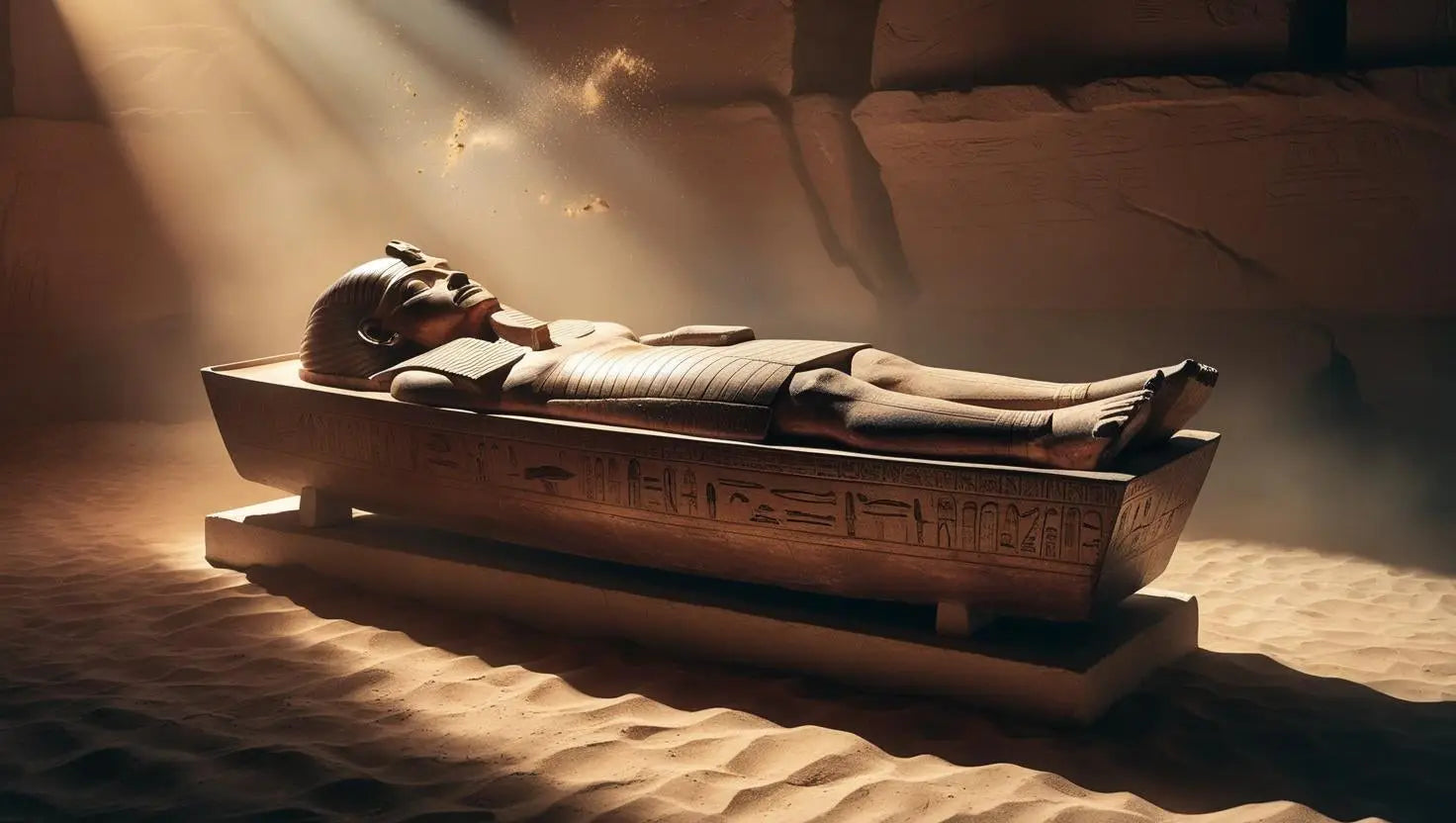
Sovereigns were buried in sarcophagi made of granite, basalt, or quartzite, hard and resistant stones symbolizing permanence.
Their extraction required impressive logistical organization, demonstrating the resources mobilized to honor the king and assert his unique place in the cosmic order.
The materials were selected based on several criteria:
-
Durability and strength
-
Prestige and rarity
-
Religious symbolism
-
Resistance to time
Each stone possessed a particular cultural and spiritual value. The choice of a rare or difficult-to-transport material reinforced the exceptional character of the deceased.
The material thus became a silent language expressing power, protection, and continuity. The colors, texture, and density of the stone were part of a carefully thought-out presentation.
Beyond the technical aspect, these choices reflect a deeply symbolic conception of death. The sarcophagus was not merely a funerary container, but a sacred vessel intended to preserve the integrity of the body and accompany the sovereign in his spiritual transformation.
Granite and the idea of eternity
Granite was particularly prized for its exceptional resistance. Its use for royal sarcophagi expressed the desire to protect the mummified body for the long term.
This stone symbolized the stability and strength of royal power. By choosing an almost indestructible material, the Egyptians asserted that the pharaoh’s reign was intended to continue into the afterlife.
Wood and multiple sarcophagi
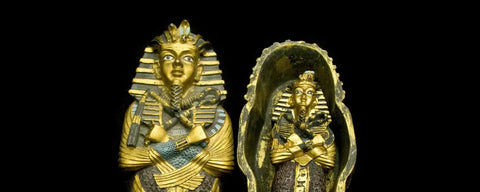
Some pharaohs had several nested coffins, often made of precious wood covered in gold. This layering created a reinforced symbolic and physical protection around the mummified body.
Each coffin served as an additional barrier against the forces of chaos and was part of the funerary ritual.
Wood, being lighter and more malleable than stone, allowed for fine carvings and detailed paintings depicting deities and protective spells, thus adding a sacred and magical dimension to the whole.
Inscriptions and sacred texts
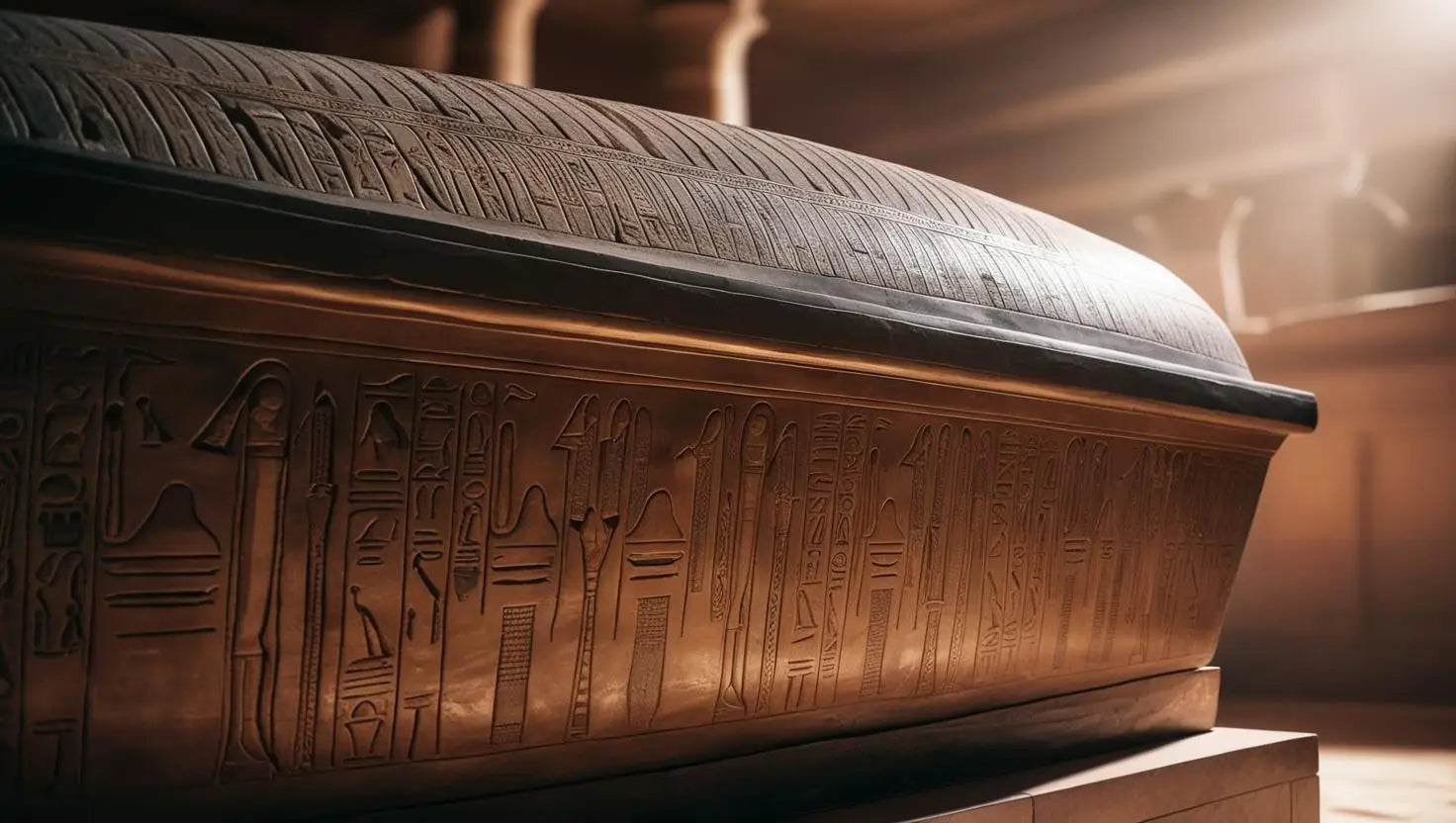
The sarcophagi of the pharaohs are covered with hieroglyphic inscriptions of great symbolic richness.
These texts were not merely decorative ornamentation: they possessed fundamental performative and religious value.
In Egyptian thought, writing held real power. Carving a formula onto a sarcophagus meant giving it concrete efficacy in the invisible world.
The inscribed formulas evoked the passage to the afterlife, the regeneration of the sovereign, and his integration into the cosmic order. They detailed the transformations necessary for the pharaoh to be reborn in a divine form.
The sarcophagus thus became a space of transition, serving as both physical protection and a spiritual shell.
Each inscription contributed to the staging of an initiatory journey where the deceased had to overcome trials and assert his royal identity.
The hieroglyphs associated names, titles, and divine attributes to recall the unique status of the sovereign.
Through these texts, the Egyptians expressed their conviction that the sacred word possessed creative force. The sarcophagus was therefore not just a funerary container, but an essential ritual support guaranteeing the continuity of royal existence into eternity.
The Book of the Dead
The Book of the Dead gathered a set of formulas, hymns, and incantations intended to guide the deceased through the various stages of the realm of the dead.
Inscribed on the walls of the sarcophagus or reproduced on papyri placed in the tomb, it symbolically accompanied the pharaoh on his posthumous journey.
These texts described the trials to be overcome, the deities to be invoked, and the words to be spoken during the judgment. They illustrate the complexity of Egyptian theology and the fundamental importance placed on salvation and eternal rebirth.
Divine representations
The figures of Osiris, Anubis, or Horus were frequently depicted on royal sarcophagi. Their presence was not merely artistic: it provided active and constant spiritual protection.
Each deity fulfilled a precise function in accompanying the deceased sovereign, whether it was watching over their body, guiding their soul, or ensuring their resurrection.
These images served as a reminder that the pharaoh, even after death, remained linked to the divine world and benefited from the support of sacred forces during their passage into eternity.

Sarcophagi and funeral rites
The sarcophagus occupied a central and sacred place in all Egyptian funeral rites. It was not merely a container for the mummy, but a fundamental element of the religious framework surrounding royal death.
Its role was part of a succession of meticulously codified stages, where every gesture held a precise symbolic significance.
After the funeral preparations, placing the body inside the sarcophagus represented a solemn moment, marking the completion of the earthly process and entry into a new spiritual phase.
The coffin was integrated into a carefully prepared, oriented, and protected space, in order to ensure the sovereign the best conditions for their passage into eternity.
Specialized priests intervened during the final ceremonies, reciting formulas and performing ritual gestures intended to guarantee divine protection.
The sarcophagus then became much more than a material object: it symbolized the transition between two worlds, that of the living and that of the gods.
Through these practices, the Egyptians expressed their conviction that death was not a final end, but a transformation managed and framed by precise rites. The sarcophagus thus embodied the sacred threshold of this spiritual rebirth.
Mummification
Mummification aimed to preserve the body for eternity, an essential condition for the survival of the soul in the afterlife according to Egyptian belief.
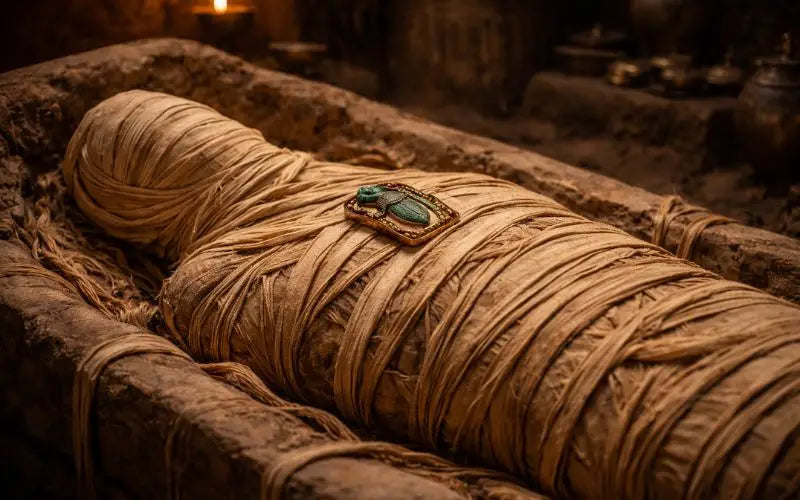
This complex process lasted several weeks and involved the removal of organs, the treatment of the body with natron, and meticulous wrapping in linen bandages.
Each step was accompanied by precise prayers and ritual gestures. Once completed, the mummy was placed in the sarcophagus, the ultimate protection guaranteeing the sovereign's physical integrity for eternity.
The Opening of the Mouth ritual
The Opening of the Mouth ritual was an essential ceremony performed before the final placement in the tomb.
Using symbolic instruments, the priests would touch the mouth and eyes of the mummy to restore its sensory faculties in the afterlife.
This ritual gesture restored to the deceased the capacity to speak, breathe, and feed themselves symbolically.
It highlights the profoundly spiritual dimension of the sarcophagus, designed not only to protect the body but also to accompany the eternal rebirth of the pharaoh.
The evolution of sarcophagi through the dynasties
Egyptian sarcophagi did not remain fixed in a single model: they evolved in parallel with the kingdom's political, religious, and artistic transformations.
Their morphology, manufacturing techniques, and decorative program reflect the major mutations of Egyptian civilization over more than two millennia.
By carefully observing these variations, archaeologists can identify specific periods, reconstruct cultural influences, and understand the changes in the conception of the afterlife.
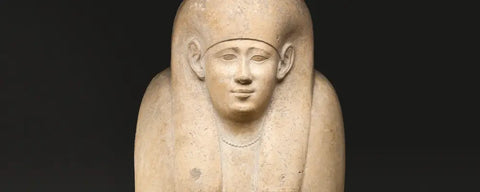
Over the dynasties, the very structure of the sarcophagus changed. The simple rectangular forms of the early periods gradually gave way to anthropomorphic coffins mirroring the idealized features of the deceased.
The proportions, the depicted postures, and the stylization of the face bear witness to an aesthetic evolution linked to dominant artistic movements.
The engraved texts and figurative scenes also became more complex over time, reflecting a theological and symbolic enrichment.
Sarcophagi thus serve as veritable visual archives, revealing the continuous adaptation of funeral traditions to changing historical contexts. They constitute essential chronological markers for retracing the history of ancient Egypt.
Sarcophagi of the New Kingdom
Sarcophagi of the New Kingdom are distinguished by exceptional decorative richness and a particularly vibrant color palette.
Artisans multiplied details, painted scenes, and hieroglyphic inscriptions, creating true works of funerary art.
Representations became more narrative and structured, illustrating with precision the pharaoh's journey in the afterlife, the trials they must endure, and their symbolic rebirth.
This period marked a significant artistic refinement, reflecting both the prosperity of the kingdom and the deepening of religious beliefs.
Archaeological discoveries and their impact
Archaeological excavations conducted since the 19th century have brought to light numerous royal and aristocratic sarcophagi, offering unprecedented insight into the funeral practices of ancient Egypt.
Each new discovery enriches our understanding of beliefs related to the afterlife, but also of the social hierarchy and political structures that governed mortuary rites.
Sarcophagi are not merely isolated objects: they are part of funerary complexes including chambers, offerings, and ritual furniture, revealing a coherent and deeply symbolic system.
Recent scientific progress has transformed the study of these artifacts. Non-invasive analyses allow for the examination of internal structures, assembly techniques, and decorative layers without damaging the pieces.
This approach contributes to preserving the objects while increasing the data available to researchers.
Archaeological discoveries also shed light on the numerous attempts at looting that these tombs were subjected to over the centuries.
The protective measures, hiding places, and ancient restorations bear witness to the exceptional value attributed to sarcophagi, both materially and spiritually, in Egyptian history.
Intact tombs
The discovery of intact tombs constitutes an exceptional source of information for archaeologists. When a sarcophagus is found in its original context, surrounded by its funerary furniture, it becomes possible to precisely understand the organization of rituals and the symbolic layout of the objects.
These findings allow for the analysis of the relationship between the sarcophagus, the mummy, the offerings, and the wall inscriptions. They also offer clues about the social status of the deceased, religious practices, and the craft techniques employed at the time.
Modern technologies
Modern technologies have profoundly transformed the study of Egyptian sarcophagi.
Digital scans, photogrammetry, and chemical analyses allow for a detailed examination of pigments, gilding layers, and material composition without altering the artifacts.
These non-invasive methods ensure the preservation of the objects while providing precise scientific data. They also facilitate the virtual reconstruction of the original decorations and the identification of any ancient restorations, thereby enriching our understanding of craftsmanship techniques and funerary practices.
FAQ on Egyptian Sarcophagi
Egyptian sarcophagi occupy a central place in the study of pharaonic civilization. They are not merely funerary containers, but true cultural, religious, and political testaments.
Through their forms, materials, and decorations, they reflect the Egyptian vision of death, power, and eternity. Their analysis allows for the exploration of beliefs related to the afterlife, social hierarchy, as well as the unique position of the pharaoh within the cosmic order.
Each sarcophagus constitutes a precious source of information for historians and archaeologists. It reveals the artistic evolutions, theological transformations, and dynastic changes that marked the history of ancient Egypt.
Studying these objects also means understanding how the ancient Egyptians conceived the protection of the body, the survival of the soul, and the continuity of royal power.
In order to delve deeper into these essential aspects, the following questions address the most frequent queries regarding Egyptian sarcophagi and their significance in pharaonic culture.
Were sarcophagi reserved for pharaohs?
No. The nobility and certain high officials also possessed them, but those of the pharaohs were more imposing and richly decorated, reflecting their divine and supreme status.
Why did they use such heavy stones?
Hard stones like granite ensured better protection against time and looting. They also symbolized the stability and eternity of royal power.
Did the inscriptions have a magical role?
Yes. The engraved texts contained sacred formulas intended to protect the deceased and guide their soul into the afterlife.
How many sarcophagi could a pharaoh have?
Some pharaohs possessed several nested coffins to reinforce the physical and spiritual protection of the mummified body.
Did sarcophagi evolve over time?
Yes. Their forms, materials, and decorations changed according to the dynasties, reflecting the religious and artistic evolutions of ancient Egypt.
Conclusion on Egyptian Sarcophagi
Egyptian sarcophagi are much more than funerary objects: they constitute major testaments to the conception of power, religion, and society in ancient Egypt.
Through their materials, inscriptions, and iconography, they reveal the central place of the pharaoh in the cosmic and political order. Every sculpted or engraved detail expresses the desire to ensure the sovereign an eternal and protected existence.
They teach us that death was not perceived as an end, but as a transition to another state of existence.
The sarcophagus became a sacred tool, a magical medium, and a symbol of continuity. Their evolution across the dynasties also shows the religious and cultural transformations of Egyptian civilization.
Today, thanks to archaeological discoveries and modern technologies, these funerary monuments continue to yield their secrets.
They remain an essential source for understanding the Egyptian vision of the afterlife and the way in which pharaohs asserted their power even into eternity.