

The Ankh: the cross of life at the heart of royal language
The Ankh is often simply translated as "life," but this translation remains reductive given the richness of its significance in Egyptian civilization. In the iconography of ancient Egypt, this symbol represents a complete, harmonious, and legitimate life, granted by the gods and inscribed in the order of the world. It is therefore not just about existing, but about living in a just balance between divine forces, nature, and human power.
It is for this reason that the Ankh appears very frequently in official art, particularly on the reliefs of temples and tombs. In these scenes, deities hold or offer the Ankh to the pharaoh. This gesture has a strong symbolic reach: it is not a simple object being offered, but a transmission of divine life.
The Ankh then represents the vital breath, the sacred energy that allows the sovereign to rule. This image asserts that the pharaoh's authority is not only political, but also validated by the divine world. In this logic, the pharaoh is considered the guarantor of Maat, the cosmic order and the balance of the world.
The Ankh thus becomes a sign of continuity: as long as order is respected, the life of the kingdom and the stability of Egypt can endure.
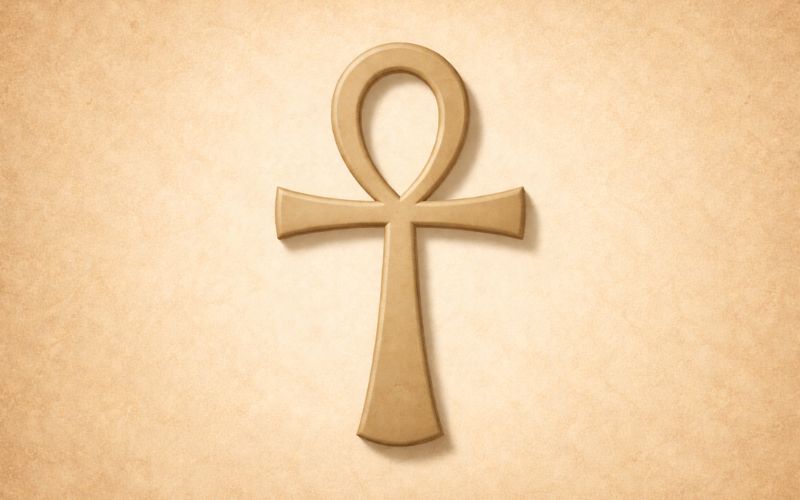
The Ankh as a mark of divine legitimacy
In ancient Egypt, political authority could not exist without a sacred justification. The pharaoh's power had to be recognized and validated by the gods, and symbols played an essential role in this demonstration. The Ankh, often represented in royal iconography, was one of those visual signs capable of making the link between the divine world and earthly power visible.
Engraved on temple walls, worn as jewelry, or integrated into religious scenes, it served to affirm that the kingdom's order was supported by divine forces. In many depictions, the gods hold the Ankh out to the pharaoh. This symbolic gesture signifies that the life, breath, and legitimacy of the sovereign come directly from the divine world.
The image conveys a clear idea: the pharaoh's power is recognized "from above" and is inscribed in the cosmic order. The Ankh thus functions as a true seal of sacred legitimacy. For the Egyptians, these images were not mere decorations. They formed a visual language understood by all. The scenes sculpted in the temples or tombs tell an official story where each symbol has a precise meaning.
In this context, the Ankh acts as a public message, clear and immediately identifiable, participating in a form of collective communication long before the invention of the printing press.
Ankh jewelry and status: who wore what?
We often associate the Ankh with pharaohs and royalty, but this symbol was in reality present at different levels of Egyptian society. Depending on social rank and usage, it could take various forms and be crafted from more or less precious materials.
This diffusion shows that the Ankh went beyond the strict framework of royal power to touch the daily life and spirituality of many Egyptians.
Deep symbolism: life, breath, rebirth, and order
Ankh cross jewelry in rituals and royal representation
In ancient Egypt, images sculpted in temples are not simple decorations. They are an integral part of religious rituals and participate in the sacred action. In Egyptian thought, representing a symbol is already equivalent to giving it real efficacy. Scenes where sacred signs appear therefore tell much more than a story: they assert the presence of the divine and the legitimacy of royal power.
In this context, the Ankh occupies a central place in ceremonies and the representation of power. Associated with blessing, vitality, and divine protection, it symbolizes life granted by the gods. When royalty displays itself with this symbol, it transmits a clear message: the pharaoh's power guarantees the vitality and balance of the kingdom.
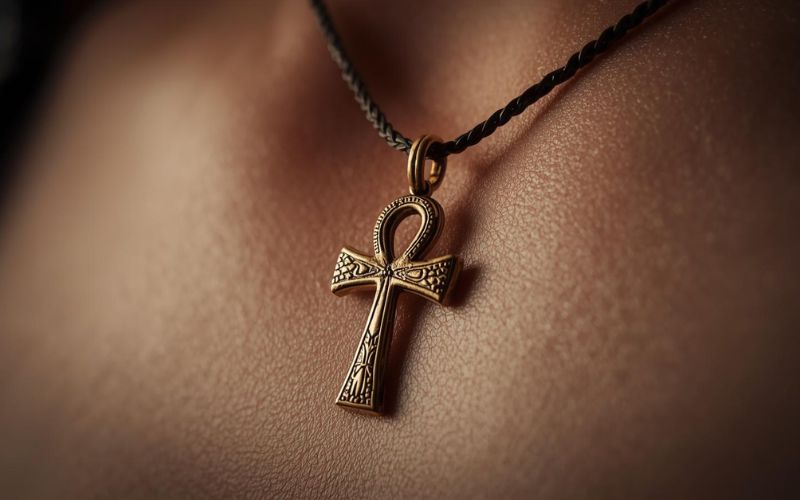
The Ankh also possesses strong visual power. Like other sacred signs—scepters, crowns, or protective symbols—it is immediately recognizable. This readability explains why it has spanned the centuries and remains one of the symbols most associated with ancient Egypt today.
In jewelry, the Ankh often appears in the form of necklaces or bracelets. The Ankh necklace, worn close to the heart, was both an aesthetic object and a spiritual protection amulet, often made of gold and adorned with stones. Ankh bracelets, sometimes personalized with hieroglyphs or sacred motifs, were worn during ceremonies to attract the gods' blessing and reinforce the wearer's spiritual protection.
Materials and aesthetics: from symbol to style
How to wear the Ankh today without betraying its meaning
Influence of Ankh jewelry on modern jewelry design
Today, Ankh jewelry inspired by ancient Egypt continues to influence contemporary jewelry. This millenary symbol, immediately recognizable, is easily integrated into modern creations thanks to its simple and balanced form. Designers draw inspiration from it to create pieces that combine historical heritage with current aesthetics.
In modern jewelry, the Ankh is often revisited through clean lines and more minimalist designs. Creators play with proportions, finishes, and materials in order to adapt this ancient symbol to current trends. It can thus be found in discreet pendants, stylized rings, or fine bracelets, designed to be worn daily.
The lasting appeal of this motif is also explained by its strong visual identity. Its unique silhouette allows it to be easily integrated into different styles, whether they be modern, elegant, or more artistic.
By revisiting the Ankh, contemporary jewelry does not merely replicate an ancient symbol. It gives it a new aesthetic dimension, allowing one to wear a piece of jewelry charged with history while integrating it naturally into current styles.
FAQ on Ankh jewelry in royalty and their symbolism
What exactly does the Ankh mean in ancient Egypt?
The Ankh means “life,” but in a broad sense: vitality, breath, continuity, and protection granted by the gods. In royal art, it often expresses the divine life transmitted to the pharaoh, the guarantor of the kingdom’s order and stability.
Why is the Ankh associated with pharaohs?
Because Egyptian royalty presents itself as a power legitimized by the sacred. In temple scenes, the gods offer the Ankh to the sovereign: it is an image of divine legitimation and the transmission of the vital force necessary for the reign.
Was Egyptian cross of life jewelry only for royalty?
No. The Ankh appears strongly in the royal and religious universe, but it could also exist in the form of simpler amulets in society. The idea remains the same: protection, luck, vitality, and a link to the sacred.
Does Ankh cross jewelry have a magical meaning?
In Egyptian thought, a symbol can have a protective and spiritual function. Wearing an Ankh refers to an intention: to place oneself on the side of life, balance, and protection. Today, many wear it as a personal talisman.
How to choose an Ankh piece of jewelry if you want to remain authentic in spirit?
Favor a legible, balanced design that is not overly ornate. Simple forms respect the spirit of the Ankh well: a clear, powerful, easy-to-recognize symbol. Then, choose a style (minimalist or more engraved) according to the atmosphere you wish to create.
What was the significance of Ankh jewelry in ancient Egypt?
Ankh jewelry were spiritual and political symbols. They represented divine protection, power, and authority over life and death.
Why is the Ankh necklace so iconic?
The Ankh necklace, worn close to the heart, combined aesthetics and spiritual protection. It was often made of solid gold and adorned with precious stones, embodying wealth and power.
What was the importance of Ankh bracelets?
Ankh bracelets served as talismans during religious ceremonies. They were personalized with hieroglyphs to attract blessings and offer divine protection.
How does Ankh jewelry inspire modern jewelry design?
Contemporary jewelry draws inspiration from historical designs by using modern materials while retaining the sacred and symbolic essence of the Ankh.
Why was Ankh jewelry considered a work of art?
Each piece of Ankh jewelry was unique, designed with precise details and materials chosen for their spiritual symbolism. These creations reflected both aesthetic beauty and sacred power.