

Origins of the constellations
Constellations in Antiquity
In Ancient Egypt, Mesopotamia, and among the Greeks, constellations were associated with deities and legends.
For example, Orion was seen as a celestial hunter, reflecting courage and strength. Civilizations used these patterns to synchronize agricultural and spiritual calendars.
The sky became a narrative canvas connecting humans to universal archetypes.
How constellations structured time
Over the centuries, constellations have served to divide the sky into zones, allowing for the measurement of time and the anticipation of seasonal cycles.
Farmers and navigators relied on these markers to plant, harvest, and travel.
This practical dimension is one of the reasons why constellations have continued to be studied and have fascinated us to this day.

What is spiritual alchemy?
Stages of transformation
The alchemical tradition describes several symbolic phases marking inner evolution. Each corresponds to a precise psychological process, ranging from confronting the shadows to the harmonious integration of lived experiences.
These stages represent a progressive movement of deepening and clarification.
They allow one to understand that periods of doubt or questioning are part of a natural cycle of growth and renewal.
Alchemical symbolism and the psyche
Alchemy uses a language of images to explore inner life. Symbols serve to express psychological realities that are difficult to formulate directly.
By working with these representations, the practitioner develops a finer perception of their internal dynamics.
The images become tools for understanding and integration, facilitating a gradual and conscious transformation of the personality.

Constellations and psychological symbolism
Constellations are not just astronomical reference points; they are also powerful archetypes in the collective unconscious.
Stellar archetypes like Leo, Scorpio, Aquarius, or Virgo represent human traits and psychological dynamics.
Studying constellations from this angle offers keys to better understanding our own behavioral and emotional patterns.
By connecting the sky to inner life, human beings project their existential questions, aspirations, and conflicts onto the stars. This symbolic projection creates a bridge between the visible universe and the invisible world of the psyche.
Celestial figures thus become supports for reflection, helping to bring to light internal forces that are sometimes unconscious.
Observing these stellar images can encourage a form of active contemplation, where one dialogues with their own mental representations.
In this perspective, the firmament acts as a vast symbolic mirror, revealing the tensions, potentials, and creative impulses that inhabit everyone. Thus, constellations participate in an inner cartography, inviting one to explore their depths with curiosity and openness.
Dream interpretation and constellations
When stars or constellations appear in dreams, they can be interpreted as symbolic messages.
A dream featuring Scorpio may evoke transformation or confrontation with the shadow.
This allows for the use of the sky and stellar myths as a psychological and introspective language.
These nocturnal images can reflect ongoing unconscious processes, signaling emotional changes or emerging realizations.
Celestial symbols then serve as subtle indicators, helping to decode complex inner experiences and better understand evolving personal dynamics.
 Constellations in spiritual traditions
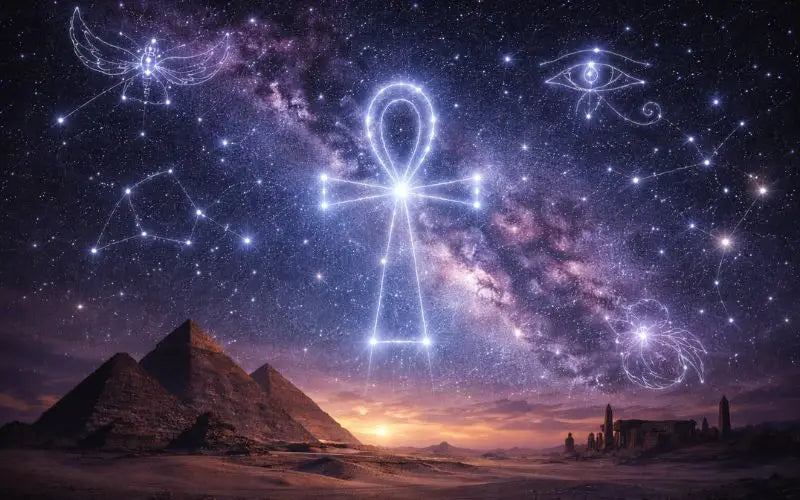
In many spiritual traditions, constellations are perceived as gateways to higher levels of consciousness.
Whether in Vedic astrology, shamanism, or Western esotericism, constellations dictate the rhythm of rituals, festivals, and seasons of introspection. They also serve as a cosmic model for organizing spiritual practices.
Beyond their symbolic dimension, they embody an ordered vision of the universe, where each celestial position corresponds to a particular energetic quality.
Spiritual masters have often encouraged the attentive observation of the night sky as a means to expand perception and cultivate humility in the face of immensity.
This contemplation nourishes a sense of belonging to a larger whole, transcending individual and cultural boundaries. Constellations thus become meditative markers, favoring inner silence and deep reflection.
They also remind us of the cyclical nature of all human experience: birth, growth, decline, and renewal.
By integrating these celestial rhythms into daily life, certain traditions seek to harmonize actions, intentions, and aspirations with a cosmic order perceived as carrying meaning and lasting balance.
 Spiritual alchemy and transformation practices
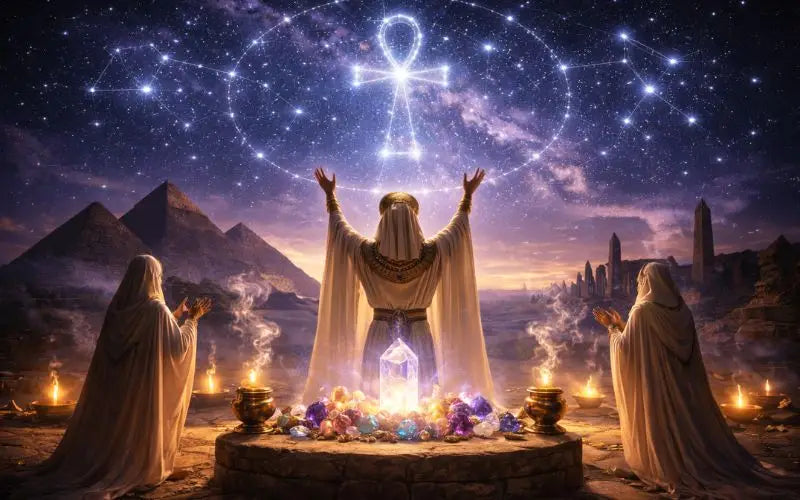
Spiritual alchemy offers concrete practices to support inner transformation. Among these are symbolic meditation, contemplative writing, and certain forms of introspective rituals.
These practices help in working with the "inner metals" that are emotions, fears, and deep-seated aspirations.
Beyond simple reflection, these exercises invite active participation in the process of change. They encourage consistency, patience, and commitment to oneself.
By adopting the posture of a benevolent observer, the practitioner learns to recognize their resistances without judgment, and then to gradually transform them.
Inner alchemy does not seek to suppress uncomfortable parts, but rather to understand them and integrate them into a more unified vision of the self. Each practice thus becomes an intimate laboratory where lucidity, compassion, and discernment are experienced.
With time, this discipline fosters greater coherence between thoughts, emotions, and actions.
It also supports the development of inner stability, allowing one to navigate life’s challenges with greater clarity and maturity.
Meditation on inner metals
Visualizing metals (lead, silver, gold) during meditation helps to identify psychological states.
Lead often represents limiting beliefs, while gold symbolizes acceptance and clarity. This approach helps to integrate the symbolic stages of transformation.
By deepening this practice, the meditator can associate each image with physical sensations or specific emotions, thereby strengthening awareness of their inner reactions.
This exploration promotes a better understanding of unconscious mechanisms and supports a process of progressive evolution.
Over time, these visualizations become mental markers that facilitate recentering and emotional stability in the complex situations of daily life.
Constellations and spiritual alchemy today
In contemporary spirituality, constellations and spiritual alchemy are found in integrative approaches that blend psychological astrology, introspective rites, and meditative practices.
Modern schools use these paradigms to promote a holistic understanding of oneself and one's relationship to the universe.
This convergence reflects a current need to bridge ancient knowledge with the modern quest for meaning. In a world marked by speed and fragmentation, these symbols offer a structuring framework for reflecting on one’s personal evolution.
They allow one to approach life transitions—professional changes, relationships, questioning—as significant stages rather than mere isolated events.
By combining observation of the sky with inner work, some practitioners encourage a symbolic reading of daily experiences.
This perspective fosters a more coherent vision of one’s journey, where every difficulty can become material for conscious transformation.
Far from being frozen in the past, these traditions are adapted, reinterpreted, and integrated into contemporary personal development approaches.
They thus contribute to a living spirituality, centered on autonomy, inner responsibility, and the continuous exploration of consciousness.
 Constellations and alchemy in daily life
Constellations and spiritual alchemy can enrich daily life by connecting symbolism and inner transformation. They help to better understand one's emotional cycles and inner strengths while providing concrete tools for growth.
Integrating these perspectives into one's routine does not require complex knowledge, but rather conscious attention to lived experiences.
Observing the sky, keeping a reflection journal, or practicing a few moments of silence allows one to give new depth to ordinary actions. These symbolic markers offer a framework for interpreting challenges, celebrating progress, and adjusting one's intentions.
They also encourage a posture of personal responsibility, where each person becomes an actor in their own evolution. By considering each day as a stage in a larger process, it becomes easier to perceive coherence and continuity in one's journey.
This approach fosters an increased presence to oneself and the surrounding world.
Thus, constellations and alchemy cease to be abstract concepts and become discreet companions, supporting a progressive transformation anchored in daily reality.
Astrological journaling
Noting the phases of the Moon and the appearances of constellations allows one to track one’s energy cycles and identify moments favorable to action or reflection.
This connects personal experience to cosmic rhythms and reinforces self-awareness.
This practice also fosters perspective regarding daily events. By rereading one's notes over the weeks, it becomes possible to spot recurring patterns, anticipate certain sensitive periods, and refine one's emotional understanding.
Meditation on alchemical symbols
Visualizing lead, silver, or gold helps in observing one's blockages and strengthening inner clarity.
This daily practice promotes the purification of the ego and the connection with one's deep aspirations.
With time, this visualization develops better mental and emotional stability. It allows one to approach challenges with greater calm and to gradually integrate the lessons learned from lived experiences.
Constellation ritual
Contemplating a constellation and meditating on its symbolic qualities, such as the strength of Leo or the balance of Libra, allows one to integrate these archetypes into one's life.
Even a few minutes a day create a concrete link between the sky and personal growth.
Repeated regularly, this practice strengthens intention and concentration. It helps direct daily actions toward consciously chosen values, while cultivating a sense of inner harmony.
FAQ on Constellations and Spiritual Alchemy
Constellations and spiritual alchemy are attracting growing interest from those seeking to connect cosmic symbolism and inner transformation.
At the crossroads of cultural astronomy, symbolic psychology, and esoteric traditions, these two fields offer a rich language for exploring meaning, identity, and personal evolution.
However, their diversity of approaches and terminology can sometimes seem complex or abstract for new readers.
This FAQ aims to provide simple, structured clarifications regarding essential concepts related to constellations and spiritual alchemy.
It aims to establish an accessible framework for understanding, without assuming prior knowledge, while respecting the symbolic depth of these traditions.
Whether one is interested out of intellectual curiosity, for introspective purposes, or as a spiritual practice, it is useful to clarify certain fundamental concepts to avoid common confusion.
By browsing the following questions, you will be able to better situate these practices in a contemporary context, understand their symbolic origins, and discern how they can be integrated into personal reflection.
This introduction thus serves as an anchor point before entering into detailed answers.
What is a constellation in a spiritual context?
A constellation is a group of stars interpreted symbolically to represent archetypes or psycho-spiritual themes. In a spiritual context, it serves as a mirror for exploring inner dynamics or life cycles.
How does spiritual alchemy help with personal growth?
Spiritual alchemy offers a metaphor for inner transformation, helping to understand and transcend the limiting aspects of the psyche to achieve greater clarity and inner unity.
Can I use constellations in my meditations?
Yes. Visualizing constellations or meditating on their symbols can enrich your meditative practice by integrating archetypes and fostering a connection to a vaster dimension.
What is the difference between astrology and spiritual alchemy?
Astrology links celestial positions to personality traits and life cycles, while spiritual alchemy focuses on inner transformation through symbolic metaphors.
Do constellations change over time?
Astronomically, the precession of the equinoxes slowly modifies the position of constellations relative to the Earth. Symbolically, interpretations evolve with cultures and eras.
Can one learn spiritual alchemy without a religious context?
Yes, because it mainly uses symbols and psychological metaphors that are accessible independently of any particular religion.
Are alchemical practices dangerous?
Symbolic approaches are not physically dangerous, but like any inner exploration, they require introspection and emotional caution.
What is the relationship between astrology and spiritual alchemy?
Astrology reveals the influence of the stars on our life cycles, while spiritual alchemy guides inner transformation and personal evolution through these celestial symbols.
Can stars or constellations influence our psyche?
Constellations serve as symbolic markers, helping to better understand our emotions, behaviors, and the important phases of our lives.
What does “as above, so below” mean in this context?
This maxim expresses that the macrocosm (the universe) and the microcosm (the human being) reflect the same principles, connecting celestial forces to our spiritual development.
Conclusion on Constellations and Spiritual Alchemy
Constellations and spiritual alchemy converge in the same quest: to understand the profound link between the external universe and the inner universe. Through celestial figures, human beings project their questions, aspirations, and archetypes.
Through alchemy, one undertakes a conscious work of transformation, seeking to transmute limitations into wisdom. Together, these two traditions offer a complete symbolic cartography: the sky as a mirror of the psyche, and the soul as a laboratory of evolution.
The article shows that their relationship is neither decorative nor abstract. Historically, constellations have structured time, inspired myths, and guided civilizations.
Symbolically, they serve as supports for introspection and psychological understanding. At the same time, spiritual alchemy proposes concrete methods to support personal growth and integrate these symbols into daily life.
Thus, connecting constellations and alchemy amounts to uniting contemplation and action, cosmic vision and inner transformation.
This synthesis answers the central question of the article: how do the sky and the mind engage in dialogue? They do so through symbol, experience, and consciousness, offering everyone a path toward a deeper understanding of themselves and the world.