
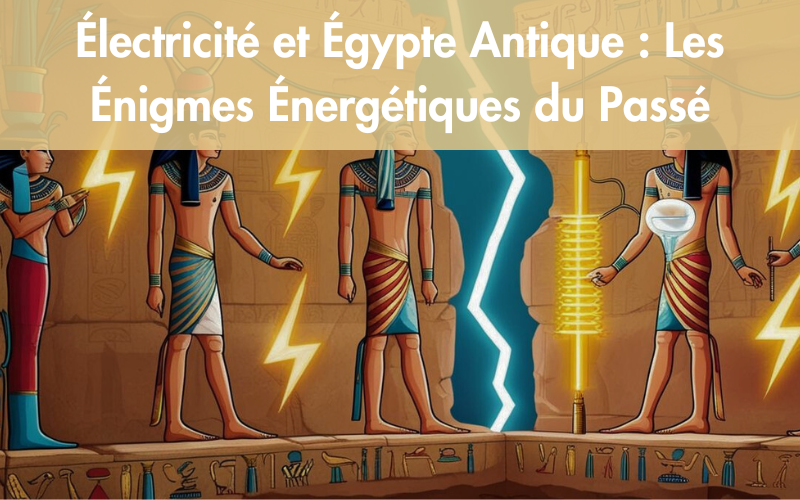
Some theories suggest that the Great Pyramid could have functioned as an energy generator. Its alignment, materials, and the presence of quartz are intriguing. These elements fuel the hypothesis of a possible use of a form of ancient electricity.

The Baghdad Batteries and their influence on energy theories
The Baghdad Batteries are often used to support the idea that electricity already existed in antiquity. These terracotta objects containing copper and iron could produce a weak electric voltage when an acidic liquid is added. Although they are not Egyptian, they fuel the hypothesis that other civilizations, such as Egypt, could have developed similar technologies.
Their discovery has profoundly influenced the collective imagination and alternative theories about ancient knowledge. However, no direct link has been established between these objects and the Egyptian civilization. The historical contexts are different, making any comparison fragile. Despite this, these artifacts show that certain chemical knowledge already existed in antiquity. They illustrate a form of technical ingenuity that is often underestimated.
However, researchers remain cautious. Evidence is lacking to confirm an actual use of electricity. These batteries therefore remain a fascinating mystery, but one that is insufficient to prove advanced technology in ancient Egypt. Their study, however, helps to better understand the evolution of technical knowledge in ancient civilizations.
Electrochemical functioning of ancient batteries
The Baghdad Batteries are based on a simple principle of electrochemical energy. A copper cylinder and an iron rod are placed in an acidic liquid, causing a chemical reaction. This reaction generates a weak but measurable electric voltage.
Modern tests have confirmed this capacity, proving that these objects could technically function as rudimentary batteries. However, no historical evidence confirms their actual use for this purpose. Researchers suggest that they could have been used for medicinal or ritual practices. The lack of direct evidence strongly limits the conclusions.
Scientific limitations and absence of direct evidence
Despite their potential, the Baghdad Batteries have numerous limitations. No ancient text mentions their electrical use. Furthermore, no device powered by these objects has been discovered. The hypotheses therefore rely mainly on modern experiments. This weakens their scientific credibility.
Archaeologists prefer simpler explanations that are consistent with the historical context. It is possible that these objects had a symbolic or religious function. In the absence of solid evidence, these theories remain speculative. The mystery persists, but caution remains essential.

The Pyramids of Giza: architecture or power plant
The pyramids of Giza are at the heart of theories related to ancient energy. Their architectural precision and impressive size still raise questions. Some researchers suggest that they could have functioned as energy devices. The presence of granite rich in quartz fuels this hypothesis, because quartz has piezoelectric properties. Under certain conditions, it can produce an electric charge.
This idea has led to the imagination that the pyramids could capture or generate electricity. However, no archaeological evidence confirms this theory. The pyramids are widely recognized as funerary structures. Their construction is based on advanced human techniques, without the use of electrical technologies. Energy theories therefore remain speculative and controversial. They are often rejected by the scientific community.
Nevertheless, they continue to fascinate the general public. They illustrate the persistent mystery surrounding these iconic monuments. Their study helps to better understand the ingenuity of the ancient Egyptians. They also testify to a social and technical organization that was particularly developed for its time.

The role of quartz in energy theories
The quartz contained in granite is often used to explain theories of ancient electricity. This material possesses a property called piezoelectricity, which allows it to produce a charge when subjected to pressure. This phenomenon is used in some modern technologies.
Some believe that the pyramids exploited this natural property. However, the conditions necessary for such production do not seem to be present in the Egyptian structures. Scientists consider this hypothesis unlikely. It lacks concrete evidence and relies on modern interpretations.
Pyramidal energy generator hypothesis
According to this theory, the pyramid acts as a terrestrial energy amplifier. Its shape and orientation would allow for the capture of natural vibrations. This would have made it possible to produce or channel a specific energy. However, no scientific evidence validates this hypothesis.
It relies mainly on speculations and modern analogies. Researchers consider it unfounded. Despite this, it remains popular in certain circles. It shows the attraction for technological mysteries of the past.

The Dendera light: religious symbol or hidden technology
The relief at the Dendera Temple is often presented as proof of ancient electricity. An elongated shape resembling a lightbulb can be observed there, accompanied by elements suggesting a cable. This image has led some to believe that the Egyptians used electric lighting. However, Egyptologists reject this interpretation. They explain this scene as a symbolic representation linked to mythology, illustrating the birth of a serpent god within a lotus.
Visual details are often misinterpreted through a modern lens. Hieroglyphic texts confirm this religious reading. This theory illustrates the dangers of anachronistic interpretations. It shows the importance of historical and cultural context. Despite this, it remains very popular. It fuels the collective imagination and reinforces the mystery surrounding ancient Egypt.
This phenomenon is also explained by the difficulty of understanding certain ancient symbols without specialized knowledge, which encourages simplified and sometimes erroneous interpretations. It also serves as a reminder that historical analysis requires rigor and caution to avoid hasty conclusions.
Symbolic interpretation of the hieroglyphs
The Dendera hieroglyphs describe religious concepts related to divine energy. The central object represents a serpent, a symbol of life and creation. It is associated with a lotus, a sacred element in Egyptian culture.
This representation has no connection to electrical technology. The shapes observed are symbolic, not technical. Egyptologists are in agreement regarding this interpretation, which is confirmed by ancient texts. This analysis highlights the importance of understanding the cultural context.
Origin and popularity of the electric theory
The Dendera lightbulb theory relies on a visual analogy. The shapes resemble modern objects, which has led to erroneous interpretations. This idea has been popularized by the internet and certain documentaries.
It is appealing due to its spectacular nature. However, it is not based on any scientific evidence. It persists thanks to the fascination with ancient mysteries and demonstrates the influence of modern perceptions on history.

Divine energy in Egyptian thought
In ancient Egypt, energy was primarily perceived as a spiritual and sacred force. The gods represented powerful natural phenomena such as the sun, water, wind, or the fertility of the land. The god Ra embodied light, creation, and the continuity of life. Temples were designed to capture and amplify this symbolic energy through their orientation and structure.
Architecture played an essential role in this worldview. Buildings were positioned with precision to maximize exposure to the sun and natural cycles. This organization shows an advanced understanding of the environment and its influence on beliefs. The Egyptians associated energy with invisible cosmic forces that governed the balance of the universe.
Religious rituals aimed to channel this divine power and maintain harmony between humans and the gods. This approach was deeply religious and symbolic. It does not correspond to a technical use of electricity, but it reveals a complex and structured vision of the world. This conception continues to fascinate today due to its richness and depth.
The role of the sun as a source of energy
The sun was the primary source of energy in Egyptian culture. It symbolized life, rebirth, and divine power in many religious narratives. Temples were oriented to capture its rays at specific moments of the day or year, creating impressive light effects during sacred rituals.
This mastery of light shows an advanced knowledge of astronomy and natural cycles. It reflects a deep understanding of the environment and its influence on religious practices.
Architecture and the circulation of spiritual energy
Temples were designed to channel spiritual energy through their architecture. Their structure facilitated the natural circulation of light and air in the various chambers. Certain spaces were intentionally dark to accentuate light contrasts and reinforce the sacred atmosphere.
This organization created a symbolic journey for worshippers and priests, strengthening the bond between humans and the gods. This approach was based on religious beliefs, not on modern scientific or technical principles.

Electricity in ancient Egypt: scientific analysis
The question of electricity in ancient Egypt remains without concrete proof to this day. Archaeological findings do not show any identifiable electrical device or infrastructure capable of producing, storing, or using any form of electrical energy.
Existing theories rely primarily on modern interpretations and sometimes misleading analogies between ancient objects and contemporary technologies.
Scientists favor explanations based on tangible evidence derived from rigorous excavations, material analyses, and the study of historical texts. The Egyptians possessed advanced knowledge in engineering, mathematics, astronomy, and social organization, which explains their impressive achievements. However, these skills did not include electricity in the modern sense.
Energy hypotheses are regularly rejected by the scientific community because they lack verifiable evidence and are based on assumptions. Despite this, they continue to fascinate and fuel the collective imagination, while also encouraging a growing interest in ancient history. It remains essential to adopt a critical approach to distinguish facts from interpretations and to better understand historical reality.
Position of modern Egyptologists
Egyptologists rely on concrete evidence to analyze history. They study objects, texts, and ancient structures using rigorous scientific methods. Their research excludes the use of electrical energy in ancient Egypt.
The techniques used were mechanical and human, perfectly adapted to the resources of the time. Alternative theories are rejected due to a lack of verifiable proof. This approach guarantees reliable scientific analysis and allows for a better understanding of the true skills of the Egyptians without modern extrapolation.
Origin of modern fascination
The fascination with ancient electricity stems from the mystery surrounding Egypt and its impressive monuments. The pyramids and temples still spark many questions. The internet and media have contributed significantly to spreading these theories.
They offer an alternative and captivating vision of history. Their originality attracts a large audience. However, they remain scientifically unproven. This fascination is also explained by the desire to reinterpret the past through a contemporary lens.

FAQ on Electricity and Ancient Egypt: The Energy Enigmas of the Past
Questions regarding electricity in ancient Egypt are sparking growing interest among the general public. Between archaeological discoveries, modern interpretations, and alternative theories, many questions arise regularly.
These topics fuel as much curiosity as they do debate, as they touch upon our understanding of the actual capabilities of ancient civilizations. The pyramids, symbolic representations, and even certain artifacts intrigue people and prompt them to question established knowledge.
However, it is important to approach these questions with a critical and informed perspective. Answers must be based on reliable evidence to avoid confusing historical facts with speculation. This FAQ section helps clarify the most frequent questions related to these energy theories.
It provides an accessible synthesis to better understand the issues at stake. By exploring these questions, one can better distinguish between what belongs to science and what belongs to the collective imagination.
Did the Egyptians use electricity?
No, there is no scientific evidence confirming the use of electricity in ancient Egypt. Existing theories are speculative and based on modern interpretations.
Did the pyramids produce energy?
No, they are considered funerary structures. The energy theories are not scientifically validated.
Is the Dendera lamp a light bulb?
No, it is a religious symbol incorrectly interpreted as a technological object. Egyptologists explain that it represents a mythological element related to creation, not an electrical device. This confusion stems from a visual resemblance to a modern light bulb.
Do the Baghdad batteries prove ancient electricity?
They show a possible chemical reaction, but not actual use of electricity. No evidence confirms they were used to produce or utilize a current. Their function remains uncertain and likely non-electrical according to researchers.
Why are these theories so fascinating?
They feed the mystery and imagination surrounding ancient civilizations. They provide an alternative and intriguing view of history. This mix of science, hypotheses, and unknowns strongly attracts the public's curiosity.
Did the Egyptians have advanced technologies?
Yes, especially in architecture, engineering, and organization. Their techniques were very advanced for their time, but they did not involve electricity.
How were the pyramids built?
They were built through impressive human organization, simple tools, and effective engineering techniques.
Is there any evidence of lost technologies?
No, there is no scientific evidence confirming the existence of advanced lost technologies in ancient Egypt.
Why do people talk about energy in Egyptian temples?
It refers to symbolic and spiritual energy linked to religious beliefs, not a physical energy like electricity.
Do hieroglyphs show modern technologies?
No, they represent religious and symbolic concepts. Their modern interpretation can sometimes be misleading.
Conclusion on Electricity and Ancient Egypt: The Energy Enigmas of the Past
At the end of this article, it is clear that the idea of electricity in ancient Egypt relies more on hypotheses than on concrete evidence. The various theories, whether concerning the Baghdad batteries, the pyramids, or the Dendera lamp, are primarily based on modern analogies and interpretations that are sometimes far removed from the real historical context.
While certain elements, such as the presence of quartz or the precise architecture of the monuments, may seem intriguing, they are insufficient to demonstrate the existence of an ancient electrical technology.
Scientific and archaeological research favors explanations based on the knowledge and techniques available at the time. Ancient Egypt is distinguished above all by its incredible mastery of engineering, astronomy, and social organization. These skills largely explain the construction of its iconic monuments without resorting to advanced technologies like electricity.
However, these energy theories continue to fascinate because they nourish the collective imagination and raise stimulating questions. They also remind us of the importance of maintaining a critical mind when faced with modern interpretations. Ancient Egypt remains an exceptional civilization, whose mysteries lie more in its genuine ingenuity than in hypothetical technologies.