
The spiritual role of jewelry in royal tombs
The jewelry found in the tombs of Egyptian queens did not serve merely to showcase the wealth or social status of the sovereign. In the religious thought of ancient Egypt, each adornment possessed a sacred dimension and was an integral part of funerary rituals. The Egyptians believed that the soul had to pass through several stages before reaching the realm of the dead, governed by the god Osiris. To face these trials, the deceased had to be protected by objects charged with symbols and mystical powers.
Priests placed the jewelry on the mummy in a precise order to enhance its spiritual effectiveness. Necklaces protected the chest and heart, considered the center of consciousness. Bracelets and rings protected the limbs, while amulets served to ward off evil forces. These objects accompanied the queen on her journey toward eternity and guaranteed her rebirth.
Funerary jewelry also had a political and symbolic function. It served as a reminder that the queen possessed a sacred status and remained linked to the gods even after her death. This divine dimension strengthened the authority of the dynasty and contributed to the continuity of royal power in the afterlife.

Religious beliefs linked to funerary jewelry
The symbols engraved on funerary jewelry reflected the profound beliefs of ancient Egypt regarding life after death. Egyptians believed the soul had to preserve its identity and spiritual strength to reach the realm of Osiris. Jewelry therefore played a protective and magical role by helping the deceased navigate the various stages of judgment.
Certain talismans were tasked with protecting the heart, which was weighed during the judgment of the dead. Others served to strengthen vital energy or invoke the protection of specific deities. These sacred objects were engraved with hieroglyphs or mythological motifs intended to activate their mystical power. Priests also recited ritual formulas while placing them on the mummy.
Protective talismans in royal adornments
The talismans integrated into the jewelry had an essential protective function. They were placed on specific parts of the body to protect vital organs and repel the malevolent spirits that could threaten the soul.
Among the most used talismans:
-
amulets protecting the heart and chest
-
pendants invoking divine protection
-
symbols associated with spiritual rebirth
-
talismans fostering stability and strength
These sacred objects were part of a complex religious system aimed at ensuring the sovereign's eternal survival.

Precious materials used in funerary jewelry
The jewelry found in the tombs of Egyptian queens was crafted from particularly precious materials. The artisans of ancient Egypt possessed remarkable expertise and mastered numerous goldsmithing techniques. Royal adornments were designed to last forever and symbolize the divine nature of the sovereign.
Gold was the metal most used for this funerary jewelry. The Egyptians considered it the flesh of the gods and a symbol of immortality. Its resistance to corrosion and its permanent luster made it an ideal material for objects intended to accompany the queen into the afterlife.
Artisans also used precious and semi-precious stones to decorate royal adornments. These stones were chosen for their colors and their spiritual significance. The combinations of materials created jewelry that was both magnificent and charged with religious symbolism.
Sacred stones in Egyptian jewelry
Certain stones were particularly prized in the manufacture of funerary jewelry. They were often imported from distant regions and represented symbols linked to deities or natural forces.
Among the most used stones:
-
lapis lazuli associated with the divine world and the heavens
-
turquoise symbol of protection and healing
-
carnelian representing energy and vitality
-
blue faience evoking water and rebirth
Each stone possessed a specific significance and reinforced the symbolic power of the jewelry.
The symbolic importance of gold
Gold occupied a central place in Egyptian religious culture. Egyptians believed this precious metal possessed a divine nature and was directly linked to the gods.
Artisans used various techniques to work gold, such as filigree, hammering, or stone inlay. Through these methods, they created complex and refined jewelry that reflected the prestige of the queens and the power of the monarchy.

Necklaces and pectorals found in tombs
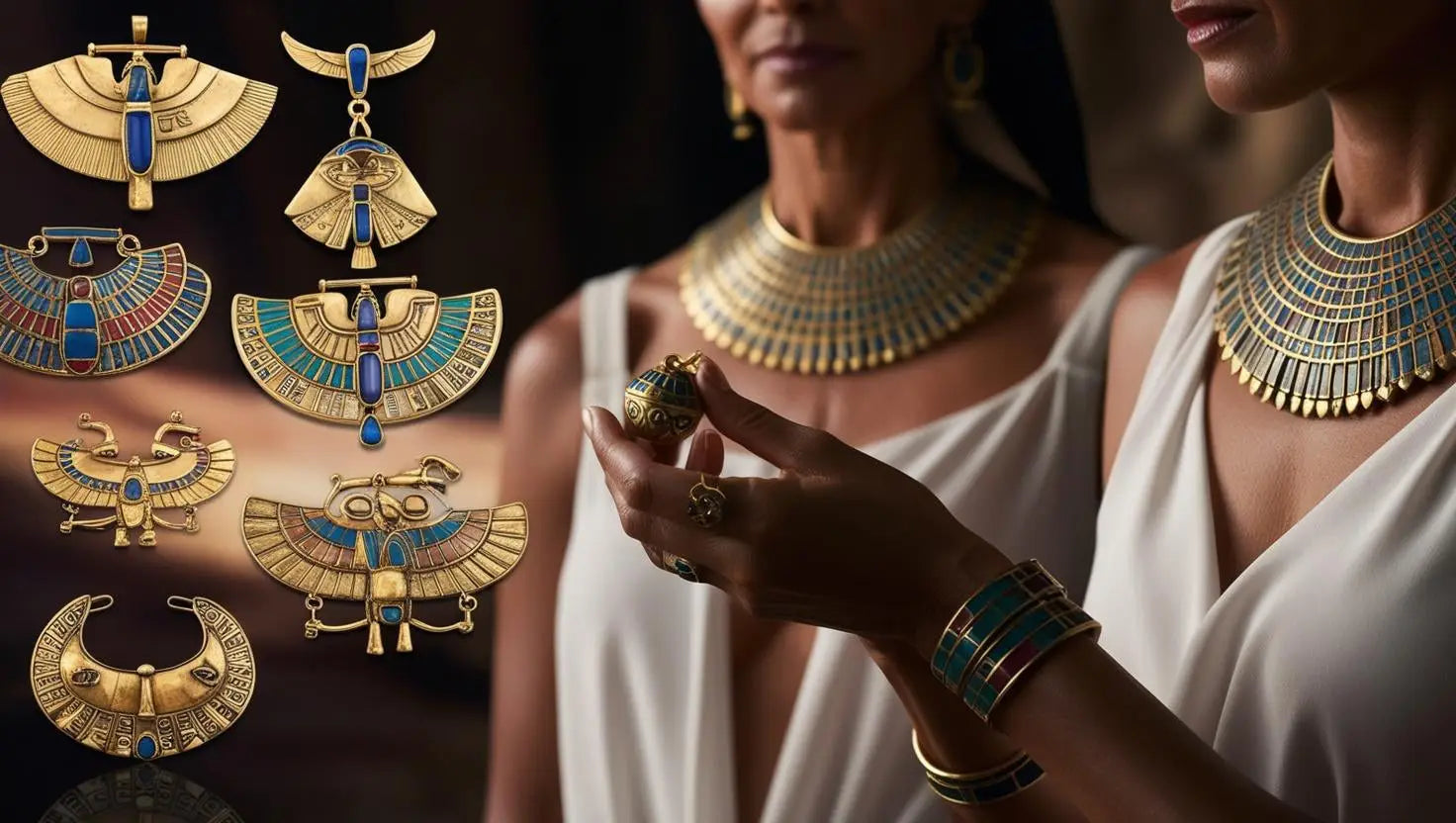
Necklaces are among the most spectacular pieces of jewelry found in the tombs of Egyptian queens. These adornments could feature multiple rows of beads and gold elements decorated with religious symbols. Their role was both aesthetic and spiritual, as they protected the sovereign's chest and heart.
Pectorals held a particularly important place in funerary rites. These large pieces of jewelry were often decorated with mythological scenes or representations of protective deities. They could illustrate the sun god Ra or the scarab symbolizing rebirth.
Artisans crafted these pectorals with remarkable precision. Precious stones were inlaid into gold frames to create complex and colorful motifs. These objects testify to the exceptional level achieved by Egyptian goldsmithing.
Symbols engraved on the pectorals
The symbols present on the pectorals had an essential spiritual function. Each motif represented a divine force intended to protect the queen in the afterlife.
Frequently found were:
-
the Eye of Horus, symbol of divine protection
-
the scarab associated with rebirth
-
the sun disk representing the god Ra
-
the outstretched wings of Isis, protector of the dead
These mythological representations transformed the jewelry into true sacred objects.
The protective role of necklaces
Funerary necklaces served to protect the speech, breath, and vitality of the sovereign in the afterlife. Their position around the neck symbolized the preservation of vital energy and the continuity of life after death. In Egyptian religious thought, the neck represented an essential passage between the body and the soul.
Some necklaces also featured magical inscriptions intended to ward off malevolent forces and invoke the protection of deities. These sacred formulas were inspired by religious texts and were part of the funerary rituals performed by priests during burial.
Bracelets and rings of the Egyptian queens
The bracelets and rings found in the tombs of Egyptian queens bear witness to the prestige and wealth of royal power. These pieces of jewelry were among the most important adornments worn by the sovereigns. They were often decorated with cartouches containing the name of the queen or that of the pharaoh with whom she was associated. These inscriptions served to affirm royal identity and the continuity of the dynasty, even after death.
Rings could also be adorned with protective amulets or symbolic stones. The heart scarab was one of the most common motifs in funerary jewelry. According to Egyptian beliefs, this emblem prevented the heart from testifying against the deceased during the judgment of the dead. This belief was linked to the famous ritual of the weighing of the heart before the god Osiris, a determining moment for accessing eternal life.
As for the bracelets, they were often worn in pairs and crafted with great precision by Egyptian artisans. They could be decorated with serpents, lotus flowers, or divine representations. Their presence in the tombs highlighted the power and dignity of the sovereign, while recalling the importance of adornments in the royal culture of ancient Egypt.
Rings adorned with scarabs
The scarab is one of the most famous symbols of ancient Egypt. It represented transformation, rebirth, and the eternal cycle of the sun in the Egyptian religion. This symbol was inspired by the behavior of the sacred scarab that rolls a ball of earth, an image associated with the movement of the sun in the sky.
Rings adorned with scarabs were often engraved with religious formulas or protective hieroglyphs. Their mission was to protect the deceased's heart during judgment in the afterlife. These pieces of jewelry thus occupied an important place in funerary rituals.
Bracelets and their symbolism
Funerary bracelets symbolized the protection of the arms and the divine strength granted to the queen in the afterlife. They were often made of gold and inlaid with precious stones like turquoise, carnelian, or lapis lazuli. Artisans sometimes engraved religious or mythological motifs to reinforce their symbolic power.
These pieces of jewelry also represented royal authority and recalled the high status of the sovereign in Egyptian society. Placed on the arms of the mummy, they accompanied the queen on her spiritual journey and affirmed her eternal prestige.

Diadems and head ornaments
The diadems found in royal tombs testify to the exceptional status of Egyptian queens and their important role in the symbolism of power. These head ornaments were often made of gold and decorated with carefully inlaid precious stones. They represented not only the wealth of the royal court but also the sacred bond between the sovereign and the protective deities of Egypt. Wearing a diadem was a visible sign of prestige and authority.
Some diadems featured upright cobras called uraeus. This symbol represented the goddess Wadjet, protector of the pharaoh and the kingdom. The upright cobra symbolized vigilance, divine power, and the royal power's ability to repel enemies. In the tombs, these ornaments served as a reminder that the queen remained protected even in the afterlife.
Head ornaments could also be decorated with lotus flowers, feathers, or solar motifs linked to the god Ra. These elements evoked rebirth and the eternal cycle of life. Egyptian artisans used various techniques to create refined pieces that highlighted the beauty and sacred status of the sovereign.
The symbol of the royal cobra
The royal cobra was a powerful symbol in Egyptian culture and often appeared on the crowns and diadems of rulers. It represented divine protection and the strength of royal power granted by the goddess Wadjet, guardian of the kingdom. In Egyptian iconography, the rearing cobra symbolized vigilance and the ability to repel enemies.
Diadems adorned with cobras were believed to ward off hostile forces and protect the sovereign even in the afterlife, thus reinforcing her authority and sacred status.
Earrings and royal fashion
Earrings appear in certain New Kingdom tombs and testify to the evolution of styles and traditions in ancient Egypt. Their presence shows that ear ornaments were among the accessories cherished by queens and noblewomen.
These jewels were often decorated with precious stones, floral motifs, or delicate pendants. They enhanced the sovereign's face and also symbolized her prestige and refinement.

FAQ about jewelry found in Egyptian queens' tombs

Why were Egyptian queens buried with jewelry?
Funerary jewelry protected the queen in the afterlife. The Egyptians believed that these ornaments warded off evil forces and guided the soul to the realm of Osiris. They also served as reminders of the sovereign's sacred status.
What materials were used for funerary jewelry?
The main materials were gold, lapis lazuli, turquoise, and carnelian. Gold symbolized immortality, while the stones were associated with protection and rebirth.
What is the meaning of the scarab in Egyptian jewelry?
The scarab symbolizes rebirth and the cycle of the sun. In funerary jewelry, it protected the heart of the deceased during the judgment of the dead.
Where can one see these jewels today?
Egyptian funerary jewelry is displayed in many museums dedicated to ancient Egypt. It comes primarily from archaeological excavations carried out in royal tombs.
Have all the queens' tombs been discovered?
Not all royal tombs are known. Many were looted in antiquity, but archaeologists continue to make new discoveries.
Which symbols appear often on funerary jewelry?
The most frequent symbols are the Ankh cross, the Eye of Horus, and the scarab. They represent eternal life, divine protection, and rebirth.
Which Egyptian queen possesses the most famous jewelry?
Certain queens such as Ahhotep or Nefertari possessed remarkable jewelry found in their tombs. These treasures showcase the prestige of Egyptian royalty.
Was funerary jewelry worn before death?
Some jewelry was used in everyday life. However, much was specially made for burial and funeral rituals.
How do archaeologists discover this jewelry?
Archaeologists discover them during excavations in ancient tombs. Each object is studied to understand Egyptian funerary practices.
Why is Egyptian jewelry well preserved?
The jewelry is well preserved thanks to the dry desert climate and the use of gold, a metal that does not deteriorate over time.
Conclusion on jewelry found in Egyptian queens' tombs
The jewelry found in the tombs of Egyptian queens constitutes one of the most fascinating testimonies of the ancient Egyptian civilization. These ornaments represented not only wealth or royal prestige but also a deep spiritual dimension. The necklaces, bracelets, diadems, and amulets were designed to protect the sovereign on her journey to the afterlife and guarantee her rebirth.
Archaeological discoveries have made it possible to better understand the role of these objects in funerary rituals. They also reveal the exceptional level achieved by Egyptian artisans in goldsmithing and the carving of precious stones.
Even today, this jewelry continues to fascinate historians and the general public. It bears witness to a civilization where religion, art, and royal power formed an inseparable whole. Thanks to these treasures, it is possible to glimpse the cultural and spiritual richness of ancient Egypt.