

Lithotherapy in ancient Egypt blended spirituality, symbolism, and medical applications.
The Egyptians attributed properties to stones that influenced the body and mind, used through amulets, jewelry, and rituals, both in daily life and in the afterlife.
What was lithotherapy in ancient Egypt?
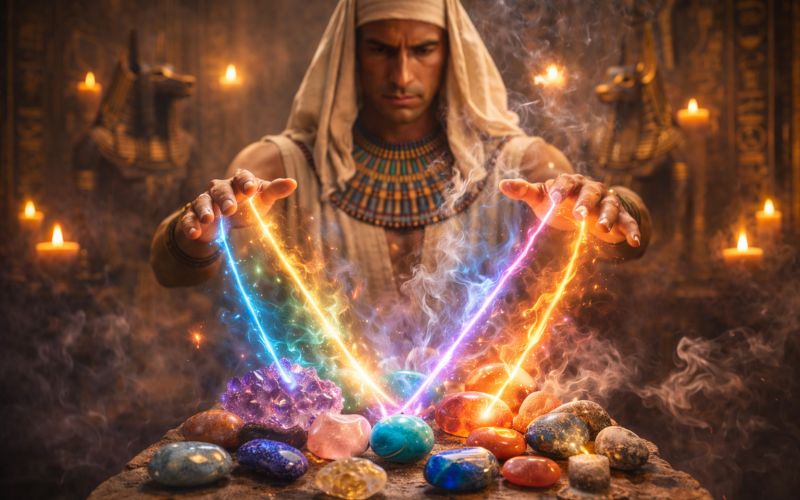
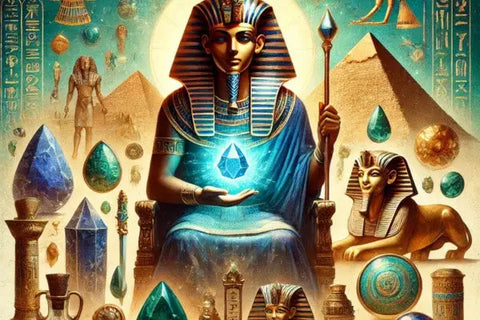
In ancient Egypt, lithotherapy referred to the use of stones for their protective, curative, and spiritual virtues. The Egyptians considered minerals to be carriers of a vital force capable of influencing the body and mind.
This practice was not limited to a simple symbolic belief: it was integrated into medical, religious, and funerary rituals. Priests and physicians, who held sacred and therapeutic knowledge, assigned each stone a specific function according to its color, nature, and divine correspondence.
Gems could be worn in the form of amulets, incorporated into sacred ceremonies, or used in medicinal preparations. Egyptian lithotherapy was based on a holistic view of health, where physical, energetic, and spiritual balance were inseparable.
Stones thus played a protective role in daily life, strengthened the bond with the deities, and accompanied the deceased into the afterlife. Far beyond mere ornamentation, they occupied a central place in Egyptian society, illustrating the close union between medicine, religion, and symbolism.
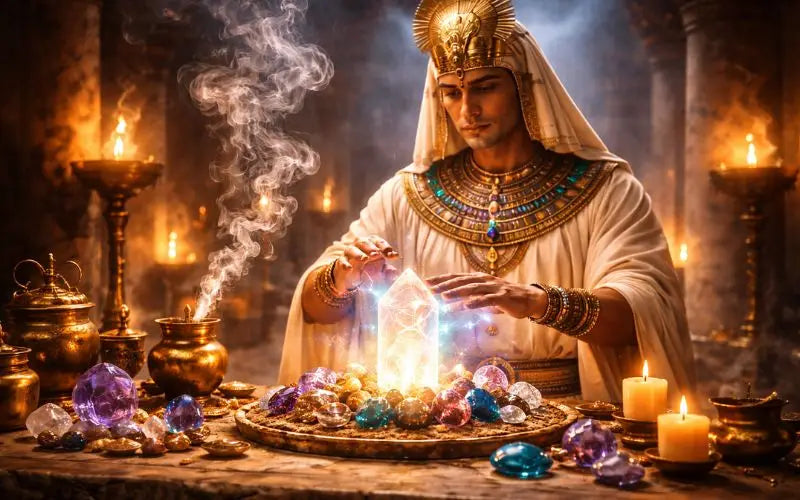
The role of sacred stones in Egyptian spirituality
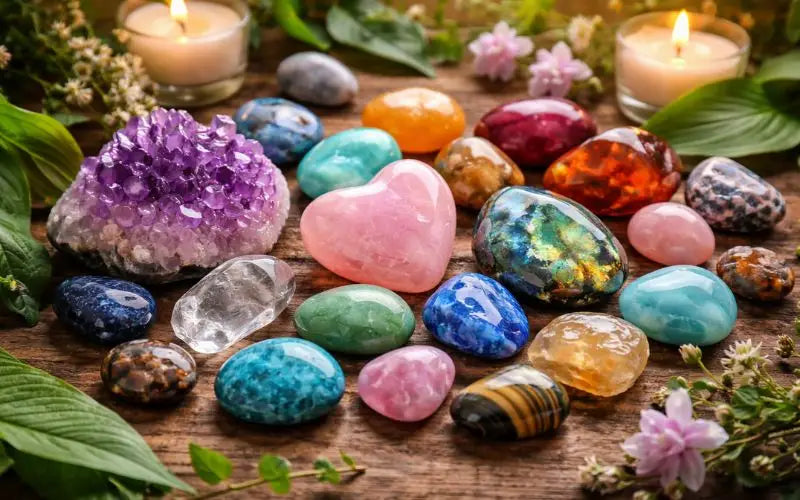
The most iconic stones and their meanings
In the culture of ancient Egypt, certain stones occupied a central place due to their color, rarity, and strong symbolic significance. They were not chosen by chance: each possessed a precise meaning and fulfilled a determined role in religious rituals, royal jewelry, and funerary practices.
Lapis lazuli, with a deep blue evoking the sky and the divine, symbolized truth, wisdom, and divine protection; it adorned amulets, royal finery, and prestigious funerary objects, such as the famous mask of Tutankhamun.
Turquoise, mined notably in Sinai, was associated with joy, prosperity, and protection against negative influences, which made it a prized stone in sacred ornaments. Carnelian, red in color, embodied vitality, courage, and the energy of blood; it accompanied both the living and the deceased to favor luck and spiritual rebirth.
As for malachite, recognizable by its intense green hue, it symbolized protection and regeneration, while being used in powder form for its medicinal and cosmetic applications.
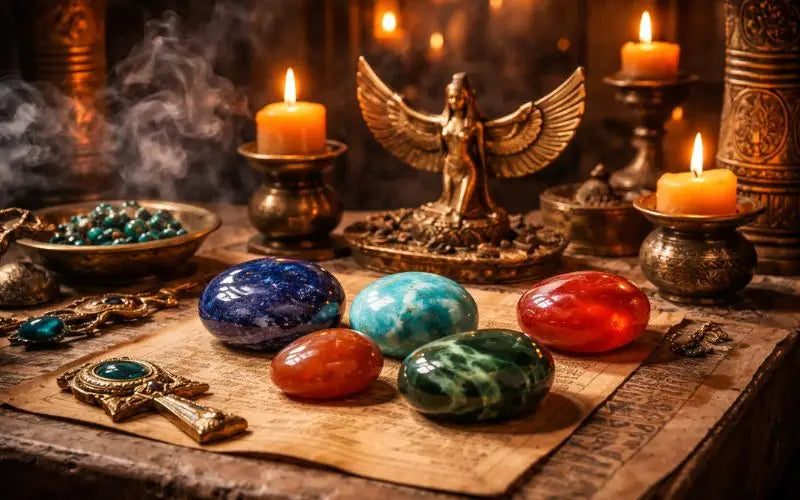
Symbolism of colors and shapes
In ancient Egypt, the colors of the stones possessed a deeply symbolic meaning and determined their use in religious rituals as well as in daily life.
Each hue was perceived as carrying a particular energy, reflecting spiritual, protective, or vital dimensions. The choice of a stone therefore did not depend solely on its beauty, but on the symbolic force associated with its color and its supposed power to influence destiny, health, or divine protection.
Blue, notably that of lapis lazuli and turquoise, represented the sky, water, and the divine world. This color evoked celestial protection, wisdom, and truth. Blue amulets and jewelry were worn to strengthen the connection with the gods and attract their benevolence.
Green, embodied by malachite, symbolized fertility, rebirth, and the eternal cycle of life. Associated with Osiris, it represented renewal after death. Wearing green stones was believed to support health and promote spiritual balance.
Red, illustrated by carnelian, evoked blood, vital energy, and power. It was used to stimulate courage, strengthen vitality, and protect against harmful forces, both in rituals and in daily life.
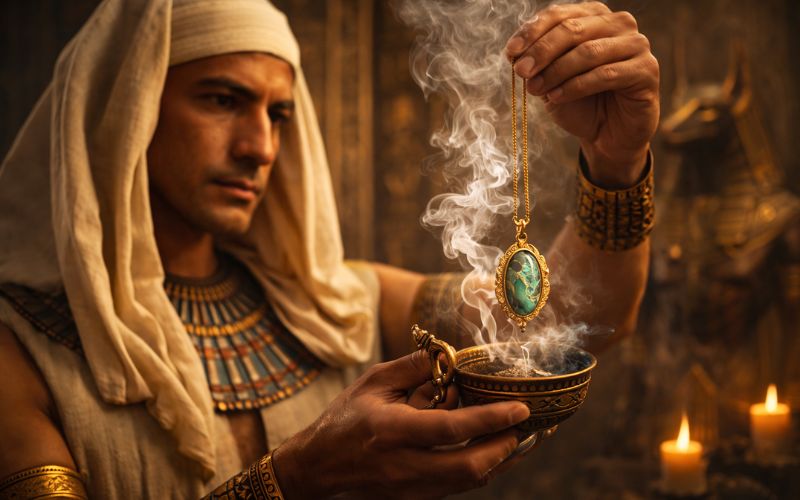
Lithotherapy and ancient medical practice
Funeral rituals and the journey to the afterlife
In ancient Egypt, funeral rites assigned a central place to precious stones, which were considered essential for ensuring the protection and security of the soul on its passage to the afterlife.
The Egyptians believed that death was merely a transition to a new form of existence, and gemstones played a decisive role in this transformation. Among the most iconic objects were scarabs carved from lapis lazuli, jasper, or carnelian, placed in sarcophagi to symbolize rebirth and protect the deceased against the forces of chaos.
These scarabs also represented the solar cycle and the perpetual regeneration of life. Stones were often fashioned into amulets engraved with sacred symbols intended to guide and protect the soul during its spiritual journey. Funeral jewelry, meticulously placed on the body, strengthened the connection with the deities and affirmed the status of the deceased.
Thus, gemstones were not mere ornaments, but true sacred talismans guaranteeing protection, prestige, and continuity in eternity.
Extraction techniques and the art of stone working
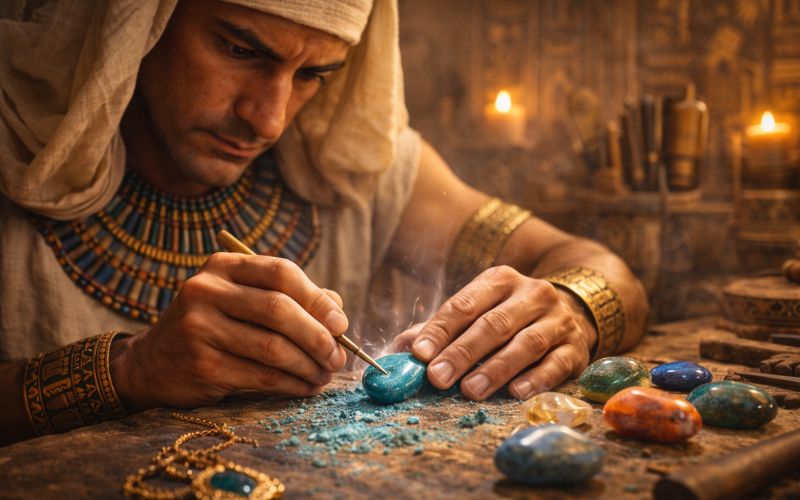
In ancient Egypt, the use of sacred stones relied not only on their spiritual symbolism but also on remarkable technical mastery in their extraction and transformation. Minerals came from local quarries or more distant regions, such as turquoise mined in the Sinai, the origin of which influenced both the material value and the symbolic significance.
Certain quarries were even considered places invested with a sacred character due to the exceptional quality or specific hue of the stones they provided. Egyptian artisans possessed advanced expertise in cutting, engraving, and polishing, using tools adapted to fashion amulets, jewelry, and ritual objects of great refinement.
Every detail was worked with precision, as the durability and beauty of the object reflected the spiritual importance of the stone itself. Inlaying them into statues, pectorals, or funeral ornaments allowed for the combination of colors and shapes to strengthen the protective and symbolic power of the whole, thereby creating harmonious compositions intended to amplify vitality and protection.
Legacy of Egyptian lithotherapy in modern culture
Stones and the great deities of ancient Egypt
In ancient Egypt, precious stones played a fundamental role in the expression of worship and in the representation of the great deities. Each god or goddess was associated with specific gems whose color, brilliance, and symbolism reinforced their spiritual and cosmic attributes.
These correspondences reflected a worldview where mineral matter embodied a sacred force, capable of manifesting protection, vitality, and divine power. Osiris, god of resurrection and sovereign of the afterlife, was closely linked to green stones such as malachite, a symbol of rebirth, fertility, and eternal life, widely used in funeral rituals to accompany the deceased.
Isis was associated with lapis lazuli and turquoise, protective stones embodying healing, wisdom, and maternal protection, frequently worn in the form of sacred amulets. Horus, god of the sky and kingship, was symbolized by blue stones evoking divine vision, vigilance, and the protection of the pharaohs.
Finally, Ra, the solar god, was associated with red and golden stones like carnelian, a symbol of vital energy, solar power, and prosperity, used in rituals related to the sun's cosmic cycle.
The use of stones according to social class in ancient Egypt
In ancient Egypt, access to stones and their use varied according to social rank, while remaining deeply anchored in the shared spiritual culture.
From the pharaoh to the people, every category of society employed stones adapted to its protective, religious, or symbolic needs. Pharaohs, considered beings of divine essence, wore rare and precious gems that affirmed their spiritual power and sacred legitimacy.
Inlaid in crowns, pectorals, and funeral objects, these stones symbolized eternity and guaranteed their protection in the afterlife. The nobility, meanwhile, primarily used semi-precious stones mounted in jewelry, intended to reinforce spiritual balance while displaying social status; the colors and motifs chosen often reflected their bond with certain deities.
The common people had access to simpler amulets, carved from common stones but invested with strong symbolic value, ensuring protection and luck in everyday life. Furthermore, the stones used in daily life differed from those reserved for sacred rituals, with each context carefully determining the choice of mineral and its spiritual function.
FAQ on The mysteries of lithotherapy in ancient Egypt
Lithotherapy in ancient Egypt still arouses keen interest today, both for its spiritual dimension and its historical and cultural anchoring. Through archaeological discoveries, ancient texts, and objects found in tombs and temples, it appears clear that stones occupied a central place in Egyptian society.
They were involved in religious rituals, accompanied medical practices, and participated in the daily protection of individuals, from commoners to pharaohs.
However, many questions remain: what were actually the most used stones? How were they integrated into funeral rites? What was their medical function? And above all, what part of symbolism and belief surrounded their use?
This frequently asked questions section aims to shed light on the essential aspects of ancient lithotherapy by providing clear and concise answers to the most common queries.
It allows for a better understanding of the role of gems in the Egyptian worldview, where medicine, religion, and symbolism formed a coherent whole. Through these questions, you will discover the foundations of this ancient practice and its lasting influence up to our era.
What is lithotherapy in ancient Egypt?
Lithotherapy in ancient Egypt refers to the use of stones for their healing, protective, and spiritual virtues in rituals, medicine, and daily life.
Which materials were the most used?
The most used stones included lapis lazuli, turquoise, carnelian, and malachite, each associated with a specific symbolism.
How did Egyptians integrate stones into funeral rites?
Stones were placed in tombs in the form of amulets and jewelry to protect the deceased and ensure their rebirth in the afterlife.
Did the stones have a real medical function?
Practitioners combined symbolism with medicinal uses; certain crushed stones were used in ointments or treatments.
Why was lapis lazuli so prized?
Lapis lazuli represented divine protection and wisdom, often associated with royalty and the gods.
What is the significance of stones in ancient Egypt?
Stones symbolized protection, life, and the connection to the gods. Each mineral and each color represented a precise spiritual energy.
Did the Egyptians believe in the powers of stones?
Yes, they believed that stones possessed protective and spiritual forces influencing a person's health and balance.
Which stones were used for protection in ancient Egypt?
Lapis lazuli, carnelian, turquoise, and malachite were used to repel negative energies.
Was lithotherapy reserved for the pharaohs?
No, it concerned the entire population. Pharaohs used rare stones, but the common people also wore stone amulets.
What is the link between Egyptian lithotherapy and modern lithotherapy?
Modern lithotherapy adopts many meanings and uses derived from the beliefs of ancient Egypt.