
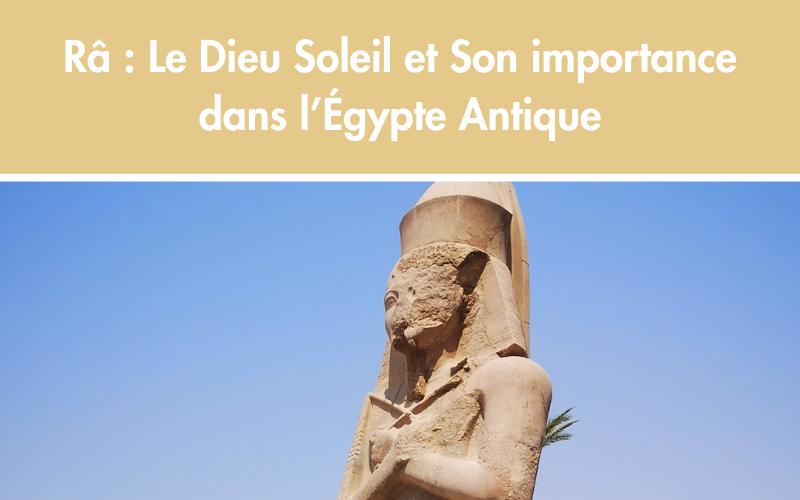
The mythological origins of Ra
In the cosmogonic narratives of Ancient Egypt, Ra is one of the first gods to appear at the moment of the creation of the world. According to the tradition of Heliopolis, he emerges from the primordial waters called Nun, a chaotic ocean that existed before any form of life. This birth symbolizes the appearance of light and order in the universe. For the Egyptians, the sun was the visible manifestation of Ra’s divine presence, and every sunrise represented a new creation of the world.
In these myths, Ra quickly becomes the creator of many other deities who participate in the organization of the cosmos. He notably engenders Shu, god of the air, and Tefnut, goddess of moisture, who help separate the sky from the earth. This cosmic structure allows for the emergence of life and the balance of the universe.
Ra’s birth illustrates the Egyptian vision of a world constantly renewed. Each day, sunlight serves as a reminder that creation continues and that cosmic order is maintained through the sun god’s divine power.

The creation of the world according to the Heliopolis tradition
According to the cosmogony of Heliopolis, Ra manifests himself on a primordial mound rising from the Nun. This mound symbolizes the first stable land in a universe still dominated by chaos. From this sacred place, the sun god gradually creates the fundamental elements of the cosmos.
Ra’s light thus becomes the source of all life and all organization. In this religious vision, the universe only exists because the solar god maintains the balance between the opposing forces of chaos and order.
The first deities created by Ra
After his appearance, Ra engenders the first deities who participate in the organization of the world. These gods form the foundations of the Egyptian pantheon and symbolize different aspects of nature.
Among these deities:
-
Shu, god of air and breath
-
Tefnut, goddess of moisture and water
-
Geb, god of the earth
-
Nut, goddess of the sky
These gods allow the cosmos created by Ra to function harmoniously.
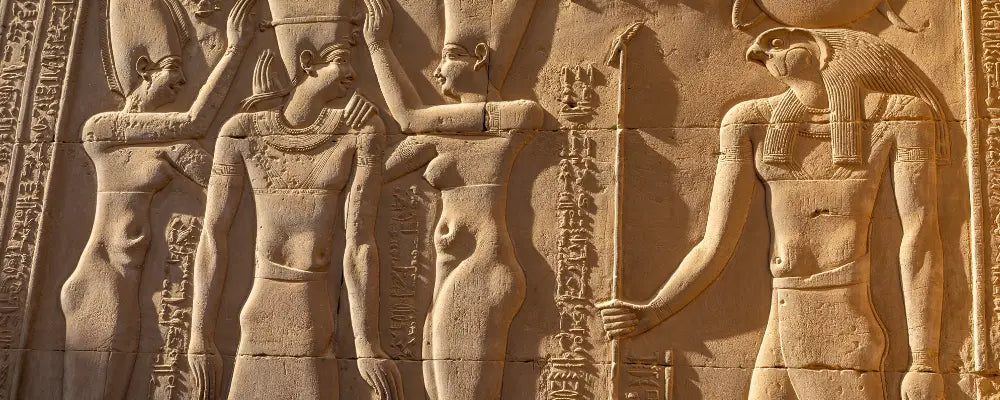
Representations of Ra in Egyptian art
In the iconography of Ancient Egypt, Ra is represented in various symbolic forms that illustrate his solar and divine power. The most well-known representation shows a man with the head of a falcon wearing a sun disk surrounded by a sacred cobra. This image associates the falcon’s celestial vision with the light of the sun and royal authority.
The sun disk represents the vital energy that allows the world to live. The cobra, called the uraeus, symbolizes divine protection and absolute power. This iconographic combination makes it possible to immediately recognize the presence of Ra in the temples, tombs, and monuments of Ancient Egypt.
These representations also had a religious and political function. They reminded the faithful of the sun god’s permanent presence and affirmed the link between divinity and royal power. In some depictions, Ra also appears in his solar barque, surrounded by protective deities who accompany him on his celestial journey.
Ra’s iconography thus testifies to the importance of the sun in Egyptian culture and its essential role in cosmic balance.
Sacred symbols associated with Ra
Several symbols are associated with Ra in the art and religion of Ancient Egypt. They represent the different dimensions of his solar power and creative force. These symbols appear frequently in temples, frescoes, and sacred objects used during religious rituals. They allowed the Egyptians to recognize the presence of the sun god and served to recall his essential role in cosmic balance and the protection of the kingdom.
Among the most important symbols:
-
the sun disk representing divine light
-
the uraeus cobra as a symbol of protection
-
the falcon associated with celestial vision
-
the solar barque representing the cosmic journey
These symbols appear frequently in temples and religious texts.
The scarab and solar rebirth
The sacred scarab, called Khepri, represents a particular form of Ra associated with the rising sun and the renewal of the world. Ancient Egyptians observed this insect pushing a ball of earth containing its eggs and saw in this movement a symbolic image of the sun moving through the sky. This natural observation inspired a strong religious symbolism linked to daily rebirth.
Thus, the scarab embodies the daily rebirth of the sun and the eternal cycle of life. Each morning, it symbolizes the transformation of Ra and the renewal of the world, reminding us that light always triumphs over darkness.

The role of Ra in Egyptian religion
In the religion of Ancient Egypt, Ra occupies a central place within the pantheon. He is considered the creator god and the guarantor of cosmic order. His light allows for the growth of plants, the fertility of the Nile, and the survival of human beings. For this reason, his cult was deeply rooted in Egyptian society.
Over the centuries, Ra was associated with other important deities. The most famous fusion is with the god Amun, giving birth to Amun-Ra, who was considered the king of the gods. This fusion reflects the evolution of Egyptian religion and the desire to unite several religious traditions.
Temples dedicated to Ra were major centers of religious life. Priests performed daily rituals there intended to honor the sun god and maintain the balance of the world. Offerings, prayers, and sacred chants were an integral part of these ceremonies.
Ra’s presence in Egyptian religion shows how much the sun was perceived as the source of all life and all cosmic stability.
The fusion of Amun and Ra
Over time, the god Ra was associated with Amun, a major deity from Thebes who was highly influential in Egyptian religion. This fusion gave birth to Amun-Ra, considered one of the supreme deities during the New Kingdom.
This association made it possible to unite the solar power of Ra with the invisible and universal dimension of Amun. Amun-Ra thus became the king of the gods and a central figure of the Egyptian pantheon, strengthening both the religious and political authority linked to the sun god.
Temples dedicated to the sun god

Ra’s daily journey
Ra’s daily journey is one of the most important narratives in Ancient Egyptian mythology. Egyptians imagined that the sun god traveled across the sky each day aboard a solar barque, bringing the light and heat necessary for life on Earth. This movement of the sun was not just a natural phenomenon: it represented a divine action guaranteeing the stability of the universe and the continuity of cosmic order.
At daybreak, Ra appears on the horizon in the form of Khepri, a symbol of rebirth and creation. At noon, he becomes Ra, the embodiment of solar power at its zenith, illuminating the entire world. When the sun sets, he takes the form of Atum, representing the end of the daily cycle and the transition into night.
The solar barque is the central element of this journey. In religious representations, it transports the god from one horizon to the other and symbolizes the perpetual movement of the sun across the sky. Often surrounded by protective deities, it also embodies divine protection and the cosmic order maintained by Ra. For the ancient Egyptians, this solar cycle represented the constant renewal of the world and served as a reminder that each day was a new birth.
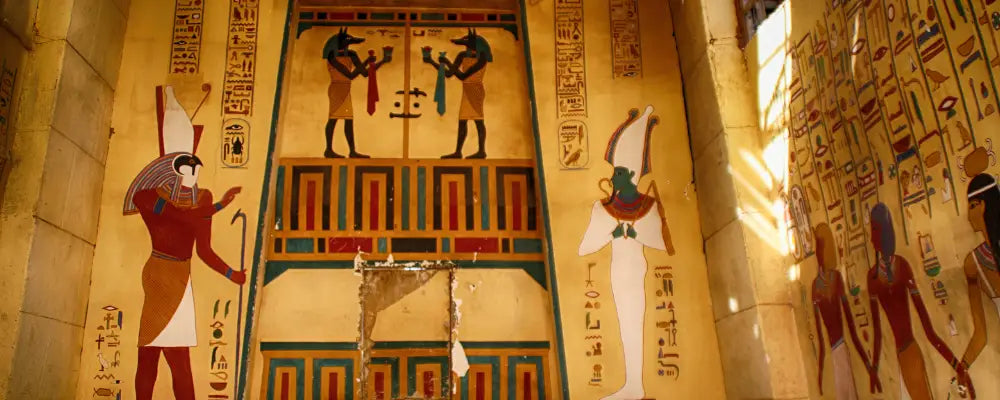
The battle against Apep
In the mythology of ancient Egypt, the god Ra is not limited to illuminating the world during the day. When the sun disappears on the horizon, he begins a perilous journey through the Duat, the underworld associated with the night and the invisible world. This nocturnal passage represents an essential phase of the cosmic cycle, as it is during this crossing that the sun god must face the forces of chaos embodied by the serpent Apophis.
Apophis is considered the primary enemy of universal order. This gigantic creature attempts every night to block the progress of the solar barque in order to prevent the rebirth of the sun. For the ancient Egyptians, this combat symbolized the permanent opposition between destructive chaos and the divine harmony that keeps the world in balance. Ra’s victory thus guaranteed the continuity of the cycle of day and night.
In funerary texts and religious narratives, several deities and protective spirits accompany Ra during this nocturnal journey. Their role consists of repelling the attacks of Apophis and defending the solar barque. This mythological account illustrates the Egyptian belief that the universe is constantly threatened by disorder, but protected by the power and vigilance of the sun god.
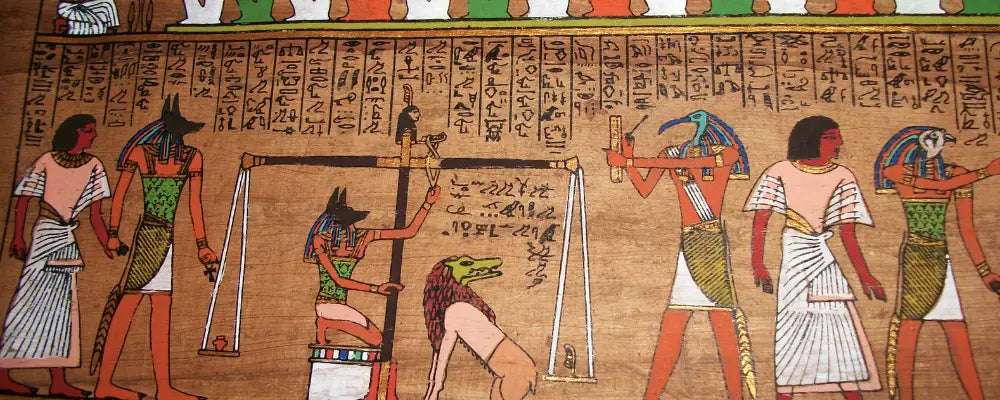
The serpent Apophis
Apophis is a gigantic creature from Egyptian mythology representing the forces of chaos, darkness, and destruction. This mythical serpent lives in the Duat, the underworld crossed by Ra during the night.
Every night, Apophis attempts to attack the solar barque in order to prevent the sun god from continuing his journey. The ancient Egyptians saw in this confrontation a symbol of the permanent danger that threatens the balance of the world. His defeat ultimately symbolizes the victory of cosmic order over destructive forces.
The role of the protective gods

Ra and the power of the pharaohs
In the civilization of ancient Egypt, Ra was not just a solar deity associated with light and the creation of the world. He also occupied an essential place in the political and symbolic organization of the kingdom. The Egyptian sovereigns asserted that their authority came directly from the sun god, which gave royal power a sacred dimension. The pharaoh was therefore not only a political leader, but also an intermediary between the gods and men.
In inscriptions engraved on temples, statues, and official monuments, pharaohs often presented themselves as the heirs or sons of Ra. This divine filiation served to strengthen their prestige and to legitimize their rule over the entire Egyptian territory. It also emphasized their responsibility to maintain Maat, that is to say, order, harmony, and justice in the world.
The great religious constructions and solar monuments testify to this close relationship between religion and royal power. By honoring Ra through temples, obelisks, and public ceremonies, the pharaohs showed their devotion to the solar deity. Thus, the cult of Ra directly contributed to the political stability and organization of ancient Egyptian society.
The pharaoh, son of the sun god
In the tradition of ancient Egypt, the pharaohs presented themselves as the direct descendants of Ra, the mighty sun god. This belief reinforced their authority among the people and granted them sacred legitimacy. By proclaiming themselves sons of Ra, the sovereign asserted that he acted according to divine will and that he had the responsibility of maintaining cosmic order and harmony in the kingdom. This divine filiation thus allowed for the close linking of political power with religion and the beliefs of the Egyptians.
Monuments dedicated to the solar god

FAQ about Ra: The Sun God and His Importance in Ancient Egypt
Who is Ra in Egyptian mythology?
Ra is the sun god and one of the most important deities of ancient Egypt. He is considered the creator of the world and the source of all life.
Why is Ra important?
The god Ra symbolizes light, life, and cosmic order. His solar journey represents the eternal cycle of birth and rebirth.
Where was Ra worshipped?
The main center of Ra's cult was Heliopolis, a major religious city of ancient Egypt.
Who is Apophis?
Apophis is a serpent representing chaos that attempts to prevent Ra from being reborn each day.
What is the relationship between Ra and the pharaohs?
Pharaohs were considered the sons of Ra, which reinforced their divine legitimacy.
Conclusion on Ra: The Sun God and His Importance in Ancient Egypt
In the mythology of ancient Egypt, Ra occupies a fundamental place as the sun god and creator of the world. His presence symbolizes light, life, and cosmic order that allow the universe to function harmoniously. Through his daily journey across the sky and his nocturnal combat against the forces of chaos, he embodies the eternal cycle of birth, death, and rebirth.
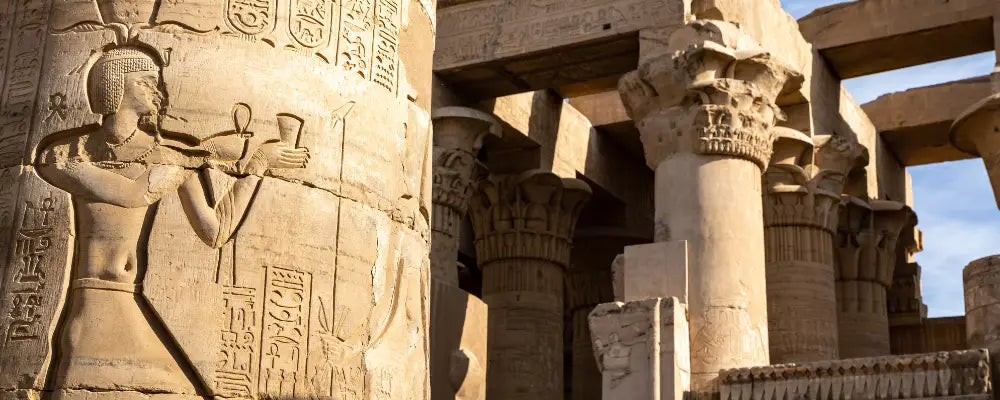
The cult of Ra profoundly marked Egyptian religion. The temples, rituals, and artistic representations bear witness to the importance accorded to this solar deity. His influence goes beyond the religious sphere, as it also touches political power. The pharaohs presented themselves as his descendants, thus asserting their divine authority and their mission to maintain the balance of the world.
Even today, the figure of Ra fascinates historians and Egyptology enthusiasts. It symbolizes the spiritual and cultural richness of ancient Egypt. Understanding the importance of the sun god allows one to grasp the worldview of this civilization and the importance it placed on the cycle of nature and universal order.