

Tutankhamun, nicknamed the pharaoh of treasures, is one of the most famous figures of ancient Egypt. His tomb, discovered in 1922 by Howard Carter, contained gold objects and symbols revealing the splendor and funerary practices of the era.
This article explores the life of Tutankhamun, his reign, and his treasures to provide a complete overview for history enthusiasts.
The reign of Tutankhamun: a child pharaoh
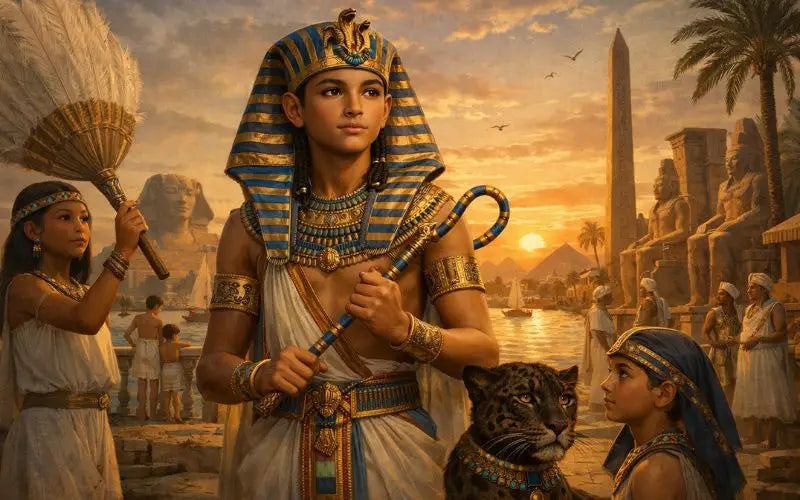
Tutankhamun ascended the throne around the age of nine, succeeding Akhenaten. His reign was marked by a return to ancient religious traditions after the monotheism imposed by his father. Despite his young age, he played an important symbolic role in restoring the political and religious stability of Egypt.
-
Return to the cult of Amun after the Amarna period.
-
Reconstruction of damaged temples and shrines.
-
Reintroduction of traditional religious rituals and festivals.
Tutankhamun had to face internal tensions and the fragility of his power due to his young age. Foreign policy remained limited, and diplomacy focused on securing alliances with neighboring kingdoms. These short years were nevertheless marked by significant reforms that restored the authority of the throne.
The discovery of the tomb: an intact treasure
The discovery of Tutankhamun's tomb in 1922 is one of the most famous archaeological events of the 20th century. British archaeologist Howard Carter, financed by Lord Carnarvon, unearthed a virtually intact burial in the Valley of the Kings, which was extremely rare for an Egyptian royal tomb.
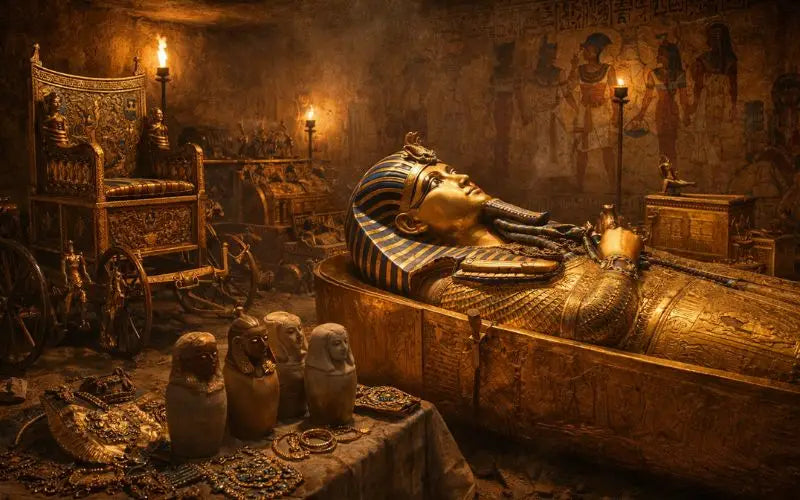
Inside, researchers discovered more than 5,000 objects carefully arranged around the pharaoh's sarcophagus. This spectacular discovery profoundly transformed our understanding of ancient Egypt, revealing the luxury, artistic wealth, and complexity of royal funerary rites.
The tomb of Tutankhamun revealed an exceptional treasure, illustrating both the craftsmanship of Egyptian artisans and the symbolic importance of the objects placed with the pharaoh to accompany him into the afterlife. Among the most remarkable pieces are several iconic objects that testify to royal power and the spirituality associated with kingship.
-
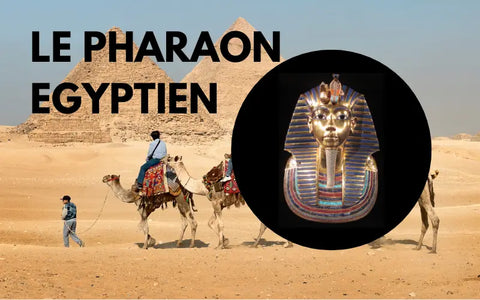
The solid gold funerary mask.
-
Ceremonial chariots and weapons.
-
Jewelry and protective amulets.
The tomb also provided a true gold mine of information for archaeologists and historians. Researchers studied the artisanal techniques, materials used, and religious practices of the era. Each object was carefully analyzed in order to better understand the beliefs, the social status of the pharaoh, and the funerary rituals practiced in ancient Egypt.
Funerary treasures and their symbolism
Tutankhamun's treasures are not only precious for their material value, but also for their religious and political symbolism. The objects were designed to protect the pharaoh in the afterlife and ensure his resurrection. Artisans used rare materials such as gold, lapis lazuli, and precious wood.
-
Protection against forces of evil.
-
Assistance in the passage to the afterlife.
-
Illustration of the divine power of the pharaoh.
Beds, chairs, and chests decorated the tomb and reflected earthly comfort for eternity. Every detail, from the inscriptions to the decorative patterns, carried a religious and symbolic message.
Daily life in the time of Tutankhamun
Studying daily life allows for a better understanding of the context in which the young pharaoh reigned. The majority of Egyptians lived along the Nile, whose annual floods made the land fertile and encouraged agriculture. Inhabitants mainly cultivated wheat and barley, used to make bread and beer, two essential elements of their diet.
Clothing was generally made of linen, a light material adapted to the hot climate. Society also followed a very strict social hierarchy, where each group occupied a precise function. Artisans and scribes played an important role in the manufacture of objects intended for temples, palaces, and royal tombs.
Egyptian society was highly hierarchical. The pharaoh occupied the top of this structure and was considered a divine sovereign responsible for maintaining order and balance in the kingdom. Nobles and viziers administered the country, while artisans, farmers, and laborers ensured the production and maintenance of the kingdom's resources.
Art was omnipresent in Egyptian society. Frescoes, sculptures, jewelry, and amulets often represented religious and mythological themes, reflecting the importance of spiritual beliefs in daily life.
The mysteries surrounding his death
The death of Tutankhamun, which occurred around the age of 18, remains one of the most fascinating mysteries of ancient Egypt. Although his reign was relatively short, the circumstances of his passing have sparked many hypotheses among historians, archaeologists, and scientists.
For a long time, certain theories mentioned a chariot accident that could have caused serious injuries, particularly fractures that might lead to a fatal infection. Other researchers have suggested that the pharaoh's fragile health could be linked to genetic diseases, a possible consequence of the frequent consanguineous marriages within the Egyptian royal family.
With modern scientific advances, several studies have attempted to provide more precise answers. DNA analysis has allowed the study of Tutankhamun's family ties and the identification of certain genetic anomalies that could explain his health problems. Furthermore, medical examinations such as CT scans have revealed clues about the young pharaoh's physical state, including traces of fractures and possible infections.
Despite this in-depth research, specialists still do not have a definitive conclusion. Some theories still mention the possibility of a political plot or poisoning linked to the power struggles of the time. Thus, the death of Tutankhamun remains surrounded by uncertainty, still fueling the interest of researchers and the general public today.

The impact of the tomb on Egyptology
Historical lessons from the reign of Tutankhamun
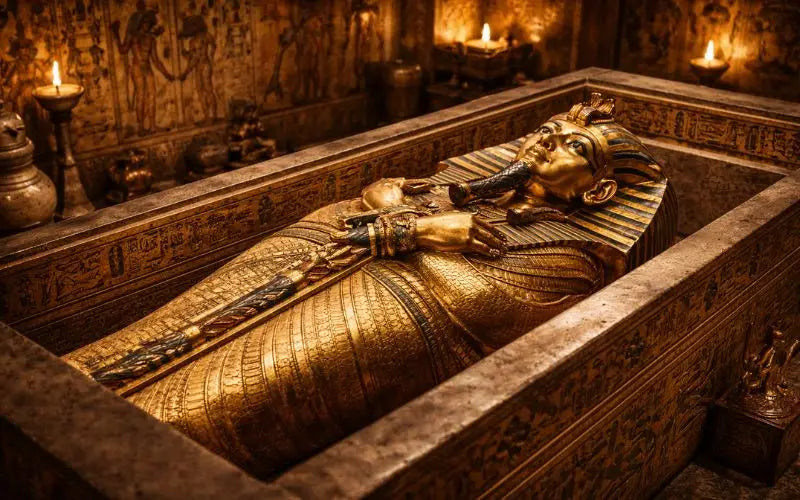
Despite his youth, Tutankhamun symbolizes resilience and the restoration of a civilization. His reign shows the importance of religion, craftsmanship, and diplomacy in ancient Egypt. His tomb also serves as a reminder of the importance of heritage preservation.
-
Return to religious tradition.
-
Consolidation of royal power after the Amarna period.
-
Influence on subsequent pharaohs, notably Horemheb.
-
Conservation of artistic and craftsmanship techniques.
-
Inspiration for future generations of Egyptologists.
-
Transmission of religious and royal symbols.
Artistic and craftsmanship techniques in the tomb of Tutankhamun
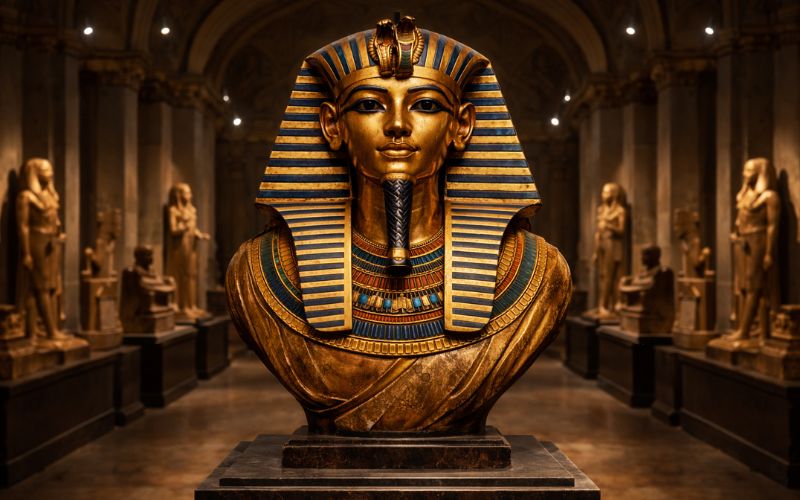
The tomb of Tutankhamun is a true testament to the ingenuity of Egyptian artisans. Every object, from the funerary mask to the jewelry, illustrates sophisticated manufacturing techniques and exceptional craftsmanship. Understanding these methods allows for a better appreciation of the labor and symbolism behind each treasure.
The solid gold mask was created using the repoussé technique, where the metal is worked by hammering to create reliefs. The inlays of precious stones like lapis lazuli or carnelian add colorful and symbolic details, reflecting the pharaoh's power and divinity.
The beds, chests, and chairs were designed with rare woods and covered in gold leaf. Artisans used inlay and marquetry techniques to decorate surfaces with religious and royal motifs, combining aesthetics with funerary function.
The jewelry and amulets, made of gold, semi-precious stones, and colored glass, combine precision and symbolism. Each piece was designed to protect the pharaoh in the afterlife and represent deities or symbols of power, demonstrating a perfect balance between beauty and religious function.
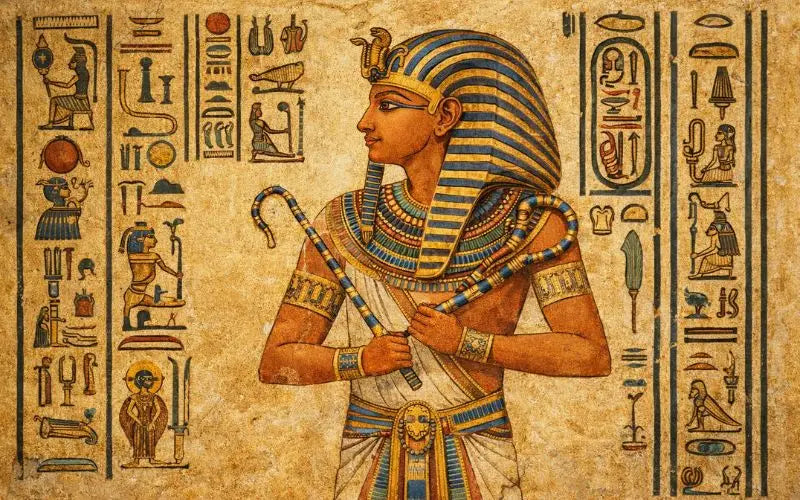
The walls of the tomb are adorned with frescoes and hieroglyphs created with natural pigments. These works recount scenes from mythology and funerary rituals, utilizing sophisticated painting and engraving techniques that have endured for millennia without losing their luster.
Recent discoveries and modern analyses of Tutankhamun
Modern scientific advances have allowed for a more precise revisiting of the reign and life of Tutankhamun. Techniques such as medical imaging, DNA analysis, and carbon dating offer new perspectives on his health, his death, and the objects in his tomb. This research enriches our understanding of ancient Egypt and the symbolic role of the treasures found.
Genetic studies have established complex family ties, confirming the frequent consanguineous marriages within Egyptian royalty. DNA has also helped detect certain hereditary diseases that could explain his fragile health and premature death.
CT scans and X-rays of Tutankhamun's remains have revealed ancient fractures, infections, and bodily abnormalities. These analyses provide clues regarding the possible cause of his death and the daily life of a child pharaoh, exposed to significant physical and medical risks.
Researchers are currently analyzing materials from the tomb and funerary objects using modern techniques. The composition of metals, pigments, and stones helps to understand manufacturing methods, trade exchanges, and the craftsmanship of Egyptian artisans.
Conservation and preservation of Tutankhamun's treasures
The treasures of Tutankhamun, exhibited at the Egyptian Museum and in certain international exhibitions, require advanced conservation techniques and constant monitoring. Their preservation helps protect these unique objects for future generations while providing researchers with the opportunity to continue scientific studies.
These artifacts, often made with precious and fragile materials, constitute exceptional heritage that must be protected with great rigor. This section explores modern methods and the challenges associated with the conservation of royal treasures.
The objects are protected through strict controls of temperature, humidity, and light to avoid gradual deterioration. Inert materials and specially designed display cases help limit chemical reactions likely to damage the metals, pigments, or ancient wood. Restoration is carried out using reversible techniques to respect the historical integrity of the objects and allow for future interventions if necessary.
Conservation is not limited to physical protection. Researchers regularly analyze the materials and the condition of each piece using modern scientific tools. This allows for the detection of signs of wear, the planning of precise interventions, and the documentation of treasures for future studies. Thanks to these continuous efforts, the legacy of Tutankhamun remains preserved and accessible for generations to come.
FAQ about Tutankhamun: the pharaoh of treasures
Who was Tutankhamun?
Tutankhamun was an Egyptian pharaoh who reigned from 1332 to 1323 BC, famous for his intact tomb and his funerary treasures.
At what age did he become pharaoh?
He ascended the throne around the age of nine, succeeding Akhenaten.
How was his tomb discovered?
The tomb was discovered in 1922 by Howard Carter in the Valley of the Kings, almost completely intact.
Why is his funerary mask famous?
Made of solid gold and inlaid with precious stones, it is a symbol of the art and wealth of ancient Egypt.
What are the most precious objects in his tomb?
The funerary mask, jewelry, ceremonial chariots, and protective amulets.
How did he die?
The exact cause is uncertain: chariot accident, hereditary disease, or political conspiracy are the main hypotheses.
What did his discovery contribute to Egyptology?
It revolutionized the understanding of funerary practices and royal luxury, while popularizing ancient Egypt.
Is there a curse linked to Tutankhamun?
The legend of the curse is popular but has no scientific evidence.
Where are his treasures kept today?
The majority are at the Egyptian Museum in Cairo, with some exhibited around the world.
What is the historical importance of Tutankhamun?
His reign, although short, symbolizes the religious and cultural restoration of ancient Egypt.
Conclusion on Tutankhamun: the pharaoh of treasures
Tutankhamun remains one of the most iconic figures of ancient Egypt, not for the duration of his reign, but for the importance of his historical and archaeological legacy.
Ascending the throne at a very young age, he contributed to the restoration of religious traditions after the Amarna period. By restoring the old cults and strengthening royal authority, his reign helped to bring a certain political and religious balance back to Egypt.
However, it was primarily the discovery of his tomb in 1922 that made him world-famous. The thousands of objects found in his burial offered researchers a unique vision of the luxury, craftsmanship, and funerary beliefs of ancient Egypt. These treasures, including the famous gold funerary mask and protective amulets, testify to the skill of the artisans and the symbolic importance accorded to life after death.
Even today, scientific research continues to provide new information about his life and death. Thus, Tutankhamun remains a major symbol of Egyptian history and the cultural richness of this ancient civilization.