

Origins: why jewelry mattered so much
In ancient Egypt, jewelry was almost never neutral. It was part of a culture where the visible and the invisible responded to each other: a symbol worn on the neck or wrist acted as a language.
The Egyptians viewed the world in terms of balance (Maat), cycles (solar rebirth), royal order, and divine protection. Wearing a piece of jewelry often meant wearing an idea.
Jewelry was also a social technology. It marked everyone's place in the hierarchy: the court, priests, scribes, artisans, soldiers, families. Materials (gold, silver, rare stones) and the complexity of the craftsmanship immediately signaled one's level of prestige.
But even the lower classes wore adornments: faience beads, simple amulets, braided bracelets, rings made of accessible materials. Jewelry therefore traversed all of society.
Finally, there is an essential funerary dimension. The body in the tomb was equipped: with amulets, necklaces, pectorals, sometimes integrated into the wrappings. The goal was not to look beautiful, but to ensure protection, identity, and continuity in the afterlife.
This is why archaeological discoveries yield so many pieces of jewelry: they accompanied the person like a spiritual kit.
Materials and stones: gold, colors, the symbolic
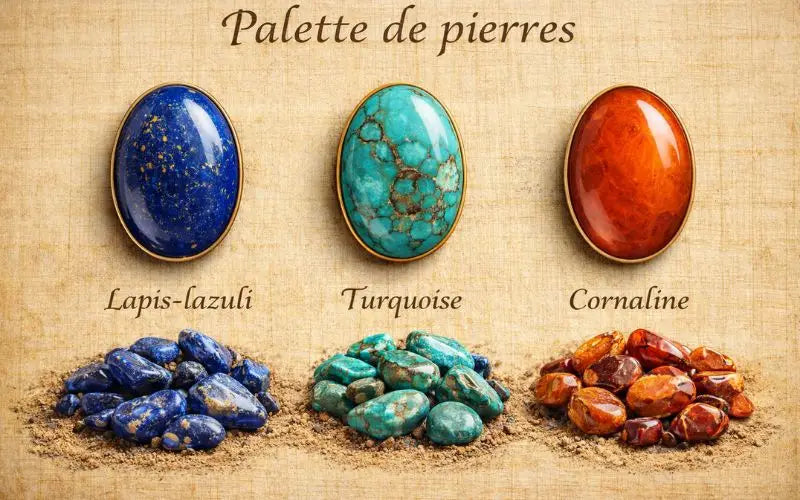
Lapis lazuli, turquoise, carnelian: an intentional palette
The Egyptians loved bold colors. Colored stones and materials (natural stones, glass, faience, enamels) were not chosen at random: color carried meaning.
- Blue: sky, the Nile, protection, the divine world (often associated with stones like lapis lazuli, or blue faience).
- Green: renewal, vegetation, regeneration (often linked to the idea of rebirth).
- Red / orange: vital energy, power, sometimes mastered danger (carnelian).
- Black: the fertility of silt, depth, rebirth (the black earth of the Nile).
- White: purity, sacred, rites (calcite, light-colored materials).
This grammar of colors explains why Egyptian jewelry is so graphic: it was conceived as a symbolic composition.
Techniques: faience, cloisonné, granulation, hammering
Egyptian jewelry is distinguished as much by its symbolic power as by the sophistication of the techniques used to create it. Ancient Egyptian artisans developed various processes adapted to available materials and the status of the patron.
Each method served a specific intention: producing protective objects in series, magnifying the light of the metal, or highlighting sacred motifs with clarity.
Technical mastery was inseparable from meaning. A polished surface, a colored inlay, or a delicate relief were not mere decorative effects: they contributed to the readability of the symbol and its visual strength.
The contrasts of textures and colors made it possible to bring out divine figures, wings, hieroglyphs, or royal emblems.
From faience work to the most complex goldsmithing techniques, Egyptian workshops combined precision, a sense of balance, and a deep knowledge of materials.
This diversity explains the aesthetic richness of the jewelry preserved today and the lasting influence of this know-how on the history of jewelry-making.
Famous jewelry of ancient Egypt and their history
Certain emblematic pieces, discovered primarily in royal funerary contexts, allow us to better understand the central role of jewelry in Egyptian civilization.
Beyond their beauty, these objects are true historical documents: they reveal the religious beliefs, social hierarchy, and technical level attained by the artisans.
Their exceptional state of preservation, particularly in undisturbed tombs, has offered archaeologists a rare glimpse into the aesthetics and symbolic codes of the era.
These pieces of jewelry also testify to the close relationship between political power and the sacred. Sovereigns and members of the elite were adorned with objects that affirmed their status while invoking divine protection. Motifs, materials, and proportions were carefully chosen to express authority, dynastic continuity, and a connection to cosmic forces.
Now preserved in major international museums, these pieces continue to influence research, contemporary jewelry, and the collective imagination.
They embody both the artistic excellence of ancient Egypt and the symbolic depth that characterizes its most prestigious creations.
Tutankhamun's Usekh collar
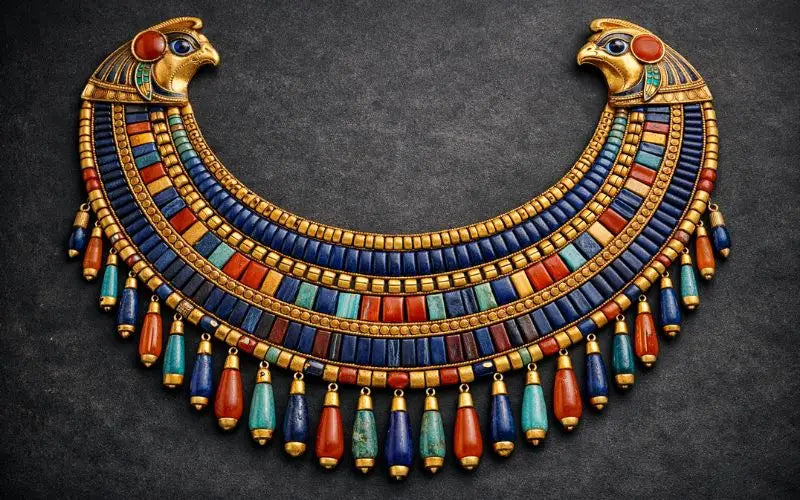
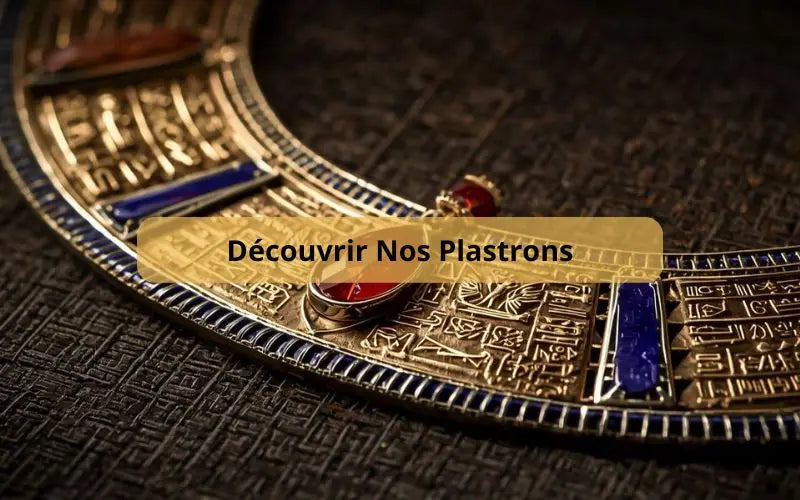
The usekh collar, or wesekh, is one of the most iconic pieces of jewelry from ancient Egypt. The one discovered in Tutankhamun's tomb, composed of rows of gold and colored stone beads, adorned with falcon heads, was part of his funerary regalia.
Worn around the neck and shoulders, it symbolized wealth, status, and divine protection, and appears frequently in Egyptian iconography.
Learn more about Usekh Collars
Tutankhamun's bracelet
Among Tutankhamun's treasures are gold bracelets inlaid with lapis lazuli and carnelian, bearing witness to the skill of Egyptian goldsmiths.
Beyond their beauty, they expressed royal power and symbols linked to protection and regeneration. The quality of the materials and craftsmanship makes them masterpieces of ancient goldsmithing.
Hatnefer's heart scarab
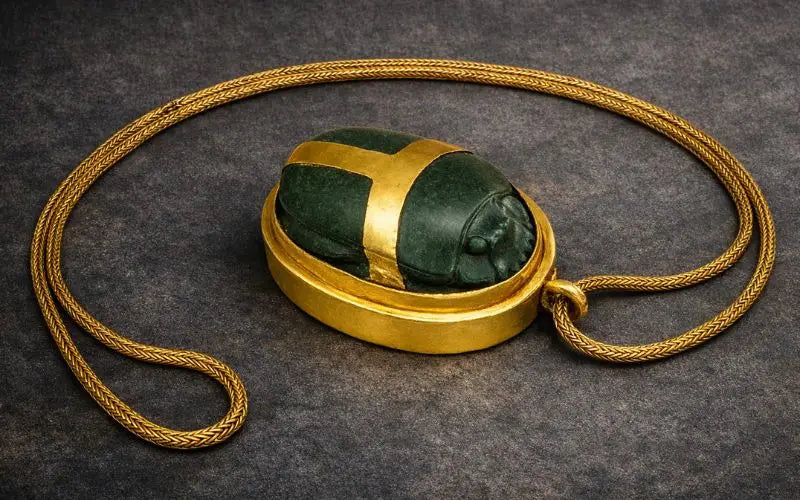
The heart scarab of Hatnefer, kept at the Metropolitan Museum of Art in New York, is a funerary amulet made of serpentinite set in gold, dating from the 15th century BC.
It protected the deceased's heart in the afterlife and ensured its integrity during the posthumous judgment. The scarab, a symbol of solar rebirth, associated with gold, illustrates the profound spiritual dimension of Egyptian jewelry.
Learn more about the Heart Scarab of Hatnefer
The Menat necklace from Malqata
The menat necklace discovered at Malqata, near Thebes, is a ceremonial piece composed of rows of faience beads and precious metals, equipped with a counterweight. It could be worn or shaken by hand during musical and dance rituals.
Associated with the goddess Hathor, it shows that some jewelry had a sacred function, transcending mere ornamentation to become true ritual objects.
The winged scarab amulet of Senusret II
Among the pieces held at the British Museum is a winged scarab amulet made of electrum (a gold-silver alloy), inlaid with carnelian, lapis lazuli, and green feldspar, associated with the royal name of Senusret II.
Remarkable for its state of preservation and the richness of its materials, it combines royal and divine symbols.
The winged scarab was perceived as a bearer of the sun and a protector in the afterlife, reinforcing its cosmic and political dimension.
Roles and uses: status, ritual, amulet, funerary
Egyptian jewelry was not limited to embellishing the body: it structured social, religious, and spiritual life. Each piece could fulfill several functions simultaneously, depending on its context of use and the status of its wearer.
Through their materiality and symbols, these objects became visible vessels for authority, faith, and protection.
Egyptian jewelry can be understood through four main, often intertwined functions:
-
Social function: to show rank, belonging, access to rare materials, and to assert a position in the hierarchy.
-
Religious function: to place oneself under the aegis of a deity, to embody a sacred principle, or to materialize a link with the invisible world.
-
Magical / protective function: to act as an amulet against evil, illness, or chaotic forces.
-
Funerary function: to prepare for continuity in the afterlife, to protect the body, to preserve the name and identity of the deceased.
What makes this jewelry unique is its ability to combine these dimensions in a single object, uniting prestige, ritual, and protection in one creation.
From Egyptomania to pop culture: a style reborn
Since antiquity, Egypt has exerted a lasting fascination beyond its borders. This attraction has resulted in several waves of "Egyptomania," particularly pronounced after major archaeological discoveries or international exhibitions.
Egyptian aesthetics have thus infiltrated architecture, decorative arts, fashion, and jewelry, where they have become an immediately identifiable visual language.
In the 20th century, certain artistic movements reinterpreted its codes: geometric lines, powerful contrasts between gold and blue, stylized silhouettes of deities, and solar symbols.
These borrowings were not simple copies, but adaptations to modern sensibilities. Today, digital visual culture and social media are further accelerating this phenomenon. Motifs like the ankh, the eye, or the scarab circulate as graphic icons, easy to recognize and share.
This constant return can be explained by the synthetic power of Egyptian symbols: simple, balanced, and charged with meaning. They adapt easily to contemporary mediums while retaining their historical aura. Thus, the Pharaonic aesthetic continues to be reborn, transformed yet always recognizable.
Egyptian jewelry today: codes, inspirations, differences
In the contemporary context, it is essential to distinguish between the different realities covered by the expression "Egyptian jewelry":
-
Archaeological jewelry: authentic pieces from excavations, preserved in museums and studied for their heritage and scientific value.
-
Inspired jewelry: contemporary creations that incorporate motifs, color palettes, and formal balances inherited from antiquity.
-
"Egyptian-style" costume jewelry: free interpretations blending different historical periods or cultural imaginations.
-
Symbolic jewelry: modern pieces focused primarily on the spiritual or identity dimension of a specific motif.
These categories serve different intentions. A current creation might be inspired by hieroglyphs, winged silhouettes, or gold/blue contrasts without seeking to faithfully reproduce an antique piece.
It is not an imitation, but a creative adaptation. What remains constant, however, is the graphic power of the symbols.
Originally designed to be readable and balanced, they retain their impact even when simplified or stylized for a modern audience.
This adaptability explains why jewelry inspired by ancient Egypt remains relevant today: it combines a strong visual identity, cultural heritage, and freedom of interpretation.
FAQ about Egyptian jewelry
Egyptian jewelry is as fascinating for its beauty as for the depth of the meanings it carries. Each necklace, bracelet, or amulet is part of a system of thought where material, color, and form contribute to a coherent vision of the world.
Understanding these creations involves exploring religious beliefs, social organization, craft techniques, and the central place of the symbol in ancient Egyptian culture.
This frequently asked questions section provides structured insight into the most common queries: the importance of gold, the choice of stones and metals, the religious dimension of jewelry, and their influence on contemporary jewelry.
It helps to better situate these objects in their historical context while offering benchmarks for interpreting their motifs and uses.
By gathering these elements, this FAQ aims to deepen the understanding of an ancient art where aesthetics and spirituality are inseparable. It invites us to look at Egyptian jewelry not as simple ornaments, but as cultural witnesses, revealing a civilization that knew how to inscribe its beliefs and identity into the very material of the jewelry.
Why was gold so important in Egyptian jewelry?
Gold symbolized eternity and the divine. Its solar luster evoked the power of the gods and continuity in the afterlife.
What materials were used to make Egyptian jewelry?
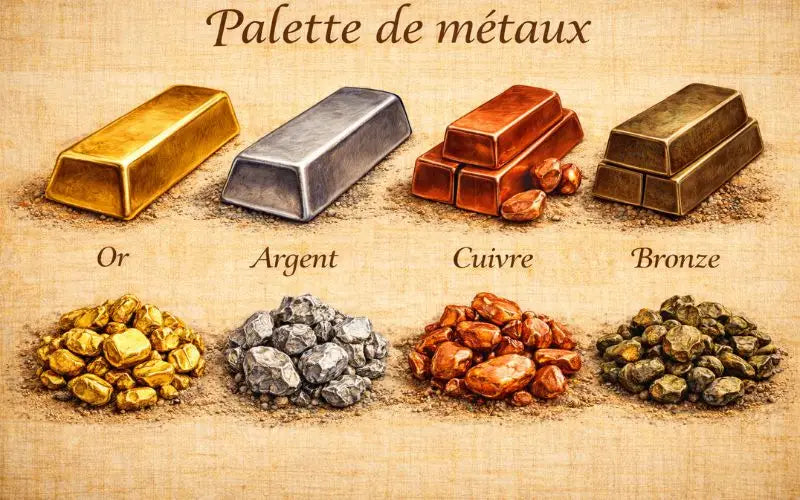
Artisans used gold, silver, electrum, faience, copper, bronze, and stones like lapis lazuli, turquoise, or carnelian, each charged with symbolic meaning.
Did all Egyptians wear jewelry?
Yes. The difference lay in the materials: precious metals and rare stones for the elite, faience and simple amulets for the modest classes.
What is the most famous piece of Egyptian jewelry?
The treasures of Tutankhamun's tomb, notably the usekh collar, are among the most famous examples of Egyptian goldsmithing.
Did the Egyptians know about gemstones like diamonds?
No. They mainly used semi-precious stones like lapis lazuli, carnelian, and turquoise, appreciated for their color and symbolism.
Why do Egyptian jewels still influence contemporary jewelry?
Their symmetry, strong colors, and powerful symbolism continue to inspire modern creations.
Why are Tutankhamun's jewels so famous?
They illustrate the wealth, technical mastery, and symbolic depth of the royal goldsmithing of the New Kingdom.
What is the usekh collar?
The usekh is a wide, multi-row collar worn around the neck and shoulders, a symbol of status and protection.
Did Egyptian jewelry have religious significance?
Yes. Many served as protective amulets or accompanied the deceased into the afterlife.
Why were the colors of the stones important?
Each color had a symbolic value, linked to protection, rebirth, or vital energy.
Conclusion on the art of Egyptian jewelry
Egyptian jewelry is not just a decorative style: these are true object-signs, designed to be simultaneously aesthetic, readable, and charged with symbolic efficacy. Each piece combines material, color, and form in a coherent composition where nothing is left to chance.
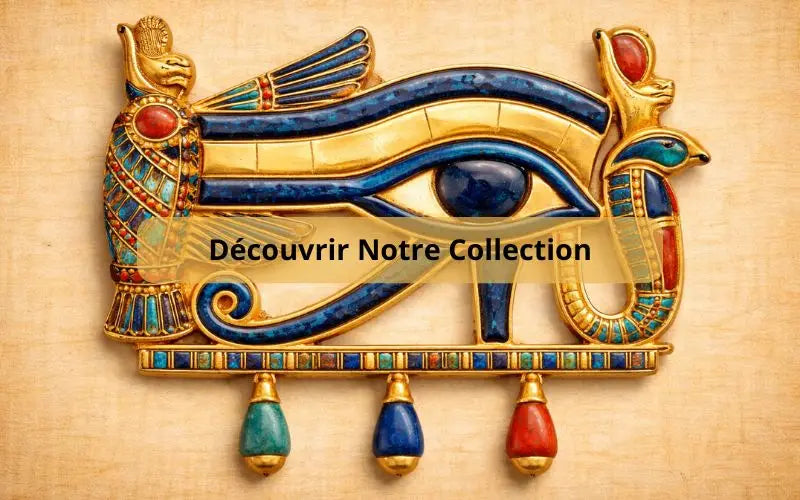
From the wide, colorful usekh to winged pectorals, from the solar scarab to the protective Eye of Horus, each motif conveys a worldview structured by balance, hierarchy, and the relationship to the divine.
Through these creations, the Egyptians inscribed essential ideas onto the body: protection against chaos, the affirmation of social rank, the continuity of the soul after death. The jewel thus becomes an extension of identity, a visible marker of belonging and belief.
This capacity to unite art, technique, and spirituality explains the enduring fascination that the Pharaonic aesthetic still exerts today.
Studied in museums, reinterpreted by contemporary designers, and widely disseminated in modern visual culture, Egyptian jewelry continues to dialogue with our era.