

How does a god function in ancient Egypt?
To understand Egyptian religion, one must first abandon the idea of a single, fixed god. In ancient Egypt, a deity is above all the manifestation of a cosmic force: the rising sun, fertility, kingship, protection, or even death.
A god embodies an active function in the universe rather than a strictly defined individual.
This is why the same deity can take several forms (human, animal, or hybrid), bear different names depending on the region, or merge with another to express an expanded power, like Amun-Ra. This flexibility is an essential characteristic of the Egyptian pantheon.
Two concepts structure almost the entire Egyptian religion:
-
Maat: just order, balance, truth, and universal harmony.
-
Isfet: disorder, falsehood, violence, and chaos.
The gods act as the guarantors of this cosmic balance. The pharaoh, meanwhile, is not just a political leader: he is the human agent tasked with maintaining Maat on earth.
Ra: the sun god, king of the gods
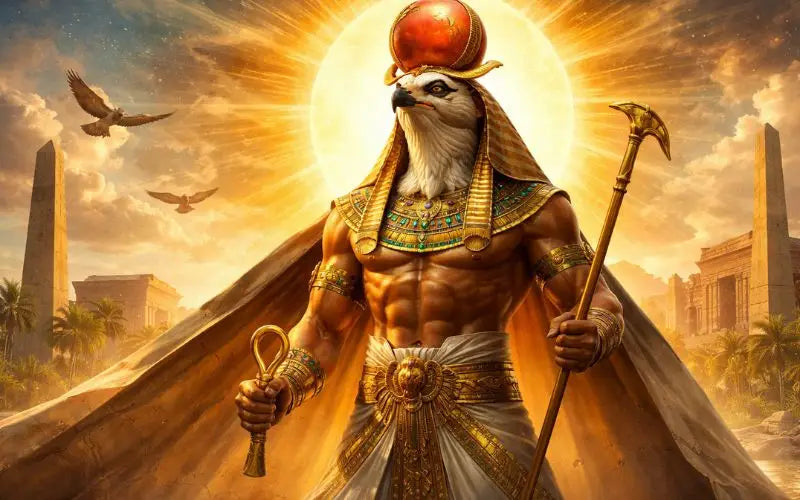
Ra is one of the most central deities of the Egyptian pantheon. As the sun god, he is generally depicted in the form of a man with a falcon's head topped by a solar disk surrounded by a cobra.
He embodies light, creation, and the vital power that allows the world to exist. Every day, he crosses the sky aboard his solar barque, diffusing warmth and clarity.
At night, his journey continues in the underworld, where he faces the forces of chaos, notably the serpent Apophis. This nocturnal crossing symbolizes the permanent struggle between order and disorder.
At dawn, his reappearance marks the victory of light and the renewal of the cosmic cycle.
Venerated throughout Egypt, with a major center at Heliopolis, Ra is considered the creator of the world and the king of the gods. Pharaohs proclaimed themselves his sons to legitimize their authority.
His influence is such that he merges with other deities, notably Amun, giving rise to Amun-Ra.
Amun: the hidden god who became king of the gods
Amun holds a central place in the religious history of ancient Egypt, particularly from the New Kingdom onwards. His name, which means "the Hidden One," refers to an invisible and mysterious dimension of the divine.
He embodies a power that is difficult to grasp, but considered fundamental in the balance of the world. Represented most often in human form topped with two tall feathers, or associated with the ram, he symbolizes authority, fertility, and creative energy.
Over the dynasties, the importance of Amun far exceeded its original scope. He became a major theological figure, associated with sovereignty, the protection of the country, and the legitimization of royal power.
His cult attained considerable proportions, supported by political and religious elites, which further strengthened his influence throughout the Egyptian territory.
Amun thus embodies the capacity of Egyptian religion to evolve and integrate new dimensions without breaking with tradition.
Ultimately, Amun represents the invisible power that became central, reflecting the close link between religion and power in ancient Egypt.
Osiris: the god of death and resurrection
Osiris occupies a central place in Egyptian religion as the sovereign of the afterlife and a major figure of renewal. More than just a god of the dead, he represents the continuity of existence and the hope of transformation after the earthly end.
His image as a mummified, motionless, and hieratic god expresses timeless stability: he symbolizes not disappearance, but permanence in another state of being.
In Egyptian thought, the afterlife is not a dark and frightening realm, but an ordered, structured space where the soul can access a form of eternity if it has lived in accordance with cosmic balance.
Osiris embodies this reassuring perspective: he guarantees that justice transcends death and that the identity of the deceased can be preserved.
His importance goes beyond the funerary sphere. He profoundly influences the Egyptian conception of the natural cycle, notably that of vegetation and the flooding of the Nile, associated with the idea of apparent death followed by rebirth.

Isis: the mother goddess and protectress
Isis is one of the most venerated goddesses of ancient Egypt. Often depicted with a throne or a solar disk on her head, Isis is the sister and wife of Osiris, and the mother of Horus. She is the goddess of motherhood, magic, and protection.
A central figure of the pantheon, she embodies a powerful feminine ideal, at once gentle and determined. Her image endures through the ages as a symbol of unwavering love, fidelity, and inner strength.
In artistic representations, she appears frequently alongside her child, highlighting her role as a nourishing mother and attentive guardian.
Isis is not limited to a domestic or emotional sphere: she occupies a major place in Egyptian theology, where she acts as a mediator between humans and the divine world.
Through her, the Egyptians express a vision of the sacred deeply linked to the concrete protection of daily life. Isis thus symbolizes a benevolent power capable of supporting, guiding, and maintaining balance in the face of trials.

Horus: the falcon god, protector of the pharaohs
The battle of Horus and Seth
After the murder of Osiris, Horus fought Seth to avenge his father and claim the throne of Egypt. This battle symbolizes the eternal struggle between order (Maat) and chaos (Isfet).
Ultimately, Horus triumphs and becomes the legitimate king of Egypt, a title passed down to all pharaohs, who were considered his earthly incarnations.

Seth: the god of chaos and storms
Seth occupies a unique and complex place in the Egyptian pantheon. Associated with storms, deserts, and the unleashed forces of nature, he embodies everything that escapes established order.
Brother of Osiris and Isis, he fully belongs to the legitimate divine sphere, which emphasizes that chaos is not external to the Egyptian world: it is an integral part of it.
His iconography shows him with an enigmatic animal head, sometimes referred to as the "Sethian animal," with hybrid and stylized features. This unusual representation accentuates his marginal and indefinable character.
Seth symbolizes the arid regions located at the borders of the Nile valley, spaces perceived as hostile but necessary for territorial balance.
In Egyptian thought, chaos does not correspond to absolute evil. It represents rather a dangerous force that must be contained, channeled, and integrated into a broader order. Seth embodies this permanent tension between stability and imbalance.
His presence serves as a reminder that harmony is never definitively achieved: it must be protected in the face of internal and external threats.
Anubis: the god of embalming and necropolises
Anubis is one of the most iconic funerary deities of ancient Egypt. Represented in the form of a black canid often identified as a jackal or as a man with a jackal's head, he is closely associated with necropolises, the protection of tombs, and mummification rituals.
The color black refers both to the fertile soil of the Nile and to regeneration, highlighting its connection to rebirth after death.
His role is fundamental in the passage between the world of the living and that of the dead. Anubis ensures the proper conduct of funeral rites, oversees embalming, and protects the integrity of the body, an essential condition for accessing the afterlife.
He is also present during the famous scene of the weighing of the heart, where he guides the deceased and ensures the ritual is carried out correctly.
Although he is not the final judge—a function attributed to Osiris—Anubis guarantees the fairness of the process. Without respect for the rites, no harmonious passage is possible.

Thoth: the god of knowledge, writing, and time
Thoth, called Djehouty in Ancient Egyptian, is generally represented in the form of an ibis or a man with the head of an ibis, sometimes appearing as a baboon.
He is the god of writing, language, calculations, measurements, calendars, and time. More broadly, he embodies organizing intelligence, which structures the world through knowledge and precision.
In a civilization based on administration, archives, monumental architecture, and the mastery of agricultural time, Thoth occupies an essential place.
He is considered the inventor of hieroglyphs and the protector of scribes, the guarantors of memory and the functioning of the State. Without writing and calculation, there would be no taxes, no construction of temples, and no transmission of sacred knowledge.
Thoth also intervenes in mythological tales as a mediator and arbiter. During the conflict between Horus and Seth, he represents reason, measurement, and the right word, capable of calming tensions and restoring balance.

Hathor: love, joy, music, and welcoming the dead
Hathor is one of the most beloved and popular goddesses of ancient Egypt. She is usually depicted as a woman wearing cow horns framing a solar disk, or sometimes in bovine form, a symbol of gentleness and fertility.
Associated with love, music, dance, beauty, and motherhood, she embodies everything that brings pleasure, harmony, and comfort to human existence.
But Hathor is not limited to earthly joy. She also plays an essential role in the afterlife, welcoming the deceased and guiding them with benevolence.
This dual dimension may seem paradoxical, yet it is profoundly consistent in Egyptian thought: the goddess who celebrates life is also the one who softens death. She represents the bond, the solace, and the continuity between the two worlds.
In some myths, Hathor can also adopt a more formidable aspect, manifesting intense protective power when it comes to defending the divine order.

Maat: the order of the world and cosmic justice
Maat is both a goddess and a fundamental principle of Egyptian thought. She symbolizes truth, justice, balance, universal harmony, and the stability of the cosmos.
Without Maat, the world falls back into Isfet, i.e., disorder, chaos, violence, and confusion. This is why Maat goes far beyond the religious framework: she constitutes a true philosophy of civilization, a political and moral ideal that structures the entire Egyptian society.
Maat is not only honored in temples; she also guides the actions of the pharaoh, who is tasked with maintaining balance in the land.
Governing according to Maat means rendering fair justice, protecting the weak, ensuring prosperity, and preserving the order established by the gods.
In the scenes of the judgment of the dead, the heart of the deceased is weighed against the feather of Maat. This gesture symbolizes the consistency between the life led and the cosmic order. Living according to Maat means acting with righteousness and moderation.
FAQ on the Main Gods of Egypt
Conclusion on the Main Gods of Egypt
The main gods of Egypt form a pantheon of exceptional richness, where each deity embodies a fundamental force: the sun, fertility, kingship, death, knowledge, or even cosmic order.
Far from being mere mythological figures, these gods structure the entire Egyptian civilization. They explain natural phenomena, legitimize the pharaoh's power, and frame the human destiny, from birth to judgment in the afterlife.
Through Ra, Osiris, Isis, Horus, Anubis, or Maat, an entire worldview emerges: a universe founded on the balance between order and chaos, between life and rebirth.
Egyptian religion does not separate the spiritual from the political or the sacred from the everyday; on the contrary, it connects every aspect of existence to a divine dimension.
Understanding the Egyptian gods therefore means entering the heart of a millennial way of thinking where symbol, myth, and power interact.
Even today, these figures continue to fascinate, not only for their singular aesthetics but for the philosophical depth they reveal about the human condition and the quest for universal harmony.