

Understanding how the Egyptians viewed life after death means exploring one of the major pillars of their civilization.
For them, death was not an end but a transition to an eternal existence. This concept structured their religion, funerary architecture, and daily morality.
The Egyptian conception of the human being and the soul
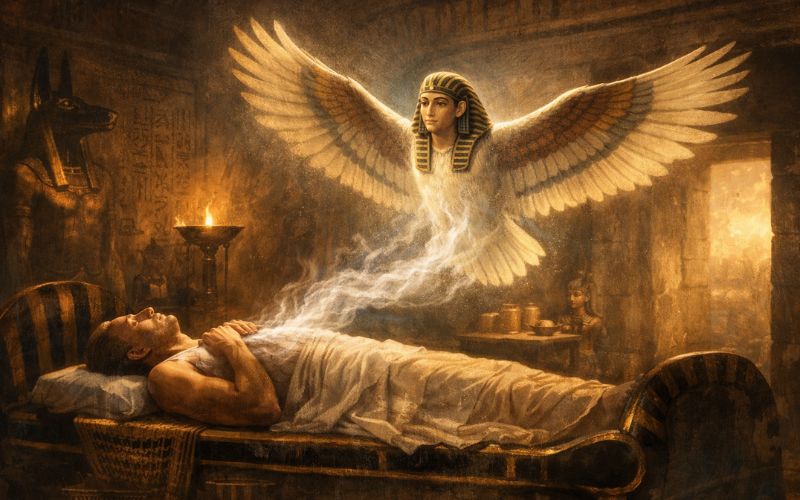
The vision of the afterlife rests on a particularly elaborate conception of the human being.
To understand how the Egyptians viewed life after death, one must grasp this multiple spiritual structure that went far beyond the simple opposition between body and soul.
The ancient Egyptians distinguished several invisible components, each playing a precise role in posthumous survival and the continuity of personal identity. The physical body had to be kept intact to serve as an anchor for the spiritual principles, an essential condition for the endurance of existence.
The khat refers to the material body, the visible shell indispensable for the recognition of the individual. The ka represents the vital force transmitted at birth and nourished by offerings.
The ba corresponds to the mobile personality, capable of moving between the earthly and spiritual spheres. Finally, the akh symbolizes the transfigured spirit, a luminous state attained after moral validation.
This conception reveals a refined and structured anthropology. Life after death was not a philosophical abstraction, but an organized extension of earthly existence. The balance between these dimensions guaranteed stability and lasting access to eternity.
Essential spiritual elements
The main components of the soul formed a structured and complementary whole, essential for survival in the afterlife:
-
The khat: bodily shell serving as a material support for existence
-
The ka: vital energy requiring regular offerings
-
The ba: mobile principle linked to identity and spiritual movement
-
The akh: transfigured spirit accessing a higher state
Each of these elements had to be protected by precise rites, sacred formulas, and adapted funerary practices to ensure the continuity and stability of eternal existence.
Mummification: preserving the body for eternity
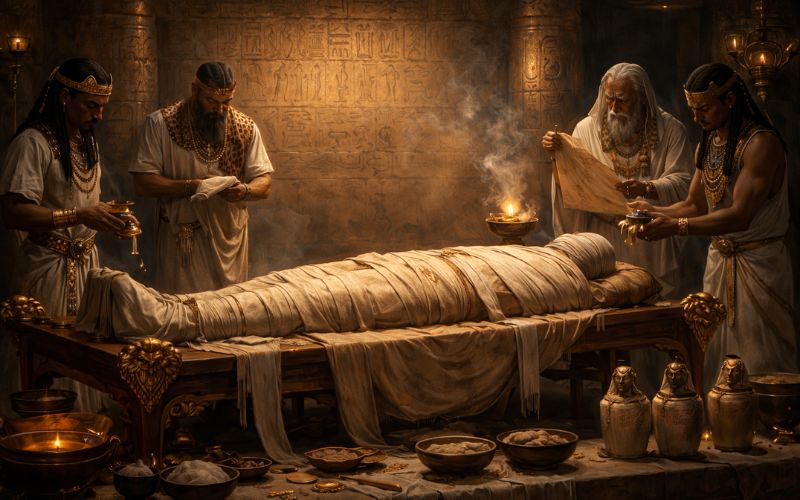
Mummification occupied a central place in how the Egyptians conceived access to eternity. It was not a mere technical process, but a sacred ritual charged with deep spiritual meanings.
The preservation of the body was essential to maintain the link between the physical shell and the invisible components of the being. Without this meticulous conservation, the identity of the deceased risked dissolving and losing its stability in the afterlife.
Specialized priests followed a rigorous protocol passed down from generation to generation. The treatment of the body took place within a precise ceremonial framework, marked by invocations, symbolic gestures, and magical protections.
The internal organs were removed with care and placed under the guard of protective deities, while the body was gradually dried out to avoid any deterioration. The complete process could take several weeks, ensuring optimal preservation.
This practice reflected a concrete and structured vision of immortality. The body became a stabilizing support allowing for the continuity of existence. The transformation brought about by mummification symbolized the passage from a mortal state to a lasting and protected condition.
The main stages of mummification
The ritual consisted of several successive phases, executed with precision and accompanied by sacred gestures:
-
Purification of the body to eliminate all symbolic impurity
-
Extraction and preservation of organs placed under divine protection
-
Drying with natron to ensure durable preservation
-
Wrapping in bandages impregnated with protective resins
Each stage was part of a strict religious framework. It aimed to protect the integrity of the deceased and guarantee the continuity of their identity in the afterlife, in accordance with the established sacred order.
The journey in the Duat: an initiatory passage
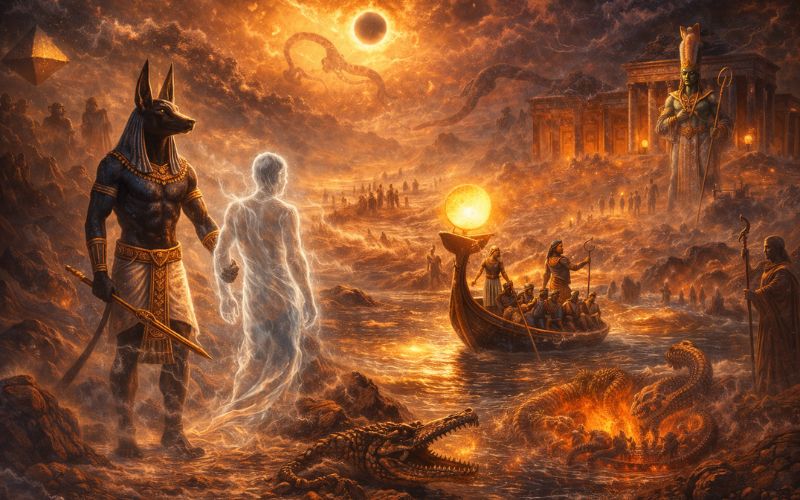
After death, the soul began a complex journey through the Duat, an intermediate world located between the earthly sphere and the eternal realm. This symbolic space was not just a place of passage, but an essential stage of inner transformation.
The deceased had to face a succession of trials requiring ritual knowledge, self-mastery, and fidelity to sacred principles. Possession of the proper formulas and the ability to recognize the entities encountered were essential to progress.
The Duat reflected a profound psychological and spiritual dimension. It represented the shadows of human existence as well as the aspirations for purification. The scenes painted in the tombs describe a universe filled with obstacles, symbolic creatures, and divine guardians.
Each stage tested the moral strength and religious preparation of the deceased.
This initiatory passage prepared the soul for the decisive confrontation of the judgment. It materialized the necessity of a conscious journey toward harmony and spiritual legitimacy.
The dangers of the Duat
The Duat was described as a complex and demanding universe, where each stage put the spiritual preparation of the deceased to the test:
-
Mythical creatures symbolizing forces of disorder and fear
-
Gates guarded by deities requiring precise ritual responses
-
Trials of sacred knowledge and recognition of divine names
These obstacles were not arbitrary. They verified the mastery of funerary formulas, moral purity, and the understanding of sacred laws. Crossing the Duat meant proving one’s legitimacy to continue the path toward eternity.
The weighing of the heart and the judgment of Osiris
The weighing of the heart constituted the most solemn and decisive moment of the posthumous journey. This symbolic ceremony marked the final confrontation between the individual and the universal moral order.
The heart, considered the seat of conscience and intentions, was examined in order to evaluate the conformity of the life led with sacred principles. The scale represented an impartial measure, reflecting divine equity.
Facing the feather of Maat, the heart revealed the moral quality of earthly existence. A favorable balance opened access to a harmonious existence in the afterlife.
Conversely, an imbalance reflected a break with the cosmic order, leading to an irreversible sanction. This scene illustrates the importance placed on individual responsibility and the coherence between acts and principles.
This ritual expresses a profoundly ethical vision of the world. Earthly existence was conceived as a continuous preparation for this decisive evaluation. Respect for sacred values conditioned the future stability of the soul.
The significance of the feather of Maat
The feather of Maat symbolized the fundamental principles that structured the universal order and Egyptian morality:
-
Truth in words and intentions
-
Justice in actions and decisions
-
Balance in the relationship with others and the cosmos
It embodied the ethical ideal to which every individual was to aspire during their earthly existence. Conforming to the values of Maat meant living with righteousness, respect, and moderation.
This fidelity to sacred principles was the essential condition for obtaining a favorable judgment and accessing a harmonious eternity.
The Field of Reeds: the ideal of a peaceful eternity
The Field of Reeds represented the culmination of the spiritual journey and the finality hoped for by every deceased person judged worthy. Described as a luminous and fertile space, they symbolized a form of eternal fulfillment where the soul could live in balance and serenity.
This representation was not a distant abstraction, but an idealized projection of earthly existence, stripped of its constraints and sufferings.
This place deeply reflected the agricultural values of Egyptian society. Prosperity was associated with the fertility of the land and the regularity of the harvests, essential elements for collective survival.
In this vision, the afterlife extended familiar activities in a harmonious and perfect form. The deceased continued to exist in a stable environment, where the cosmic order was fully respected.
This conception reveals a continuity between the earthly world and the spiritual world. Eternity was thought of as a state of lasting accomplishment, founded on justice and balance.
It embodied the reward granted to those who had respected sacred principles during their life.
An idealized vision of life

Funerary rites and sacred objects
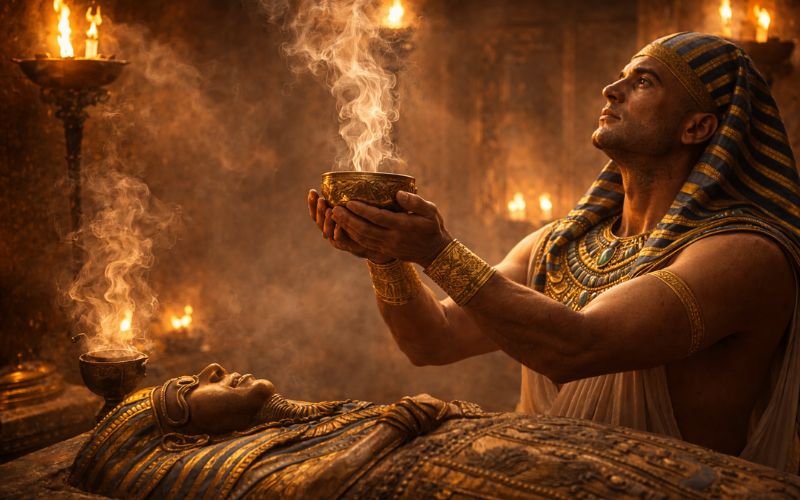
Funerary rites occupied an essential place in how the Egyptians conceived the transition to eternity. Each ceremony was carefully codified to ensure the protection and stability of the deceased in the afterlife.
The tombs, whether mastabas, hypogea, or royal burials, were adorned with frescoes depicting symbolic scenes, benevolent deities, and formulas intended to guarantee spiritual security.
The texts inscribed on the walls, notably from the Book of the Dead, served as a ritual guide for overcoming posthumous trials.
Amulets played a major protective role. Placed on the mummy or inserted into the bandages, they formed a magical barrier against hostile forces.
The scarab evoked rebirth and perpetual transformation, while the Eye of Horus embodied protection and integrity. The materials used, often precious, reinforced the sacred dimension of these objects.
These elements were not decorative but invested with a concrete spiritual function. They consolidated the security of the deceased and facilitated their harmonious integration into the eternal order.
The most common objects
In Egyptian tombs, one could find a variety of objects carefully selected to accompany the deceased on their journey toward eternity:
-
Protective amulets intended to ward off negative forces
-
Ushabtis tasked with performing symbolic labor in the afterlife
-
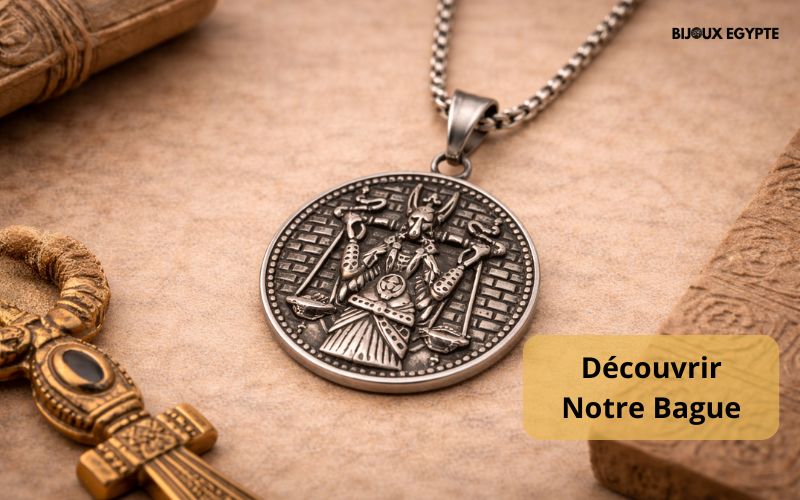
Sacred jewelry bearing divine and protective motifs
Each element possessed a precise religious meaning and served a specific spiritual function.
Their presence reinforced the magical protection of the deceased and ensured their safety against invisible trials.
The role of the gods in the afterlife
Divinities held a central place in the Egyptian understanding of the afterlife. In ancient religious thought, the passage to eternity could not be accomplished without the active intervention of divine powers.
Each stage of the posthumous journey was placed under the supervision of a specific god, guaranteeing the legitimacy and regularity of the process. This organization reflected a deeply structured vision of the spiritual universe.
Osiris was recognized as the supreme authority of the kingdom of the dead, the embodiment of rebirth and sovereign power in the invisible realm.
Anubis watched over the observance of funeral rites and accompanied the deceased through the delicate phases of transition.
Isis represented fidelity, protection, and the benevolent assistance granted to the soul. Thoth, meanwhile, embodied wisdom and precision, ensuring the rigor of decisions made in the spiritual domain.
This divine hierarchy reflected an orderly and regulated conception of the afterlife. Access to immortality depended on the respect of sacred laws and cosmic harmony. The intervention of the gods guaranteed the stability of the judgment and the coherence of the posthumous destiny.
The main deities of the afterlife
Several deities intervened directly in the posthumous destiny of the deceased, each assuming a precise function in the sacred order:
-
Osiris: sovereign of the kingdom of the dead and symbol of resurrection
-
Anubis: guide of souls, protector of tombs, and guardian of rites
-
Isis: protective figure associated with fidelity and spiritual support
-
Thoth: guarantor of divine fairness and the recording of the judgment
Their coordinated action ensured the coherence of the spiritual process, the legitimacy of the verdict, and the stability of the cosmic order.
FAQ on How did the Egyptians view life after death?
Why did the Egyptians mummify their dead?
Mummification allowed the body to be preserved so that the ka and the ba could remain attached to it. Without preservation, immortality was compromised.
What was the weighing of the heart?
It was the moral judgment of the deceased. Their heart was compared to the feather of Ma'at to determine their access to eternity.
What did the Duat represent?
The Duat was the intermediate world traversed by the soul before the final judgment.
Who was Osiris?
Osiris was the god of resurrection and the sovereign of the kingdom of the dead.
Did all Egyptians believe in life after death?
Yes, this belief structured the entire society, although practices differed according to social status.
Conclusion on How did the Egyptians view life after death?
How did the Egyptians view life after death? As a transition toward an eternal existence governed by a structured and coherent divine order.
For them, physical disappearance did not mark the end of being, but the passage toward a new form of existence inscribed within a precise cosmic framework. Their vision associated personal morality, meticulous funeral rites, and constant spiritual protection to ensure the stability of the soul.
Mummification ensured the preservation of the material vessel, the judgment of Osiris evaluated moral conformity, and the Fields of Aaru represented the fulfillment of a righteous life.
Each stage of the posthumous journey translated a deeply organized conception of the universe, where balance and justice occupied a central place. Earthly life was perceived as a continuous preparation for this transformation.
This conception of eternity shaped monumental architecture, funerary iconography, and Egyptian spirituality for millennia. It reveals a civilization oriented toward permanence, coherence, and harmony between the visible and invisible worlds.