

Understanding the 9 gods of the Ennead of Heliopolis: a complex pantheon
The 9 gods of the Ennead of Heliopolis: a complex pantheon constitute an elaborate theological construct that organizes the Egyptian vision of the ancient world.
This religious structure is not limited to a simple mythological narrative passed down through oral tradition; it forms a genuine, hierarchical, and deeply coherent explanatory system.
Each deity occupies a precise place within a carefully structured sacred genealogy, creating a logical sequence between the origin, organization, and continuity of the universe.
The Ennead also reflects a desire to harmonize visible and invisible forces within an intelligible framework. It offers an orderly reading of reality, where natural phenomena, cycles of time, and social stability find their justification in a structured divine schema.
The organization into nine entities conveys a powerful symbolic conception, based on the idea of balance and totality.
Studying this pantheon allows one to gauge the intellectual sophistication of ancient Egypt. It reveals a civilization capable of articulating cosmology, spirituality, and the representation of power within a unified, stable, and enduring vision of the world.

A foundational cosmogony at the heart of Egyptian religion
The Ennead of Heliopolis constitutes one of the most influential cosmogonic narratives of ancient Egypt. Developed in a major religious center dedicated to the sun, it offers a structured and progressive explanation for the appearance of the world.
This theological system is based on a fundamental principle: the universe emerges from a primordial chaos called Nun, an amorphous and infinite expanse symbolizing the absence of organization.
From this original matrix arises the creator god Atum, the starting point for an ordered process of cosmic manifestation.
Creation is then organized according to a clearly hierarchical divine genealogy. Each generation embodies an essential cosmic principle and participates in the establishment of a structured, stable, and intelligible world.
This theological construct reflects an elaborate train of thought, concerned with explaining not only the origin of elements but also their interaction and complementarity.
The Ennead thus transcends the simple narrative framework: it constitutes a genuine intellectual model that allows for an understanding of the universe's coherence.
It also plays a major ideological role. By inscribing human power within a pre-existing cosmic order, this cosmogony contributes to the consolidation of the religious and institutional stability of Egyptian society.

Atum, creator principle and origin of the cosmos
Atum occupies a central place among the 9 gods of the Ennead of Heliopolis: a complex pantheon.
He appears as the first conscious manifestation emerging from the Nun, before any differentiation of the world.
His self-generation reflects a powerful theological conception: the universe is born from an autonomous divine will, without external intervention. This singularity makes Atum a complete entity, containing within itself the potential for all future creation.
In Heliopolitan thought, his appearance marks the transition from the formless to the ordered. He initiates a process of progressive structuring that transforms primitive indistinctness into an organized reality.
Atum also represents a cyclic dimension, associated with the setting sun, a symbol of completion and latent renewal. This association reinforces the idea that every ending contains the seeds of a new beginning.
He embodies cosmic totality, uniting complementary polarities within himself. This original unity underscores the internal coherence of the Egyptian religious system.
As the primary source, Atum establishes a stable framework from which the entire Heliopolitan theology develops.
Symbolism and representations of Atum
Atum is often depicted in human form wearing the double crown. He can also appear in the guise of a serpent, a symbol of eternity. These representations convey his connection to cycles and renewal.
His major attributes include:
-
The was scepter
-
The ankh cross
-
The pschent crown
He embodies cosmic completeness. His iconography reinforces his role as the beginning and end of the solar cycle.
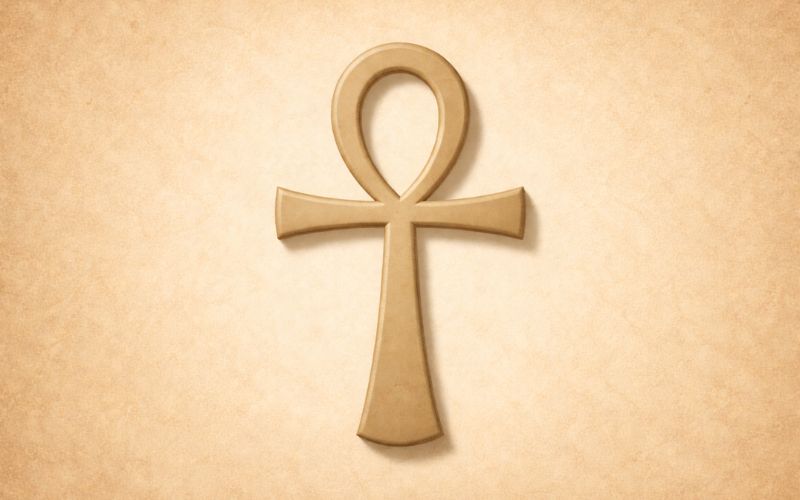
Shu and Tefnut, separation of the primordial elements
Their role in cosmic balance
Shu and Tefnut represent invisible yet fundamental forces. Their action allows for the appearance of the habitable world.
They symbolize:
-
Balance of the elements
-
Cosmic respiration
-
Climatic regulation
In Egyptian thought, air and moisture are essential for fertility. Their role transcends the simple mythological framework.
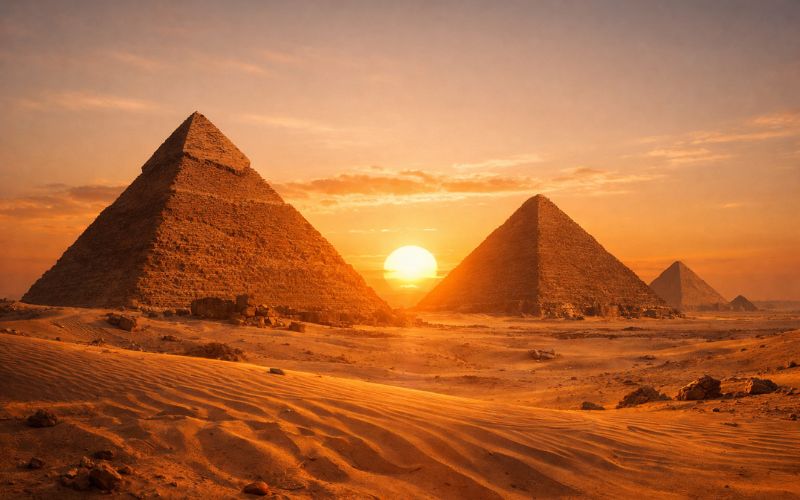
Geb and Nut, the separated earth and sky
Symbolism of the eternal cycle
Their relationship embodies cosmic continuity and the permanent renewal of the world. Each day symbolically reenacts the act of creation, affirming the victory of order over imbalance.
We find here:
-
The solar cycle
-
Agricultural fertility
-
The stability of the world
This duality expresses a circular conception of time, essential to the Egyptian vision of the universe.
Osiris, Isis, Seth, and Nephthys: tensions and complementarities
The final generation of the 9 gods of the Ennead of Heliopolis: a complex pantheon, introduces a deeply human dimension to Egyptian theology.
With Osiris, Isis, Seth, and Nephthys, the mythological narrative takes on a particular intensity, marked by rivalry, loyalty, and transformation. This phase of the pantheon stages complex family relationships that translate the fragilities and balances of the world.
The conflict between Osiris and Seth becomes a symbolic model of fundamental oppositions. It is not merely a divine clash, but a representation of the permanent tensions that permeate existence.
Isis appears as a figure of mediation and reconstruction, while Nephthys quietly accompanies the processes related to passage and protection. Together, they embody a nuanced vision where destruction and restoration coexist.
This divine generation introduces the notion of moral responsibility and continuity. It illustrates that order does not maintain itself automatically, but requires intervention, loyalty, and balance.
Their interaction gives Egyptian mythology a lasting dramatic and symbolic depth.
The major functions of this generation
Each deity occupies a specific function in the general balance and participates in a complementary dynamic essential to the coherence of the divine world:
-
Osiris: sovereign of the realm of the dead and guarantor of the judgment of souls
-
Isis: keeper of sacred knowledge, protector, and figure of fidelity
-
Seth: incarnation of unpredictable forces, violence, and upheaval
-
Nephthys: discreet guardian of funerary rites and support in moments of transition
Their interaction structures a complex vision where opposition, solidarity, and transformation coexist to maintain cosmic order.

The balance between order and chaos in the Ennead
The Ennead is based on a central principle: the preservation of Maat, a fundamental concept denoting cosmic order, justice, and universal harmony.
This idea structures the 9 gods of the Ennead of Heliopolis as a whole: a complex pantheon where each force must contribute to the stability of the world.
However, this balance is never permanently achieved. Seth embodies the constant threat, representing the forces of rupture, instability, and disorganization.
Faced with this tension, other deities symbolize restoration and continuity. Maintaining harmony requires constant vigilance and action.
In Egyptian thought, chaos is not eliminated but mastered and contained to avoid returning to the primordial undifferentiated state. This vision reflects a realistic understanding of the world, based on the coexistence of opposites.
The pharaoh plays an essential role in this symbolic system. Considered the legitimate heir of Horus, he is charged with defending Maat on Earth.
Religion thus becomes a structuring political framework, anchoring royal authority in a higher cosmic order legitimized by divine forces.
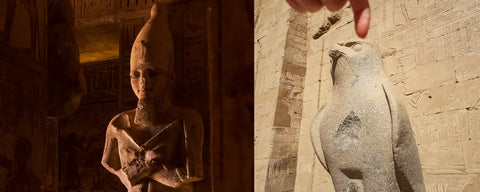
Religious and political influence of the Heliopolitan pantheon
The 9 gods of the Ennead of Heliopolis—a complex pantheon—left a profound mark on religion and the organization of power in ancient Egypt.
Their theological structure is not limited to a mythological narrative: it shapes cult practices, funeral rites, and royal ideology.
Osiris gradually became the reference figure for the justified deceased, embodying the hope of survival after death based on righteousness and spiritual legitimacy.
Isis, for her part, inspired a lasting cult that spread beyond Egyptian borders into the Mediterranean world.
The pantheon directly influences several dimensions of society:
-
The architecture of solar temples
-
The writing and dissemination of funerary texts
-
The consolidation of dynastic legitimacy
This theology offers a structuring framework that connects religion, power, and social organization. It helps anchor political authority in a sacred order, perceived as immutable and universal.
For millennia, this coherent vision of the world nurtured Egyptian spirituality and reinforced the kingdom’s cultural continuity.
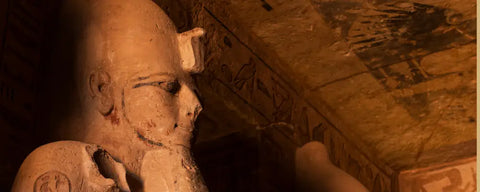
FAQ about The 9 gods of the Ennead of Heliopolis: a complex pantheon
The 9 gods of the Ennead of Heliopolis: a complex pantheon still spark many questions today among enthusiasts of history and Egyptian mythology.
This structured pantheon, at the heart of ancient cosmogony, constitutes one of the most elaborate foundations of pharaonic religious thought.
Understanding its organization, major figures, and role in the Egyptian worldview requires clarifying several key points.
The Ennead is not limited to a simple list of deities: it represents a coherent system explaining the origin of the universe, the hierarchy of divine forces, and their influence on society.
The most frequent questions often concern the exact composition of the group, the role of certain major figures, and the geographical importance of the religious center of Heliopolis.
Other inquiries concern the precise role of certain deities and the symbolic scope of this theological structure.
The answers provided below help to better grasp the internal logic of this pantheon and its lasting impact on the spirituality, culture, and political organization of ancient Egypt.
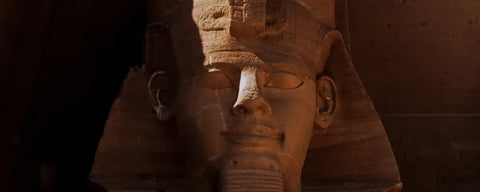
Conclusion on The 9 gods of the Ennead of Heliopolis: a complex pantheon
The 9 gods of the Ennead of Heliopolis: a complex pantheon form a coherent theological structure that explains the birth of the world, cosmic balance, and royal legitimacy.
Through this hierarchical organization, the ancient Egyptians constructed a worldview based on order, the complementarity of forces, and the continuity of the cosmic cycle.
This divine genealogy is not just a symbolic story: it reflects an elaborate reflection on the origin, stability, and transformation of the universe.
The Ennead highlights a structured conception of the sacred, where each deity possesses a precise function within a harmonious whole. It links cosmology, spirituality, and political power in a remarkable synthesis.
By placing the pharaoh within this divine continuity, it also consolidates the coherence of the state and religious stability.
Even today, this pantheon remains one of the major pillars of Egyptian mythology.
It continues to fascinate historians, archaeologists, and enthusiasts alike, both for its symbolic richness and its intellectual depth, revealing the extraordinary sophistication of the pharaonic civilization.