
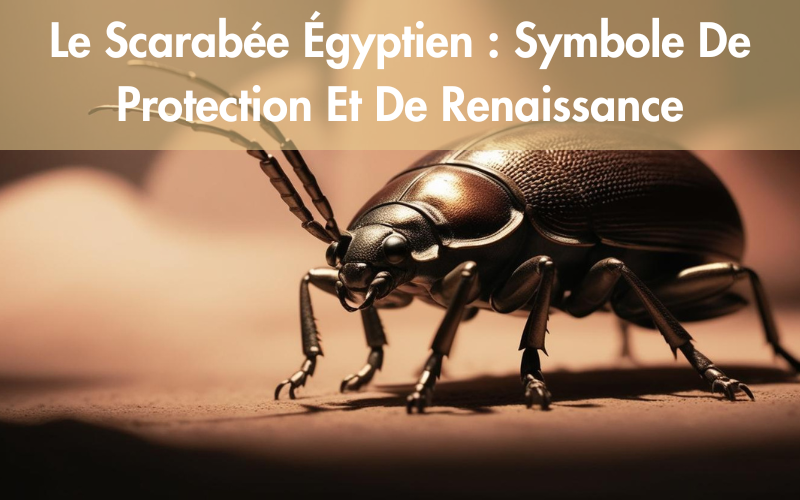
The Egyptian scarab is one of the most powerful symbols of ancient Egypt. Associated with the sun, rebirth, and spiritual protection, it held a central place in the religion and culture of this civilization.
The Egyptians saw in this insect a symbol of the eternal cycle of life and the renewal of the world. Still today, the scarab fascinates with its spiritual significance and historical legacy.
The origin of the scarab in ancient Egypt
In Egyptian civilization, the scarab finds its origin in the careful observation of nature. The Egyptians observed the dung beetle, an insect that rolls balls of organic matter in which it lays its eggs. When the young scarabs appeared, the ancient Egyptians thought they were born spontaneously from the sand or earth. This mysterious observation fueled the idea of spontaneous creation and a form of natural rebirth.
This perception deeply influenced Egyptian spirituality. The scarab gradually became a powerful symbol representing rebirth, transformation, and the perpetual cycle of life. Priests and scribes interpreted its behavior as a symbolic representation of the creation of the universe.
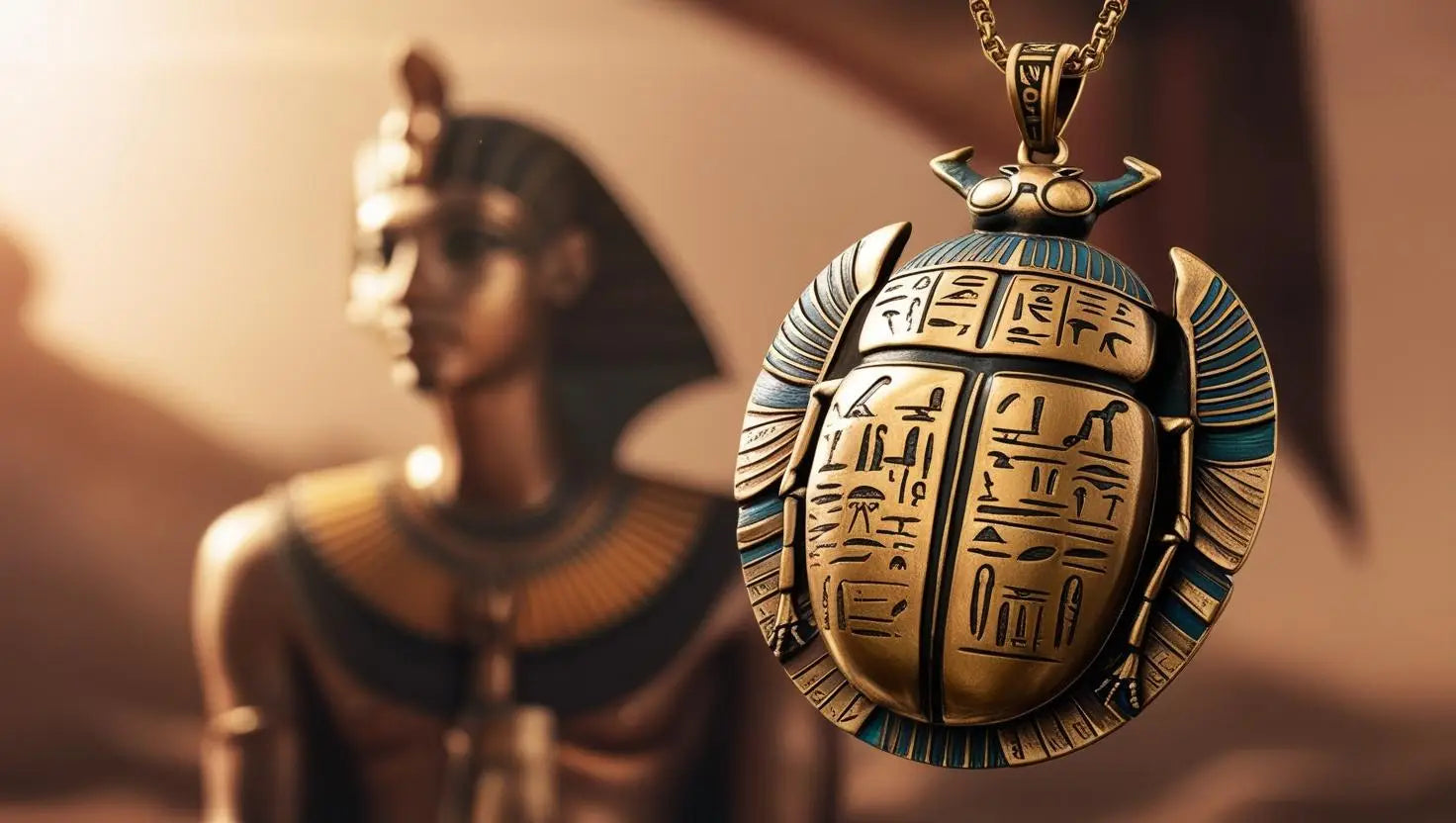
Over time, the image of the scarab was integrated into religious and artistic practices. Its representation is found in numerous sacred objects, jewelry, and amulets. These objects were not merely decorative but carriers of deep spiritual meaning.
The scarab thus embodies the close relationship between nature and religion in ancient Egypt. It serves as a reminder that for the Egyptians, every natural phenomenon could reveal a divine and cosmic dimension.
The dung beetle and its symbolic role
The dung beetle profoundly influenced the religious symbolism of ancient Egypt. Egyptians observed this insect rolling a ball in front of it, a gesture that reminded them of the sun's movement across the sky. This analogy led to the idea that the scarab participated symbolically in the cosmic movement of the world.
In their spiritual vision, this insect embodied the power of creation and transformation. The fact that young scarabs seemed to appear from the rolled matter reinforced the idea of a miraculous birth. This observation contributed to making the scarab a sacred symbol associated with the birth of life and the permanent renewal of the universe.
The transformation of an insect into a sacred symbol
With the development of Egyptian religion, the scarab became much more than a simple insect observed in nature. Priests integrated this symbol into their cosmology and the mythological narratives linked to the creation of the world.
Artisans began to reproduce the shape of the scarab in stone, faience, and precious metals. These representations were often engraved with religious symbols or the names of pharaohs. Thus, the scarab became a powerful spiritual object used as a protective talisman and a symbol of rebirth throughout ancient Egypt.

The scarab and the god Khepri
In Egyptian mythology, the scarab is closely linked to the god Khepri, a deity associated with the rising sun. Khepri represents the daily birth of the sun and symbolizes the permanent renewal of the world. Every morning, the Egyptians saw the sun appear on the horizon, an image they interpreted as an act of divine creation.
Priests compared this phenomenon to the behavior of the dung beetle. Just as the insect pushes its ball before it, Khepri was depicted pushing the solar disk across the sky. This analogy profoundly marked the Egyptian religious imagination.
Khepri was part of a solar cycle composed of three forms of the sun god. In the morning, the sun appeared as Khepri, a symbol of rebirth. At noon, it became Ra, representing power and light. In the evening, it took the form of Atum, the incarnation of the setting sun.
This daily transformation reflected the Egyptian vision of time, perceived as an eternal cycle of death and rebirth. The scarab perfectly embodied this idea, which explains its frequent presence in temples, amulets, and religious texts.
Thus, the scarab was not just an animal symbol, but a direct representation of an essential cosmic force in Egyptian religion.
Khepri and the birth of the sun
Khepri represents the moment when the sun is reborn each morning. This daily rebirth was considered a cosmic miracle and a symbol of hope for the Egyptians.
In temples and religious texts, Khepri was often depicted as a man with a scarab head or directly in the form of an insect. This representation showed the deep link between nature and the divine in Egyptian spirituality. For the Egyptians, every sunrise was proof that the universe continued to renew itself and maintain the cosmic order established by the gods.
The scarab as a cosmic symbol
The scarab became a representation of the eternal movement of the universe. Its natural behavior evoked the movement of the sun and the cycle of time.
For the Egyptians, this symbol was a reminder that life is a constant process of transformation. Rebirth was not only a cosmic phenomenon but also a spiritual promise for the human being. The scarab thus embodied the continuity of life and the idea that every end can become a new beginning.
The scarab as a protective amulet
In ancient Egypt, the scarab was widely used as spiritual protection. Egyptians believed that scarab-shaped amulets could ward off negative forces and protect the soul against malicious influences. These talismans were worn by the living but also placed in tombs.
Scarab amulets were made from numerous materials such as faience, stone, gold, or semi-precious stones. They were often engraved with magical formulas or divine names intended to strengthen their spiritual power.
These objects were widespread in Egyptian society. Nobles, priests, and even modest people often owned a protective scarab. It was believed to bring luck, prosperity, and protection against invisible dangers.
The scarab was also associated with spiritual rebirth. Wearing a scarab amulet meant benefiting from the creative energy of the sun and the cosmic cycle.
Thus, these talismans represented much more than decorative objects. They were considered sacred objects capable of influencing the destiny and spiritual protection of their wearer.
The different forms of scarab amulets
Protective scarabs existed in several forms in ancient Egypt. They could be worn as pendants, rings, or small talismans attached to clothing.
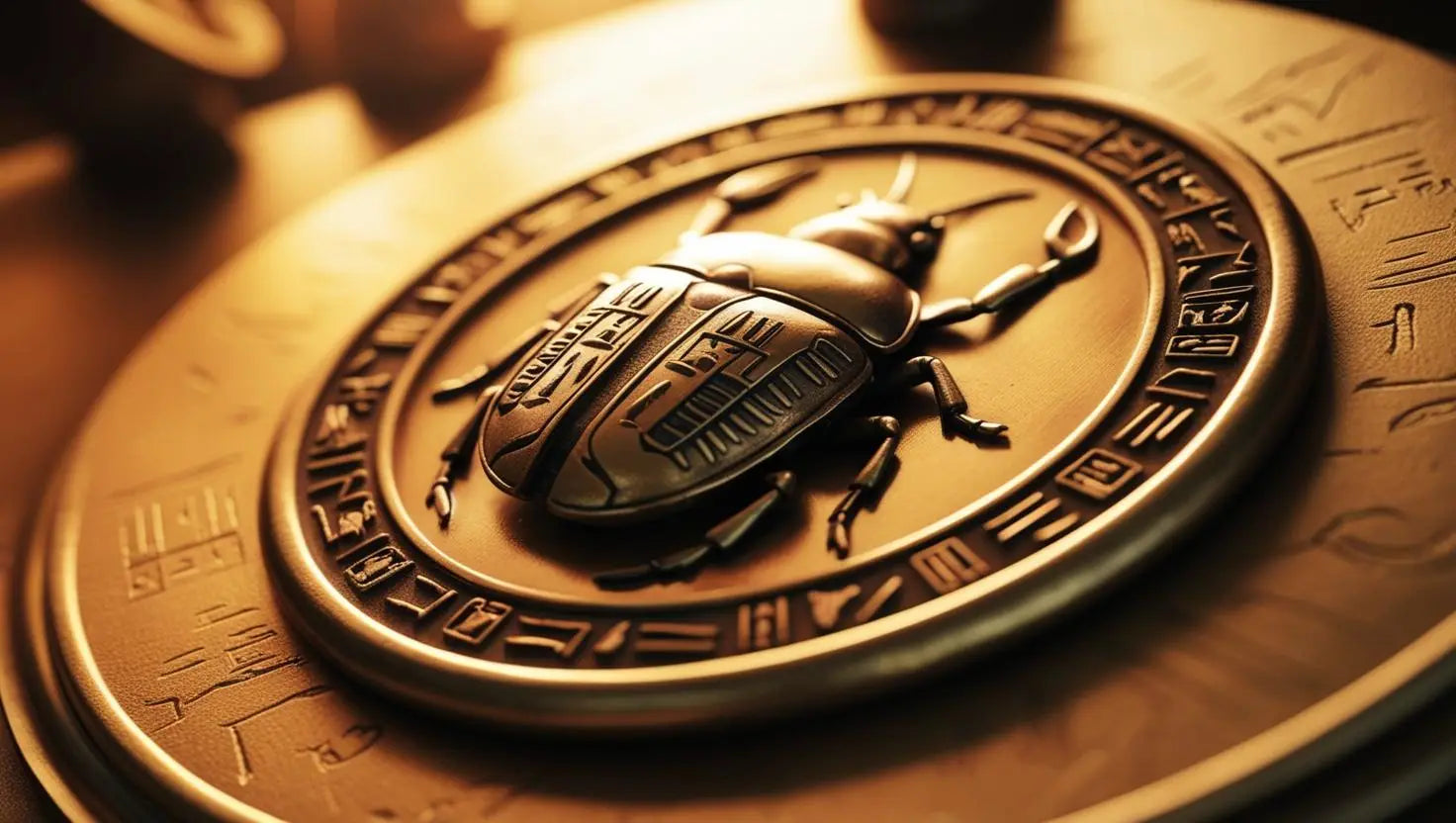
Some scarabs also served as personal seals to mark documents or objects. These items were often engraved with religious symbols or royal names. Their compact form and spiritual significance made them precious and very common objects in daily life.
The magical inscriptions on scarabs
Scarab amulets often featured engraved inscriptions on their flat underside. These texts could be prayers, magical formulas, or divine names.
These inscriptions were meant to strengthen the object's spiritual protection. Egyptian priests believed that words possessed a sacred power capable of influencing reality. Thus, wearing a scarab engraved with a protective formula helped attract the favor of the gods and ward off the forces of chaos.

The scarab in funerary rituals
The scarab held an essential place in the funerary rites of ancient Egypt. In the Egyptian religious vision, death was not an end but a transition to a new existence. The scarab symbolized this rebirth of the soul in the afterlife.
During mummification, an object called a heart scarab was placed on the chest of the deceased. This amulet served to protect the heart, considered the seat of conscience and memory.
According to Egyptian beliefs, the deceased had to pass judgment before the god Osiris. During this ordeal, the heart was weighed against the feather of Maat, the symbol of truth and justice. If the heart was pure, the soul could access eternal life.
The heart scarab was meant to prevent the heart from testifying against the deceased during this judgment. It acted as a spiritual protector during this crucial stage.
Through this powerful symbol, the Egyptians hoped to ensure the continuity of life after death and guarantee an eternal existence in the realm of the gods.
The heart scarab in mummification
The heart scarab was generally made of green stone, a color strongly associated with regeneration, life, and renewal in the symbolism of ancient Egypt. It was placed directly on the chest of the deceased during the funerary rituals performed during mummification.
This sacred amulet often bore an excerpt from the Book of the Dead, a collection of funerary texts intended to accompany the soul on its journey. These magical formulas were intended to protect the soul of the deceased, prevent the heart from testifying against him, and help him safely cross the underworld.
The spiritual role of the scarab in the afterlife

The scarab in art and modern culture
The Egyptian scarab continues to influence contemporary art and culture. Its image still symbolizes rebirth, protection, and personal transformation. This thousand-year-old symbol inspires artists, jewelry designers, and history enthusiasts today.
In modern jewelry, the scarab appears in many creations inspired by ancient Egypt. Designers use its iconic shape to evoke luck, protection, and spirituality.
The scarab has also become a popular motif in the art of tattooing. Many people choose this symbol to represent a new beginning or an important change in their life.
In cinema, literature, and museums, the scarab remains an iconic element of the Egyptian imagination. It evokes both the mystery of ancient civilizations and the fascination with their spiritual beliefs.
This symbol transcends centuries and cultures, proof of the enduring power of Egyptian symbolism. The scarab thus continues to embody the idea that life is a constant cycle of transformation.
The scarab in contemporary jewelry
Jewelry inspired by the scarab is now very popular in high-end and spiritual accessories. They often represent luck, protection, and personal transformation, values directly inherited from the symbolism of ancient Egypt.
Modern designers reinterpret this symbol in pendants, rings, or bracelets, using materials such as gold, silver, or natural stones. These creations draw inspiration directly from the ancient motifs used by Egyptian artisans, while adapting them to contemporary trends and current styles.
The scarab in modern tattoos

FAQ on the Egyptian Scarab: A Symbol of Protection and Rebirth
The Egyptian scarab is one of the most fascinating and iconic symbols of ancient Egyptian civilization. Associated with spiritual protection, rebirth, and the eternal cycle of life, this sacred insect deeply influenced the religion, art, and beliefs of the ancient Egyptians. Found on numerous amulets, jewelry, funerary objects, and sculptures, the scarab embodied a symbolic force linked to the sun, creation, and transformation.
Even today, this symbol continues to intrigue and spark numerous questions. Its connection to the god Khepri, its role in funerary rituals, and its presence in modern jewelry and tattoos often raise questions among enthusiasts of history, archaeology, and spirituality. Many people seek to understand the deeper meaning of this symbol and the reasons for its importance in ancient Egypt.
In this FAQ dedicated to the Egyptian Scarab: A Symbol of Protection and Rebirth, we answer the most frequently asked questions from web users. These answers provide a better understanding of the origin, symbolism, and lasting influence of the scarab in Egyptian culture and the collective imagination around the world.

What does the scarab symbolize in ancient Egypt?
The scarab primarily symbolizes rebirth, transformation, and spiritual protection. It is associated with the god Khepri and the cycle of the sun. For the Egyptians, this insect represented the constant renewal of life and cosmic balance.
Why did the Egyptians wear scarabs?
Scarabs were worn as protective amulets. The Egyptians believed they warded off negative forces and attracted good luck. These talismans were also used in religious and funerary rituals.
What is the heart scarab?
The heart scarab is an amulet placed on the chest of the deceased during mummification. It protects the heart during judgment in the afterlife and helps the soul attain eternal life.
Why is the scarab linked to the sun?
The behavior of the dung beetle reminded the Egyptians of the movement of the sun across the sky. This observation led to the association between the scarab and the solar god Khepri.
Is the scarab considered good luck today?
In many modern cultures, the scarab is considered a symbol of protection, transformation, and good luck. It is often used in jewelry and tattoos.
Conclusion on the Egyptian Scarab: A Symbol of Protection and Rebirth
The Egyptian scarab is one of the most fascinating symbols of ancient Egyptian civilization. Throughout the centuries, it has embodied rebirth, transformation, and spiritual protection. The Egyptians saw much more in this insect than just an animal: it represented the eternal movement of the sun and the cosmic cycle of life.
Used as an amulet, seal, or funerary object, the scarab accompanied people through every stage of their existence. It protected the living from the forces of chaos and guided the dead to the afterlife. Its association with the god Khepri and the solar cycle reinforced its importance in Egyptian religion.
Even today, this symbol continues to inspire modern art, culture, and spirituality. Jewelry, tattoos, and artistic works testify to the enduring fascination with this mythical figure.
The scarab reminds us of a universal idea: life is a constant cycle of transformation. Every ending can become a new beginning, and every sunrise announces a rebirth. It is this worldview that explains why the scarab remains such a powerful symbol throughout the millennia.