
At the heart of Egyptian mythology, the afterlife is not merely a place of shadows, but a structured, symbolic, and deeply spiritual space.
Among the most fascinating narratives is that of the 12 Gates of the kingdom of the dead, a nocturnal journey laden with mysteries and lessons.
Between solar cosmology, funerary rituals, and visions of eternity, this myth reveals the full richness of ancient Egyptian religious thought.
Origin of the 12 Gates in funerary texts
The 12 Gates find their origin in the great religious texts of the New Kingdom, notably the Book of Amduat and the Book of Gates.
These compositions decorate royal tombs and describe the twelve hours of the night traveled by Ra. Each hour corresponds to a region of the Duat, guarded by specific deities and populated by benevolent or hostile entities.
These texts were not intended for the general public but were reserved for the Pharaoh, the guarantor of cosmic order. By identifying with the sun god, the sovereign ensured his daily rebirth.
Gradually, these beliefs spread and influenced broader funerary concepts. The 12 Gates thus became a symbolic model of the passage from death to immortality.
The structure of twelve divisions reflects the observation of the solar cycle and nocturnal time. Night is not perceived as an end, but as a transformation. This conception illustrates the cyclic vision of life characteristic of ancient Egypt.
The Duat: Sacred geography of the underworld
The Duat is the invisible realm where the nocturnal journey takes place. Unlike a punitive vision of hell, it constitutes a structured space, organized and governed by divine laws.
It encompasses rivers of fire, fertile fields, dark caverns, and luminous sanctuaries.
This underworld is populated by deities, guardians, and departed souls. Some regions welcome the righteous, while others punish the forces of chaos. The Duat thus represents a space of cosmic regulation where order must be constantly restored.
The Egyptians imagined this sacred geography as parallel to the world of the living. Each gate acts as an initiatory threshold separating distinct energetic zones. To traverse the Duat is to cross levels of consciousness and purification.
This sacred mapping shows that death is not a rupture, but a passage. The Duat thus becomes a space of transition, guaranteeing the continuity of universal balance.
The nocturnal journey of Ra through the Gates
Each night, Ra embarks on his journey through the 12 Gates. Aboard his solar barque, he successively traverses the dark regions in order to be reborn at dawn.
This cycle symbolizes the daily victory of light over darkness. It also embodies the constant regeneration of the cosmic energy that keeps the universe in motion.
During this voyage, Ra is accompanied by protective deities who ensure the stability of the crossing. He faces hostile creatures and must pass through thresholds guarded by formidable entities.
Each gate requires the knowledge of a sacred name or a precise magical formula, for in Egyptian thought, knowing the name is equivalent to exercising power over that which is named.
This journey is not only cosmic, it is initiatory. The deceased who identifies with the sun god symbolically follows the same path, integrating principles of transformation and spiritual mastery. Thus, the myth becomes a universal model of overcoming and elevation.
The morning rebirth of the sun confirms the success of the passage. It guarantees the continuity of the visible and invisible world, as well as the dynamic balance between order and chaos.
Spiritual symbolism of the 12 Gates
The 12 Gates possess a deeply symbolic dimension. They represent the stages of inner transformation that the soul must undergo to access a higher state of existence.
Each threshold embodies a moral, energetic, or spiritual test, requiring clarity, courage, and detachment.
These gates can be interpreted as:
-
A progressive purification
-
A confrontation with personal shadows
-
An apprenticeship of cosmic order
-
An integration into eternity
The progression follows an ascending and structured logic. The soul moves from initial darkness to the rebirth of light, crossing increasingly subtle levels of understanding.
This symbolism reflects the Egyptian philosophy based on balance, responsibility, and alignment with universal laws.
The guardians embody psychic or cosmic forces that test inner stability. Defeating them does not mean destroying them, but recognizing and moving past them.
The journey thus becomes a metaphor for spiritual maturation and the harmonization of the different dimensions of being.
The final gate marks the fusion with the solar light. It illustrates conscious reintegration into the eternal cycle of life, in a form of rediscovered unity.
The role of Maat and the judgment of the soul
The principle of Maat plays an essential role in the passage of the Gates. Maat represents the truth, justice, and universal order that govern both the visible and the invisible world.
Without conformity to these principles, no progression is possible, because cosmic balance relies on the harmony between the individual and divine laws.
Before or during the journey, the soul is subjected to judgment. Its heart, considered the seat of conscience and intentions, is weighed against the feather of Maat.
This ritual determines the moral purity of the deceased and reveals the sincerity of their earthly actions. The scene underscores the importance given to personal responsibility.
In case of failure, the soul may be devoured by Ammit. This hybrid entity symbolizes the final annihilation of the being.
Destruction is not an eternal torture but a disappearance, an inability to access spiritual continuity.
Respecting Maat during earthly life therefore constitutes the key to salvation and access to the afterlife.
The 12 Gates become the cosmic extension of this moral principle, reminding us that universal order depends on a constant harmony between human conduct and divine balance.
Apophis and the forces of chaos
At the heart of the nocturnal journey appears the threat of Apophis.
This gigantic serpent embodies primordial chaos and attempts to prevent the solar rebirth by seeking to immobilize the divine barque.
Every night, Ra must triumph over this destructive force so that the dawn can rise and the world can continue to exist.
Apophis symbolizes:
-
Cosmic disorder
-
Inner fears
-
Ignorance and dissolution
-
The breaking of balance
It represents everything that threatens the stability of the created world. Its attack is not only physical; it is cosmic and symbolic, aiming to plunge the universe back into the primordial undifferentiated state.
The dramatic tension of this confrontation underscores the precariousness of universal harmony.
The battle against Apophis is never definitively won. It repeats every night, reminding us that order must be constantly protected and renewed. This perpetual struggle reflects the fragility of the world and the need for constant vigilance.
Priests recited ritual formulas to support Ra in this invisible combat. Magic, the sacred word, and the knowledge of divine names played an essential role in preserving cosmic balance.
The 12 Gates as an initiatory journey
Beyond the cosmic myth, the 12 Gates form a true initiatory journey that is structured and progressive. They can be interpreted as stages of a spiritual ascension guided by principles of transformation and transcendence.
Each gate marks a higher level of consciousness, implying a deeper understanding of the invisible laws that govern existence.
The deceased traverses:
-
Initial fear
-
Purification
-
The moral ordeal
-
Cosmic integration
This progression recalls the initiation rites present in many ancient traditions, where the initiate must symbolically die to one state in order to be reborn into another.
The nocturnal journey thus becomes a metaphor for inner transformation, requiring clarity, courage, and detachment from earthly attachments.
Each stage implies a crossing—not just of an external threshold, but of an internal limit.
The progressive abandonment of the ego leads to union with the divine principle and the acceptance of a reality far vaster than human individuality.
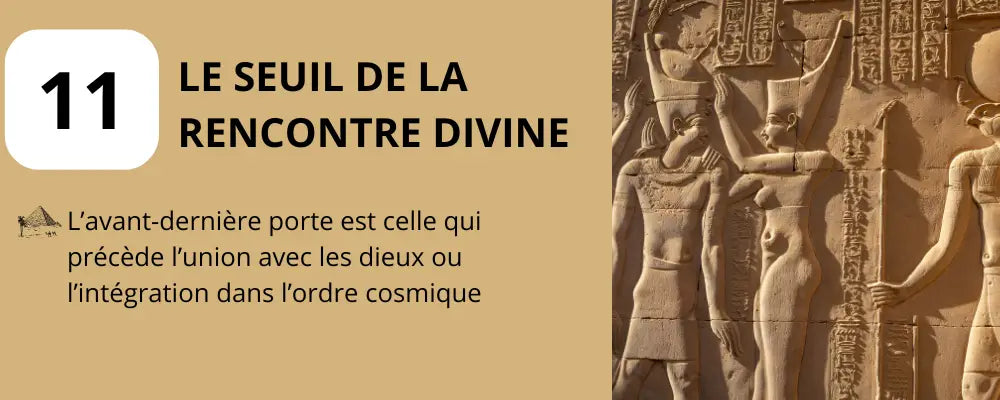
The eleventh gate symbolizes this ultimate threshold before rebirth.
The twelfth gate, finally, embodies the rediscovered light and marks the culmination of a process of elevation toward solar immortality.
Representations in tombs and funerary art
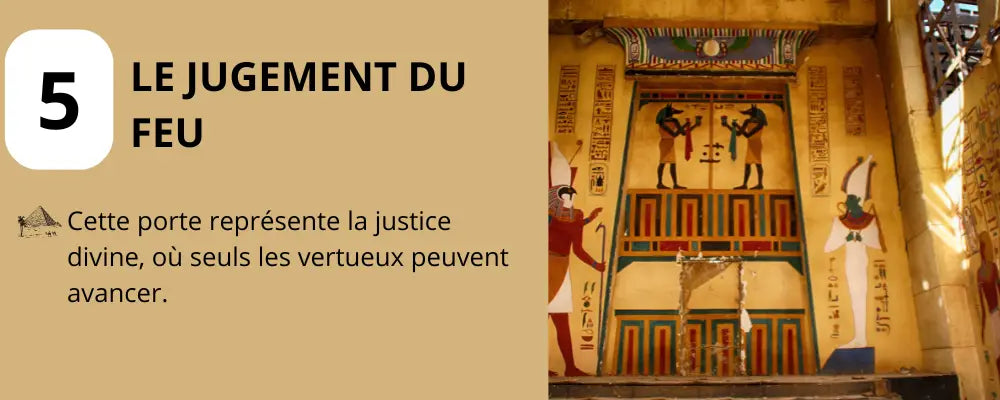
The scenes of the 12 Gates appear in the tombs of the Valley of the Kings, particularly under the reigns of the New Kingdom.
The walls are covered with carefully traced hieroglyphs and detailed illustrations describing the nocturnal hours. The compositions follow a precise organization, often distributed along the walls of corridors and funerary chambers.
These representations show:
-
The solar barque
-
The guardians of the gates
-
Regions of fire and water
-
Blessed or condemned souls
Funerary art served a protective and ritual function.
The images were not decorative but performative, meaning they acted symbolically within the invisible world.
Their presence ensured the knowledge of the necessary formulas and materialized the cosmic path within the space of the tomb.
The iconographic precision reflects the importance of sacred transmission. The colors, figure positions, and inscriptions followed codified rules.
Every detail possessed a magical and theological meaning, inscribed in a rigorous artistic tradition.
These frescoes today constitute a major source for understanding Egyptian cosmology, the organization of the afterlife, and the ancient conception of the passage toward eternity.
Legacy and modern interpretations
The 12 Gates continue to fascinate historians, archaeologists, and spirituality enthusiasts around the world. Their iconographic richness and theological complexity still fuel numerous analyses today.
Their symbolism has inspired modern esoteric readings, sometimes detached from their initial historical framework. Some see in them a parallel with universal initiatory paths related to the evolution of consciousness.
However, it is essential to distinguish between contemporary interpretation and the ancient context.
Originally, these narratives responded to a specific religious vision centered on sacred royalty, solar cosmology, and the perpetuation of the world order. Funerary texts did not offer abstract philosophy, but a ritual device intended to guarantee survival in the afterlife.
The current interest in the 12 Gates shows the timeless richness of Egyptian mythology. They embody a deep reflection on death, transformation, and eternity, while testifying to a structured and symbolically coherent thought.
Understanding these gates means grasping the essence of Egyptian funerary thought in its religious and cultural dimension.
The myth thus remains an inexhaustible source of inspiration and study for scholars and enlightened amateurs alike.
FAQ on the 12 Gates of the Kingdom of the Dead in Egyptian Mythology
The 12 Gates of the Kingdom of the Dead raise many questions, as their symbolism and complexity continue to fascinate even today.
Between solar cosmology, funerary rites, and initiatory ordeals, this central theme of Egyptian mythology sometimes remains difficult to grasp in its entirety.
Ancient sources, tomb depictions, and modern interpretations can also cause confusion if one does not clearly distinguish between the religious context and contemporary symbolic reading.
This FAQ aims to provide clear, concise, and accessible answers to the most frequently asked questions on the subject.
It helps to better understand the role of Ra, the function of the guardians, the significance of the number twelve, or the true nature of the Duat in Egyptian thought.
Whether you are discovering this myth for the first time or wishing to deepen your knowledge, these complementary insights help structure the essential concepts.
Exploring the 12 Gates means entering the heart of the Egyptian vision of the afterlife, where death is never an end, but a passage toward transformation and luminous rebirth.
What do the 12 Gates represent in Egyptian mythology?
The 12 Gates symbolize the stages of Ra’s nocturnal journey through the Duat. They also represent the soul's spiritual journey toward eternity. Each gate corresponds to an ordeal or an initiatory threshold.
Where can the description of the 12 Gates be found?
They are described in New Kingdom funerary texts, notably the Book of Amduat and the Book of Gates. These narratives mainly adorned royal tombs.
Who must cross the 12 Gates?
Originally, the pharaoh identified with Ra to accomplish this journey. Gradually, the belief extended to every soul aspiring to immortality.
What is Apophis’s role in this journey?
Apophis embodies chaos and attempts to prevent the solar rebirth. Its defeat ensures the continuity of the cosmic cycle.
What happens if the soul fails?
According to tradition, the impure soul can be devoured by Ammit. It then ceases to exist, deprived of eternity.
Are the 12 Gates a form of hell?
No, the Duat is not a hell in the modern sense. It is a space of transformation and cosmic regulation.
Why is the number 12 important?
It corresponds to the twelve hours of the night. It symbolizes the completion of the nocturnal cycle preceding the solar rebirth.
Conclusion on the 12 Gates of the Kingdom of the Dead in Egyptian Mythology
The 12 Gates of the Kingdom of the Dead in Egyptian mythology represent much more than just an ancient religious narrative: they embody a complete vision of the passage between life and eternity.
Through Ra's nocturnal journey in the Duat, the Egyptians expressed their understanding of the cosmic cycle, divine justice, and spiritual transformation.
Each gate symbolizes an essential stage where order must triumph over chaos, where light must be reborn after darkness.
This structured journey illustrates the profound conviction that death is not a disappearance, but a transition requiring preparation, knowledge, and moral rectitude.
Respect for Maat, mastery of sacred formulas, and alignment with the universal order determine access to immortality. Thus, the 12 Gates reflect a philosophy based on balance, responsibility, and cosmic continuity.
To understand these gates is to grasp the essence of Egyptian funerary thought: a spirituality where rebirth, harmony, and light constitute the ultimate outcome of the soul's journey.