

Jewelry from Ancient Egypt was much more than just adornment. Charged with symbolism, it embodied protection, spirituality, and immortality.
Throughout their history, Egyptian jewelry reveals a civilization where every ornament possessed a sacred meaning.
The origins of jewelry in Ancient Egypt
The first pieces of jewelry appeared as early as the Predynastic period, long before the great pyramids. They were initially crafted from shells, bones, and local stones, reflecting a primitive need for ornamentation but also symbolic protection.
Quickly, with the unification of the country, artisans developed sophisticated techniques for working with precious metals. Goldsmithing thus became a sacred art, linked to temples and royal power.
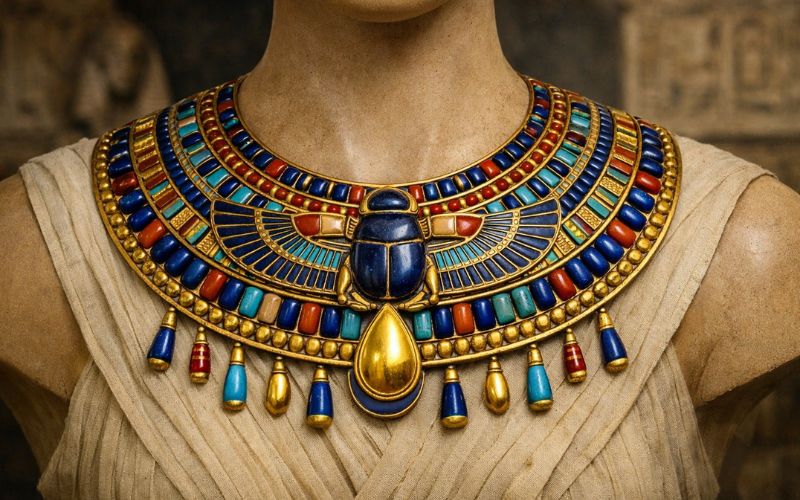
Jewelry played a central role in social structure. The elites wore wide collars called "usekh," as well as bracelets and finely decorated rings.
The common classes adopted simpler versions that were still charged with symbolism. The object is never neutral: it protects, identifies, and connects one to the divine world.
The royal workshops were particularly advanced. They mastered:
-
Gold granulation
-
Inlaying semi-precious stones
-
Cloisonné
-
Symbolic engraving
This sophistication demonstrates that jewelry was considered to have high religious and political value.
Sacred materials and their spiritual significance
The choice of materials was never left to chance in the art of Egyptian jewelry.
Each stone and metal possessed a specific spiritual vibration integrated into ancient cosmology.
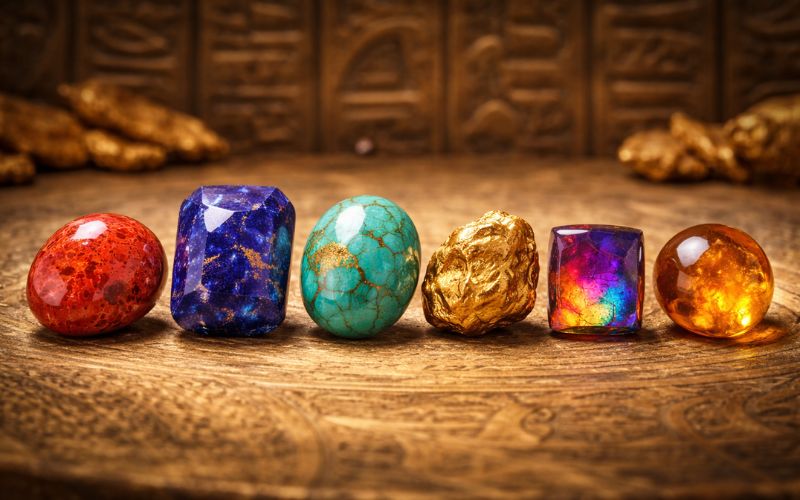
Gold, considered the flesh of the gods, symbolized eternity and solar immortality. Its unalterable shine reinforced its association with eternal life and divine power. It was primarily reserved for pharaohs and deities, thereby affirming their sacred nature.
Lapis lazuli, imported from Afghanistan via distant trade routes, represented the night sky and divine wisdom.
Its deep color evoked the celestial vault and the cosmic infinite. Turquoise, extracted from the mines of the Sinai, embodied protection, fertility, and joy. Carnelian, with its intense red, was associated with vital energy, blood, and protective strength.
Among the most used materials:
-
Gold: immortality and divine power
-
Lapis lazuli: truth and celestial wisdom
-
Turquoise: protection and happiness
-
Carnelian: vitality and strength
This material richness illustrates a vision where matter itself becomes an active vector of spiritual symbolism and cosmic balance.
The great symbols of Egyptian jewelry
Egyptian jewelry stands out for its exceptional iconographic richness, which reflects the spiritual universe of the Nile civilization.
Each engraved or sculpted motif possessed a precise function, inscribed within a deeply religious worldview. Symbols served to invoke invisible forces, attract divine benevolence, or repel disorder.
They were chosen according to the wearer's personal situation: protection, fertility, prosperity, or spiritual guidance. This selection was never random, but guided by structured beliefs transmitted by priests and specialized artisans.
Beyond their magical dimension, these signs formed a true visual language understandable by the whole of society.
They expressed complex concepts such as universal balance, cosmic justice, or the eternal cycle of life. Compositions often combined multiple symbols to amplify their spiritual effectiveness.
This layering of meanings shows that the jewelry was conceived as an active object, capable of interacting with the invisible world. Thus, the symbolism was not a simple decorative tradition, but part of a coherent religious structure deeply rooted in Egyptian culture.
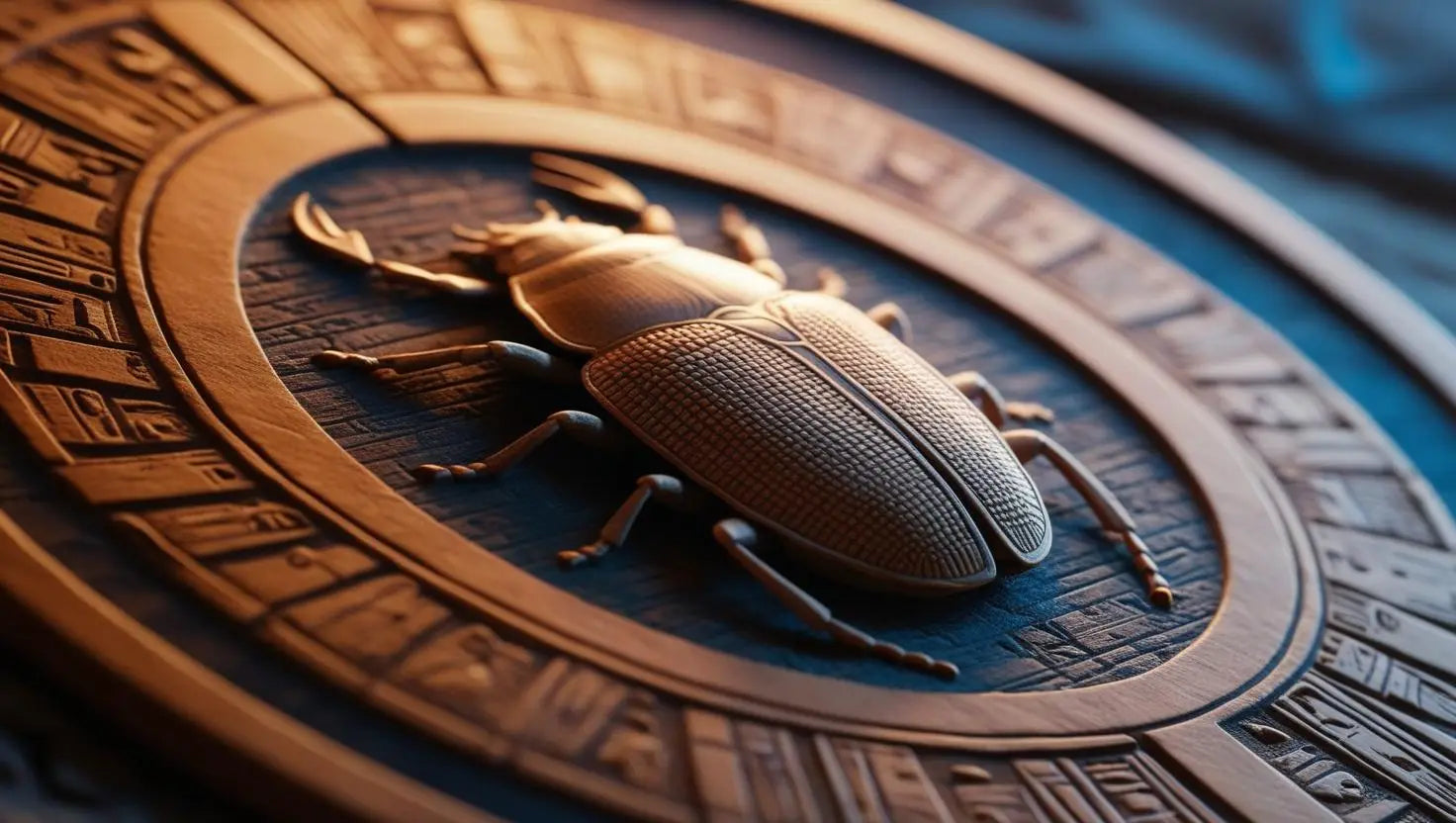
The scarab: solar rebirth
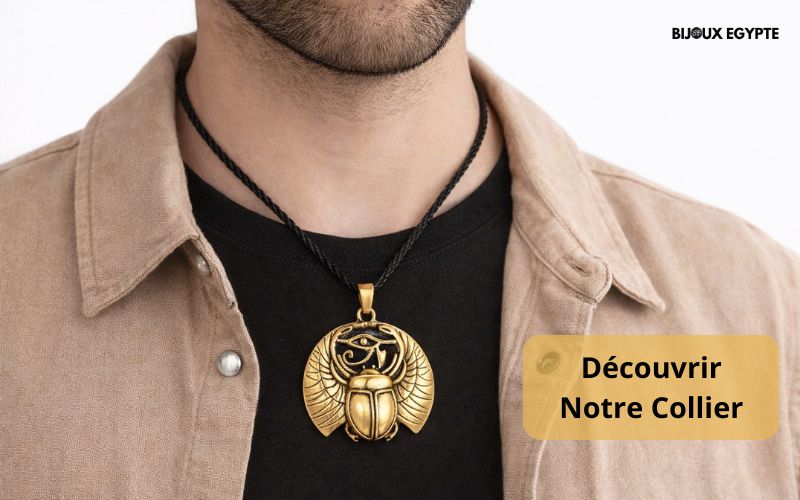
The scarab represents the god Khepri, incarnation of the rising sun. The insect pushing its ball evoked the sun's daily movement across the sky. It symbolizes rebirth, transformation, and the eternal cycle.
In funerary rites, the scarab heart was placed on the deceased's chest. It served as a witness during the judgment of the soul. This piece of jewelry condensed powerful symbolism linked to resurrection.
The Ankh: key to eternal life
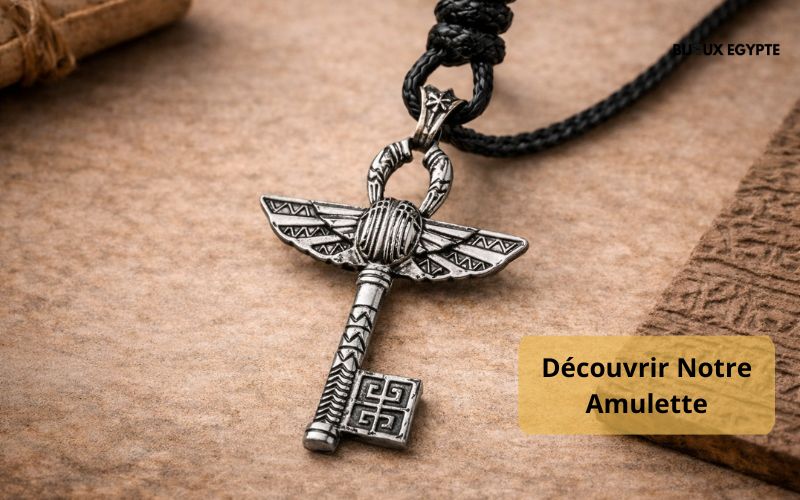
The Ankh is probably the most famous symbol. It represents eternal life and perpetual regeneration. Often held by gods in wall paintings, it is associated with the vital breath. Worn as a pendant, it becomes an amulet ensuring the soul's continuity after death.
It also embodies the union of masculine and feminine, symbolizing cosmic balance. Its symbolism goes beyond simple immortality: it represents the infinite circulation of divine energy.

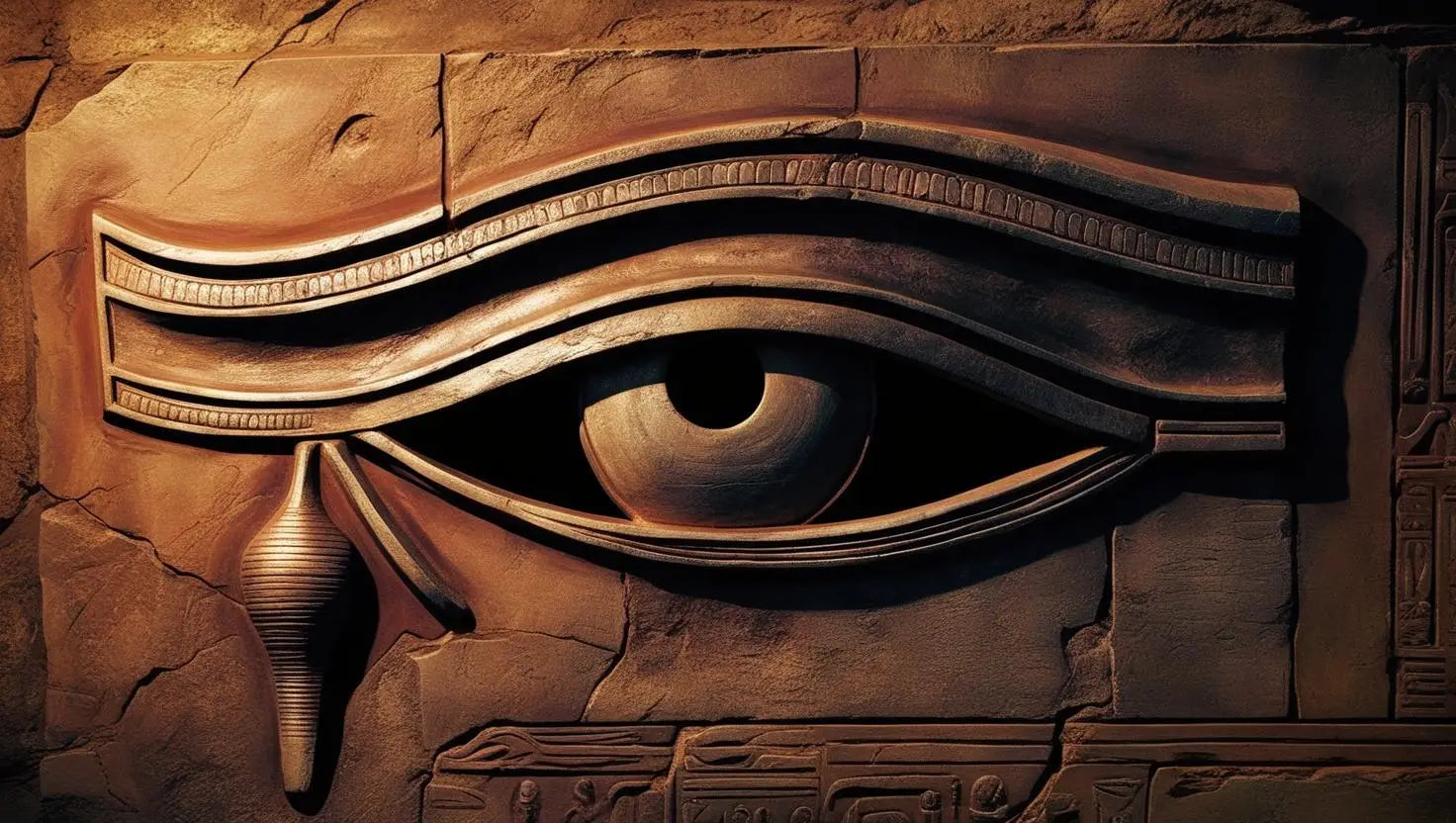
The Eye of Horus: protection and healing
The Eye of Horus, called the Wedjat, symbolizes healing and divine vigilance. According to myth, the eye was torn out during a fight against Seth and then restored. It thus becomes a symbol of restoration and recovered integrity.
Worn as jewelry, it protects against evil and promotes physical and spiritual health. It was also engraved on sarcophagi to ensure the protection of the deceased in the afterlife.
Funerary jewelry and the quest for immortality
In Egyptian culture, death was not perceived as a final disappearance, but as a transition to another form of existence.
Funerary jewelry therefore occupied an essential place in the rituals linked to the passage into the afterlife. Placed on the mummy or integrated into the wrappings, they were part of a precise set destined to preserve the deceased's spiritual identity.
Each amulet corresponded to a sacred formula meant to be activated in the invisible world.
Protective necklaces, engraved rings, and richly decorated pectorals were designed to accompany the soul during post-mortem trials.
The heart scarab played a central role during judgment, guaranteeing the sincerity of the deceased before the deities. Amulets in the shape of the Djed pillar embodied the stability and continuity of existence. Other talismans reinforced the magical protection around the mummified body.
Funerary jewelry had several functions:
-
Protection against hostile spirits
-
Maintaining body integrity
-
Strengthening the ka (vital energy)
-
Guaranteeing rebirth
This close link between jewelry, ritual, and immortality highlights the depth of the sacred symbolism attributed to these objects in Egyptian spirituality.
Jewelry and royal power
In Ancient Egypt, royal jewelry was not a matter of simple material prestige: it constituted a visible affirmation of the cosmic order embodied by the sovereign.
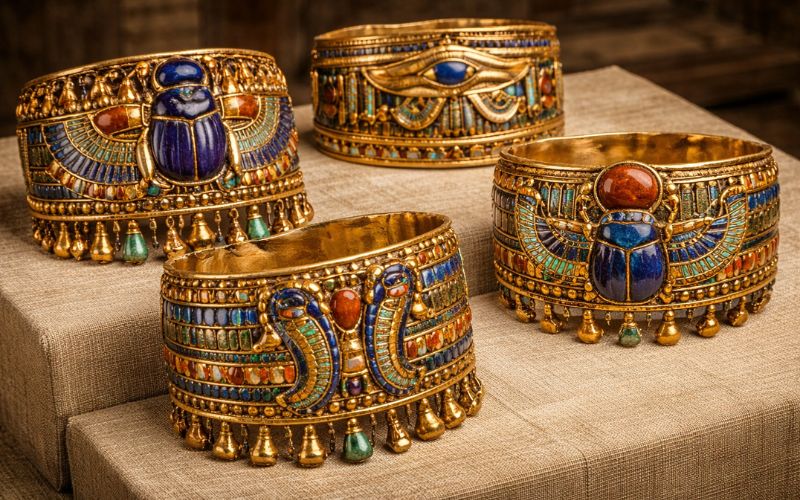
The pharaoh, considered the intermediary between gods and men, wore carefully codified ornaments. Crowns, diadems, pectorals, and bracelets were designed to affirm his sacred role and divine legitimacy in the eyes of the people.
Every visual detail contributed to the construction of an image of unquestionable authority.
Pectorals inlaid with fine stones frequently represented protective deities or scenes symbolizing the victory of order over chaos.
These compositions served as reminders that the sovereign guaranteed universal balance. Jewelry was also used during major religious ceremonies, reinforcing the sacred dimension of the royal office.
Its brilliance and richness conveyed the prosperity of the kingdom and the divine favor granted to the current reign.
Royal jewelry expressed:
-
Divine filiation
-
Domination over the forces of chaos
-
Cosmic authority
-
Dynastic continuity
Thus, the symbolism of jewelry becomes a political and religious instrument essential to the maintenance of sovereignty.
The evolution of styles through the dynasties
Over the centuries, Egyptian jewelry has undergone marked aesthetic transformations, reflecting the country's political and cultural shifts.
During the Old Kingdom, creations favored clean lines and balanced compositions, emphasizing symmetry and clarity of form. The Middle Kingdom introduced greater refinement in detail and an increased pursuit of chromatic harmony.
With the New Kingdom, goldsmithing reached an artistic peak: adornments became more imposing, more colorful, and technically sophisticated.
These stylistic evolutions reflect an increasing mastery of metallurgical techniques and stone inlaying.
Opening up to trade enriched the palette of available materials and stimulated the creativity of artisans. Yet, despite these visual transformations, the fundamental spiritual principles remained unchanged.
Protective motifs and cosmic references continued to be integrated into the compositions.
The evolution reflects:
-
Political changes
-
Trade exchanges
-
Artisan innovation
-
Religious adaptation
This continuity throughout the stylistic diversity explains the permanence of the symbolism and the enduring fascination exerted by these jewels through the ages.
The influence of Egyptian jewelry in the modern world
Even today, jewelry inspired by ancient Egypt enjoys international success and transcends trends without losing its appeal.
Iconic motifs such as the ankh, the eye of Horus, or the scarab are regularly reinterpreted in contemporary jewelry. Their strong, geometric, and immediately recognizable aesthetic is as appealing as their spiritual dimension.
They cater to a modern search for meaning, identity, and symbolic protection.
In the 20th century, the Art Deco movement contributed significantly to reintroducing Egyptian visual codes into Western design.
Major archaeological discoveries sparked a lasting craze, influencing fashion, architecture, and the decorative arts.
Today, these references are adapted to minimalist or contemporary styles while retaining their evocative power. Ancient symbolism thus finds a new expression in modern creations.
We find this influence in:
-
High jewelry collections
-
Esoteric jewelry
-
Contemporary artisan creations
-
Cultural and spiritual accessories
The Egyptian legacy continues to inspire designers and creators, confirming the timeless reach of these ancestral symbols.
FAQ about The Powerful Symbolism of Egyptian Jewelry and Its History
The symbolism of Egyptian jewelry raises many questions today, as its cultural and spiritual richness remains so fascinating.
Throughout their history, these objects have crossed the centuries while maintaining an aura of mystery and sacred power.
Archaeological research, funerary discoveries, and the study of ancient texts have shed light on part of their significance, without, however, exhausting the subject.
Each detail, whether it be a motif, a material, or a context of use, reveals a worldview deeply structured by religion and cosmology.
Many people wonder about the real scope of these jewels: were they purely spiritual, social, or political? What was their place in daily life and funerary rituals? How to explain their persistent popularity in the modern world?
This section answers the most frequently asked questions to provide clear and concise insights. It helps to better understand why the powerful symbolism of Egyptian jewelry continues to intrigue, inspire, and transmit a timeless cultural heritage.
What is the main significance of Egyptian jewelry?
They symbolize protection, rebirth, and connection to the divine. Each piece of jewelry acts as a spiritual amulet intended to protect its wearer in life and after death.
Why was gold so important in ancient Egypt?
Gold represented immortality and the flesh of the gods. Its unalterable brilliance symbolized solar eternity and divine power.
What does the scarab represent in jewelry?
The scarab symbolizes rebirth and the cycle of the sun. It was particularly used in funerary rituals to ensure resurrection.
Is the ankh only a religious symbol?
No. It represents eternal life but also cosmic balance. It has become a universal symbol of spirituality.
Did the working classes wear jewelry?
Yes, but in simpler versions. The symbolism remained present, even with less precious materials.
Why were jewels placed in tombs?
They protected the deceased and helped them on their journey to the afterlife. Each amulet had a specific function.
What jewelry did pharaohs wear in ancient Egypt?
Pharaohs wore pectorals, usekh collars, diadems, and gold bracelets inlaid with stones. These jewels affirmed their divine status and power.
What is the difference between an amulet and an Egyptian jewel?
An amulet is designed solely for protection, while a piece of jewelry can be decorative and spiritual. In ancient Egypt, most jewelry also had a protective function.
What materials did the Egyptians use to make their jewelry?
They mainly used gold, lapis lazuli, turquoise, carnelian, and faience. Each material possessed a precise symbolic meaning.
Did Egyptian jewelry have an astrological significance?
Yes, some symbols were linked to the sun, stars, and cosmic cycles, reflecting the connection between spirituality and astronomy.
Conclusion on The Powerful Symbolism of Egyptian Jewelry and Its History
The powerful symbolism of Egyptian jewelry reveals much more than a simple taste for ornamentation: it highlights a civilization where every object was meaningful.
Throughout their history, these jewels served as mediators between the human and the divine, between the visible and the invisible. They embodied daily protection, the affirmation of social status, and preparation for eternity.
Their role spanned all dimensions of Egyptian life, from royal power to funerary rites and personal spirituality.
These adornments functioned as true talismans, activating symbolic forces linked to rebirth, cosmic balance, and immortality.
Their iconographic and material richness reflected a worldview deeply structured by religion and the quest for universal harmony.
If these jewels continue to fascinate today, it is precisely because they condense complex thought into powerful and timeless visual forms.
Thus, understanding the symbolism of Egyptian jewelry means grasping the very essence of ancient spirituality and recognizing the enduring influence of this heritage in our contemporary imagination.