

Egyptian jewelry is much more than mere adornment: it is made of sacred symbols rooted in a millennia-old tradition.
The 7 Egyptian pieces of jewelry for spirituality enthusiasts each embody a specific energy, ranging from protection and rebirth to inner awakening, for those in search of meaning.
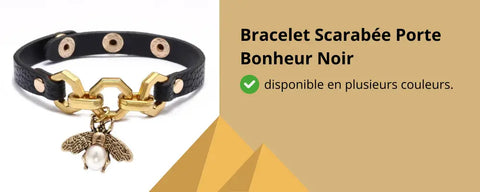
The scarab bracelet: a symbol of renewal
The scarab is associated with the solar god Khepri, representing the rising sun and daily rebirth.
In Egyptian thought, it symbolizes the perpetual movement of creation and life's capacity to emerge even from darkness. By observing this insect pushing its sphere, the ancients saw a metaphor for the sun traversing the sky.
Scarab amulets were inscribed with sacred formulas and placed over the hearts of the deceased to ensure protection and rebirth in the afterlife. Thus, this symbol embodied continuity, transformation, and victory over inertia.
Wearing a scarab bracelet today means aligning oneself with this dynamic of renewal and inner progression.
It accompanies periods of transition, reconstruction, or a search for meaning. This piece of jewelry serves as a reminder that every cycle entails a phase of effort before the blossoming of new light.
It represents perseverance, resilience, and the ability to transform experiences into personal strength. Chosen consciously, it becomes a talisman for evolution and spiritual affirmation.
Spiritual significance of the scarab
The scarab embodies several symbolic dimensions:
-
Rebirth and regeneration
-
Protection of the heart and soul
-
Inner strength in the face of transformation
-
Connection to solar energy
It is often associated with inner light and the ability to reinvent oneself. In a modern spiritual context, it becomes a symbol of conscious evolution.
Wearing this piece of jewelry helps to ground the idea that all transformation is an initiatory passage.
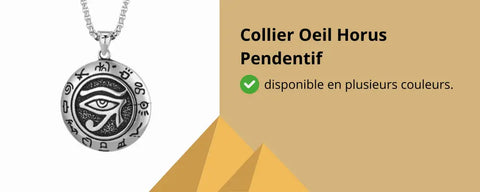
The Eye of Horus pendant: absolute protection
The Eye of Horus, also known as the Wadjet, is one of the most powerful symbols of Ancient Egypt. It is linked to the god Horus, a celestial deity embodying royal protection, vigilance, and divine justice.
According to myth, his eye was torn out during a battle against Set and later restored, becoming an emblem of healing, regained integrity, and cosmic balance.
This symbolic reconstruction reinforced its association with repair and wholeness. Used as a protective amulet, it was engraved on jewelry, sarcophagi, and ships to ward off hostile forces.
The Eye of Horus pendant is sought after today by people mindful of the subtle influences in their environment. It acts as an energy shield and a constant reminder of inner clarity.
This symbol also embodies awakened consciousness and the ability to discern truth from falsehood. Wearing this jewelry means asserting a stance of active protection and mental clarity.
It is particularly well-suited for those who wish to strengthen their emotional stability and preserve their spiritual balance in the face of external tensions.
Powers attributed to the Eye of Horus
Ancient traditions attributed a protective and stabilizing dimension to the Eye of Horus, essential in both daily life and sacred rites.
It was perceived as a symbol of restored integrity and inner coherence in the face of imbalances.
Ancient beliefs recognized it for, among other things:
-
Protection against evil and the evil eye
-
Restoration of spiritual integrity
-
Harmonization of energies
-
Support during periods of vulnerability
In a contemporary interpretation, it evokes conscious vigilance, emotional mastery, and the ability to maintain one's balance against external influences.
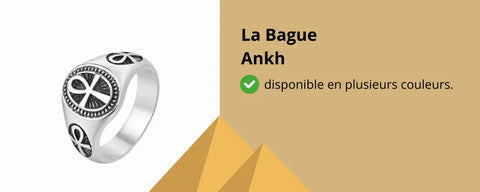
The Ankh ring: the key of life
The Ankh, often called the cross of life, is one of the most iconic hieroglyphs of Ancient Egypt.
This sacred symbol frequently appears in religious scenes, held by deities bestowing the breath of life upon sovereigns.
Its shape, consisting of a loop surmounting a cross, evokes the union between the celestial principle and the earthly plane. It embodies eternal life, vitality, and the continuity of existence beyond physical death.
The Ankh ring thus becomes a constant reminder of the sacred dimension of the human condition and the invisible energy that animates all things.
In ancient iconography, the Ankh was associated with prosperity, longevity, and divine protection.
Wearing an Ankh ring today symbolizes a connection to a universal and timeless life force. It attracts those engaged in meditation, self-knowledge, or inner harmonization.
This piece of jewelry represents the union of polarities, emotional stability, and personal alignment. It serves as a reminder that life is a continuous flow connecting the visible and the invisible, matter and spirit, action and consciousness.
The Ankh in modern spirituality
In contemporary spiritual approaches, the Ankh transcends its historical context to become a universal symbol of harmony and expanded consciousness.
It is often used as a meditation aid or as a visual reminder of inner alignment.
In current practices, the Ankh evokes:
-
The immortality of the soul
-
Balance between masculine and feminine
-
Spiritual consciousness
-
The continuity of the life cycle
It also represents personal responsibility toward one's own journey and invites the cultivation of coherence, vitality, and conscious presence in everyday life.
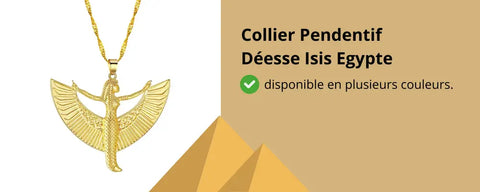
The Goddess Isis necklace: embody feminine power
The goddess Isis is one of the major figures of the Egyptian pantheon and one of the most powerful feminine archetypes of antiquity. She embodies sacred magic, protective motherhood, and divine wisdom.
As the wife of Osiris and mother of Horus, she symbolizes fidelity, resilience, and the ability to restore order after chaos. In mythological accounts, she reconstitutes the body of Osiris, demonstrating her mastery of invisible forces and her unwavering determination.
Her cult spread as far as the Greco-Roman world, a testament to her enduring spiritual influence.
The Goddess Isis necklace is chosen by those who wish to assert their inner power with awareness and elegance. It represents maternal protection, but also strategic intelligence and emotional depth.
On an energetic level, it evokes fertile creativity and the ability to transform trials into structuring experiences. This piece of jewelry thus becomes a symbol of emancipation, personal sovereignty, and spiritual grounding.
It accompanies women who wish to honor their intuition while cultivating stability and inner strength.
The sacred attributes of Isis
A major figure of the sacred feminine, Isis embodies a spiritual authority founded on knowledge, patience, and mastery of subtle forces.
Her image is often associated with the throne, a symbol of legitimacy and stability. She represents a reflected power, capable of acting with discernment and depth.
Isis is traditionally linked to:
-
Protective magic
-
Healing
-
Unconditional love
-
Transmission of knowledge
Her symbolism invites the development of inner wisdom, a sense of responsibility, and trust in one's intuitive abilities.
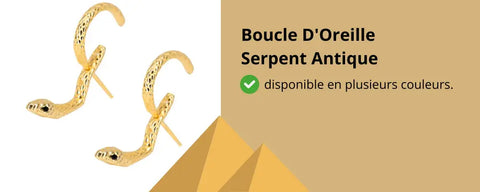
Serpent earrings: awakening and intuition
The serpent occupies a central place in Egyptian symbolism and appears in numerous sacred representations.
It is notably associated with the uraeus, the upright cobra visible on the pharaohs' headdress, a sign of sovereignty and celestial protection. This sacred reptile embodied constant vigilance and controlled power.
Its ability to shed its skin made it a natural symbol of transformation, rebirth, and cyclical evolution. In temples and on royal crowns, it represented a protective energy ready to neutralize any invisible threat.
Snake earrings now convey this dimension of awakening and inner clarity. They symbolize the capacity to let go of limiting patterns and move forward with consciousness.
The snake also evokes a refined instinct and a subtle perception of one's environment. Wearing this piece of jewelry is akin to affirming a stance of intelligent adaptation in the face of change.
It is particularly well-suited for people engaged in work on introspection or the development of their intuition. This symbol reminds us that personal transformation requires courage, observation, and self-mastery.
Symbolism of the ancient snake
In Egyptian symbolic thought, the snake embodies instinctive intelligence and energy in perpetual motion.
Its upright posture evokes attention, responsiveness, and silent mastery. It represents a latent force capable of manifesting with precision at the opportune moment.
The snake is traditionally associated with:
-
Ancestral wisdom
-
Deep transformation
-
Royal protection
-
Awakening of consciousness
Its image also suggests the ability to adapt and maintain clarity in the face of life's cycles.
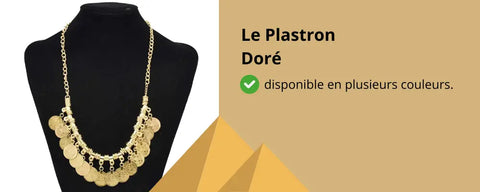
The Tutankhamun pectoral: the glamour of the sacred
The pharaoh Tutankhamun remains one of the most famous figures of ancient Egypt, notably thanks to the spectacular discovery of his almost intact tomb in the 20th century.
The treasures brought to light revealed exceptional artistic refinement and an advanced mastery of goldsmithing. Among these sacred objects were richly decorated pectorals, composed of gold, semi-precious stones, and protective symbols.
These pieces were not merely ornaments, but ritual supports embodying the divine power granted to the sovereign. Every detail reflected the cosmic order and the pharaoh's spiritual legitimacy.
A pectoral inspired by this legacy evokes majesty, presence, and a connection to the sacred today. It symbolizes inner authority, responsibility, and nobility of soul.
This type of jewelry is often chosen for ceremonies, symbolic events, or moments of deep meditation. It acts as a tangible reminder of personal dignity and spiritual verticality.
Wearing a royal-style pectoral is akin to asserting a strong and conscious presence, anchored in a thousand-year-old tradition of balance between power and spirituality.
The role of pectorals in ancient Egypt
In a royal and ceremonial context, pectorals held a highly symbolic and identity-defining function.
Placed on the chest, they materialized the vital center and asserted the sacred dimension of the sovereign. Their composition followed a precise codification mixing iconography, colors, and noble materials.
Pectorals served to:
-
Symbolically protect the heart
-
Assert sacred status
-
Honor the deities
-
Reinforce the ritual dimension
They represented a visual synthesis of legitimate power, connecting earthly authority and cosmic order.
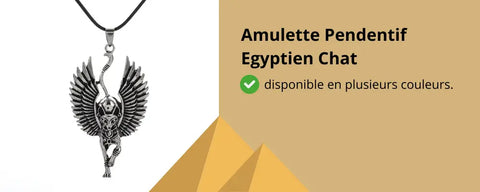
The Bastet amulet: the protective totem animal
The goddess Bastet is represented in the form of a cat or a cat-headed woman, the incarnation of a power that is both gentle and formidable.
She was particularly venerated in the city of Bubastis, where great festivals were dedicated to her. Bastet embodies the protection of the home, fertility, and family stability.
In ancient Egypt, cats were considered sacred, protected by strict laws, and associated with domestic prosperity. Feline symbolism expressed silent vigilance and the ability to react with precision.
The Bastet amulet is chosen as a protective talisman to reinforce inner security and emotional grounding.
It represents a sharp instinct, natural grace, and the ability to defend one's space without excessive aggression. On a spiritual level, it evokes independence, discreet intuition, and self-control.
Wearing this piece of jewelry is akin to cultivating a calm strength, capable of observing before acting. It is suitable for those seeking protection, relational balance, and daily harmony, while maintaining their autonomy.
The spiritual virtues of Bastet
In symbolic tradition, Bastet represents a protective energy based on mastery and clarity.
Her image evokes the ability to preserve one's space while maintaining a balanced attitude. She embodies a calm authority, capable of firmness without excess.
Bastet is traditionally associated with:
-
Protection of the home
-
Emotional balance
-
Independence
-
Gentle strength
Her symbolism encourages autonomy, inner vigilance, and harmony in daily relationships.
Why Egyptian jewelry remains fascinating today
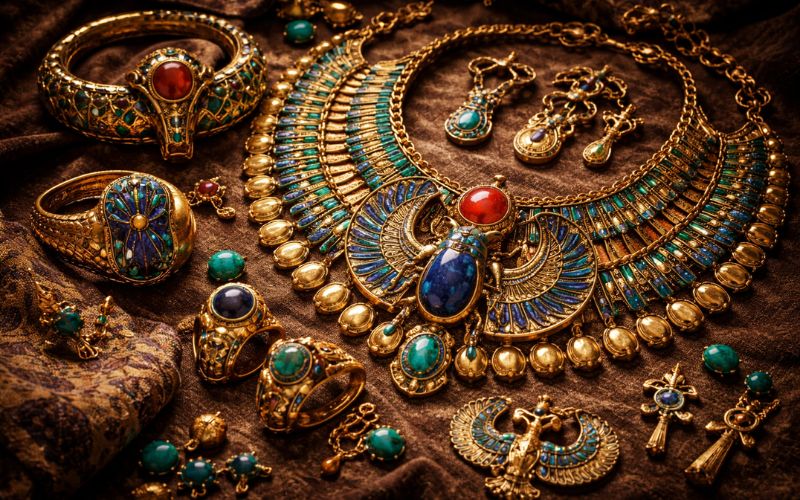
Egyptian symbols have crossed the centuries thanks to their spiritual richness and the coherence of their cosmology. They combine refined aesthetics, structured mythology, and an energetic dimension deeply rooted in the worldview of antiquity.
Each piece of jewelry tells a story rooted in a thousand-year-old civilization where art, religion, and power were intimately linked.
The shapes, colors, and materials used followed a precise symbolic logic, often connected to natural elements and invisible forces. This historical depth reinforces their contemporary appeal and feeds the collective imagination.
Today, this jewelry meets a modern quest for meaning, identity, and a connection to something greater than oneself. They allow one to express a spiritual sensitivity while wearing an aesthetic object charged with strong symbols.
Their popularity is explained by the subtle balance between ancient heritage and contemporary interpretation. They integrate easily into varied styles while maintaining their sacred dimension.
By wearing these symbols, many seek to affirm a more conscious worldview, connecting tradition, spirituality, and personal expression.
FAQ about The 7 Egyptian jewelry pieces for spirituality enthusiasts
Egyptian jewelry raises many questions, as its symbolism is so rich and ancient.
Before choosing a talisman inspired by ancient Egypt, it is natural to want to understand the deep meaning of each symbol, its mythological origin, and its traditional use.
The 7 Egyptian jewelry pieces for spirituality enthusiasts are not just aesthetic accessories: they carry a cultural, religious, and energetic dimension that is as intriguing as it is fascinating.
Through this FAQ on The 7 Egyptian jewelry pieces for spirituality enthusiasts, we address the questions most frequently asked by internet users.
Spiritual meaning, choosing the right symbol, protective scope, or historical context: each point deserves to be clarified with precision.
This section will help you better understand the symbolic legacy of these sacred jewels and make an informed choice in accordance with your personal sensitivity and spiritual journey.
What is the spiritual meaning of Egyptian jewelry?
Egyptian jewelry is associated with sacred symbols linked to protection, rebirth, and awakening. Each motif has a precise meaning derived from ancient mythology. They are considered energetic talismans.
Which Egyptian jewelry piece should I choose for protection?
The Eye of Horus and the Bastet amulet are the most associated with protection. They symbolize divine vigilance and the protection of the home, respectively. The scarab also protects the symbolic heart.
Is the scarab lucky?
Yes, it is traditionally linked to rebirth and renewal. In ancient Egypt, it symbolized resurrection and transformation. It is often worn during periods of change.
Is the Ankh a religious symbol?
Originally, the Ankh is a sacred symbol representing eternal life. It was used in a religious and funerary context. Today, it is interpreted as a sign of spiritual balance.
Can you give Egyptian jewelry to someone new to spirituality?
Yes, this jewelry is accessible to everyone. Its simple and powerful symbolism makes it an excellent entry point. It allows for the discovery of the world of sacred symbols.
Conclusion on The 7 Egyptian jewelry pieces for spirituality enthusiasts
The 7 Egyptian jewelry pieces for spirituality enthusiasts should not be perceived as simple ornaments inspired by an ancient civilization.
They represent a powerful symbolic heritage, shaped by millennia of beliefs, rites, and sacred representations.
Each piece of jewelry studied, from the scarab to the Eye of Horus, from the Ankh to Bastet, embodies a specific energy: protection, rebirth, balance, intuition, or inner sovereignty. Their strength lies in this ability to connect the contemporary individual to a worldview where the visible and the invisible coexist.
These symbols continue to fascinate because they address universal concerns: seeking protection, evolving, understanding one's place in the world, and asserting one's spiritual identity.
Choosing one of these pieces of jewelry is like selecting an archetype that resonates with one’s own journey. Thus, these talismans become daily reminders of intention, awareness, and personal alignment.
The 7 Egyptian jewelry pieces for spirituality enthusiasts therefore offer much more than a distinctive style: they provide a lasting symbolic connection between ancestral tradition and the modern inner quest.