

Since antiquity, the Egyptian scarab has intrigued and fascinated due to the richness of its symbolism. Associated with the rising sun, rebirth, and protection, it occupies an essential place in the beliefs of ancient Egypt.
Through its history, its uses, and its spiritual significance, the scarab reveals a worldview based on the eternal cycle of life and the power of transformation.
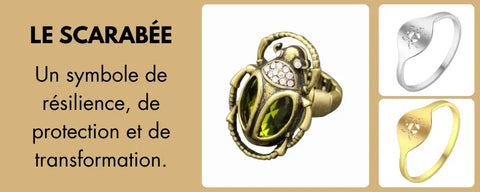
Origin of the scarab in ancient Egypt
The sacred scarab, inspired by the Scarabaeus sacer beetle, has been observed since the Old Kingdom.
The Egyptians noticed that the insect forms a ball of dung which it rolls across the ground, a gesture symbolically associated with the movement of the sun across the sky.
This cosmic analogy transformed a simple insect into a living representation of the solar cycle. The scarab thus became a religious emblem deeply rooted in pharaonic culture.
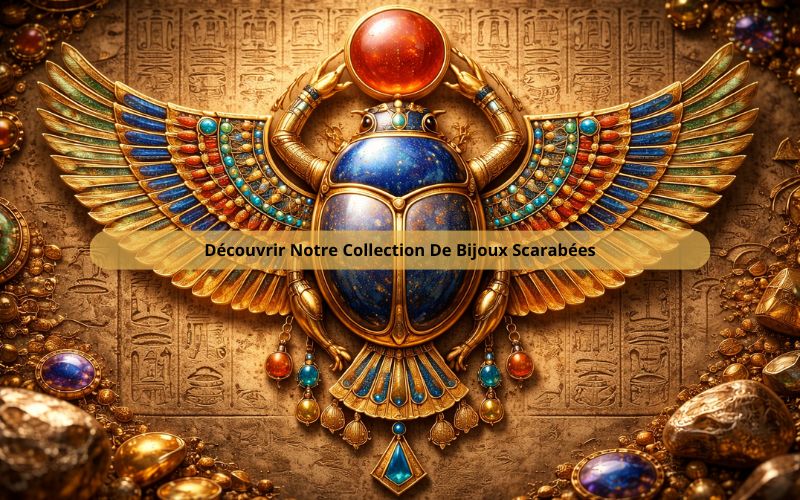
The motif appears everywhere: in tombs, temples, and everyday objects. It was engraved in stone, sculpted in faience, and carved from semi-precious stones such as lapis lazuli or carnelian.
Its image went beyond mere decoration to become a cosmological symbol. It embodied the principle of permanent rebirth, a direct reflection of the sun rising daily over the Nile.
Artisans developed different types of scarabs according to their use: administrative seals, protective amulets, or funerary objects.
Each piece sometimes bore hieroglyphic inscriptions mentioning the name of a pharaoh or a sacred formula. Thus, the scarab became a bridge between political power and the spiritual dimension.
The scarab and the solar god Khepri
The scarab is closely linked to Khepri, a deity representing the rising sun. Khepri symbolizes the daily birth of the solar orb, complementary to Ra at midday and Atum at dusk.
In the form of a man with a scarab head, he embodies perpetual renewal.
In Egyptian theology, Khepri pushes the sun just as the scarab pushes its sphere. This image conveys a cyclical conception of time. Each dawn is a victory over nocturnal chaos, a cosmic rebirth.
The scarab thus becomes a visual metaphor for continuous creation. Wearing its image is equivalent to associating oneself with this dynamic of regeneration.
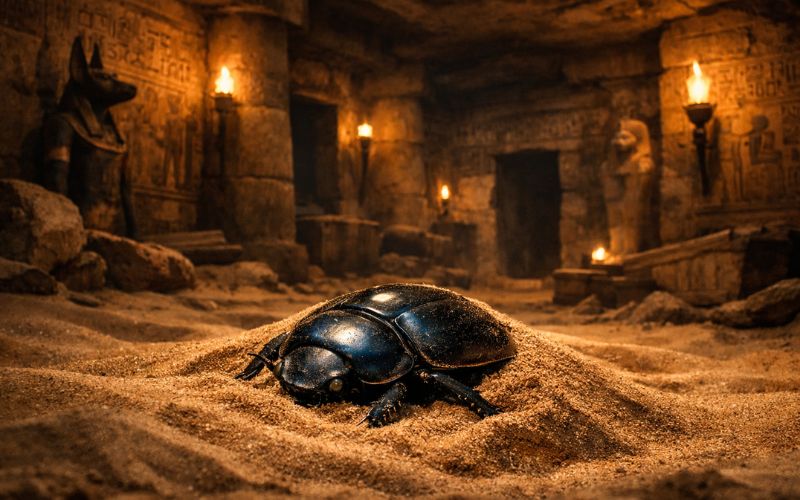
The scarab as a symbol of renewal
The concept of rebirth is central to Egyptian spirituality. Every year, the Nile floods, fertilizes the land, and then recedes, creating life anew.
The sun disappears every evening only to be reborn at dawn. The scarab embodies this uninterrupted cycle and becomes a living image of cosmic renewal.
In funerary rites, it symbolizes the transformation of the soul. Death is not an end, but a transition to a new existence.
This vision explains why the scarab is so often placed with the deceased. It represents the invisible continuity between the earthly world and the afterlife.
The oval shape of the scarab also evokes the primordial egg, the source of creation in certain Egyptian cosmogonies.
It suggests the silent germination of a new life. This dimension explains its current appeal during periods of personal or spiritual transition.
Even today, the scarab is associated with:
-
A new beginning
-
Inner transformation
-
Resilience in the face of hardship
-
Energetic renewal
It embodies the ability to be reborn after a difficulty, to rebuild oneself after a trial, and to move forward with renewed strength, faithful to the idea of an eternal cycle.
The heart scarab in funerary rites
The heart scarab was placed on the chest of mummies. It symbolically replaced the heart during judgment in the afterlife. Engraved with excerpts from the Book of the Dead, it protected the deceased before the divine tribunal.
Its function was clear: to prevent the heart from testifying against its owner. It became a talisman ensuring a favorable rebirth.
This funerary use reinforces the idea that the scarab is intimately linked to the survival of the soul and to eternity.
The scarab as a protective talisman
Beyond renewal, the scarab is a powerful symbol of Protection in the Egyptian tradition.
The Egyptians wore it to guard against invisible forces deemed hostile and to attract divine benevolence. It served as both a daily amulet and a sacred object, integrated into private life as well as ritual practices.
Engraved scarabs were often used as personal seals. Mounted on rings or fixed to swivel mounts, they were used to authenticate documents by stamping a unique mark into clay.
This practical function reinforced their symbolic value, combining legal protection and legitimate authority.
In daily life, men, women, and children wore scarab-shaped amulets suspended from necklaces or sewn into clothing.
It was believed they strengthened vitality, promoted prosperity, and warded off harmful influences. The scarab thus became a discreet companion, a guarantor of balance and security.
Today, this symbolism continues to inspire. The scarab is perceived as:
-
A shield against negative energies
-
A universal good-luck charm
-
A symbol of inner stability
-
A reminder of strength and perseverance
Its symbolic power transcends the centuries and retains a deeply protective resonance.
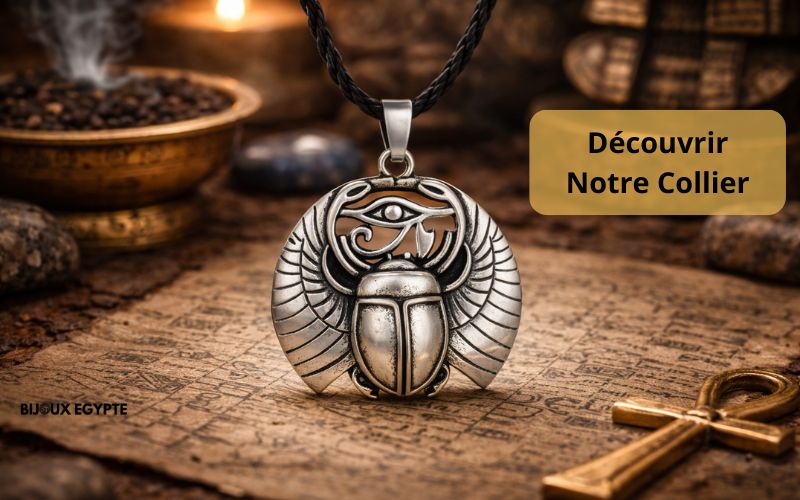
The scarab in Egyptian art and craftsmanship
The scarab occupies a major place in the decorative art of ancient Egypt.
It appears on jewelry, necklaces, bracelets, and rings. Artisans used blue faience, a symbol of regeneration and fertile water.
This vibrant hue recalled the waters of the Nile and reinforced the sacred dimension of the object.
Its stylized form follows precise codes. The rounded back and legs are simplified, while the flat base often bears finely engraved hieroglyphic inscriptions.
These inscriptions could mention a royal name, a title, or a protective formula intended to attract divine favor.
Commemorative scarabs were produced under certain pharaohs to celebrate political events, alliances, or victories.
They circulated as prestige objects and asserted the authority of the sovereign. Their distribution helped reinforce the image of sacred power.
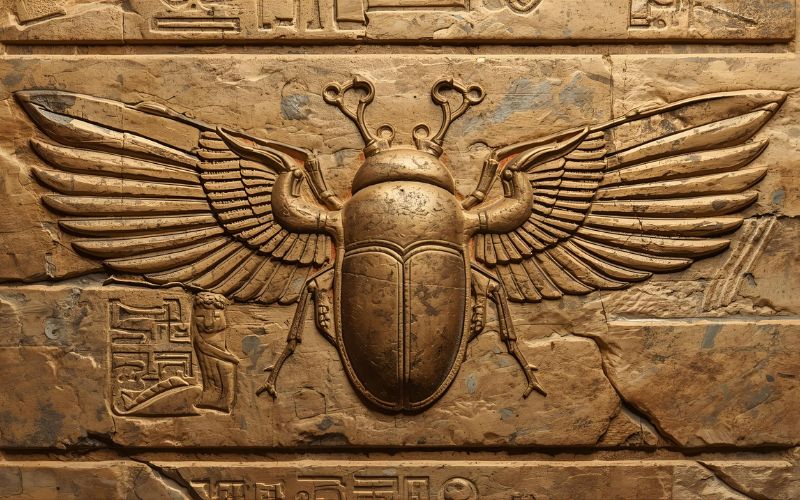
The motif is also found in wall frescoes and monumental bas-reliefs. It symbolizes the divine protection granted to the sovereign and the cosmic order maintained by royalty.
The aesthetics of the scarab combine balance of form and symbolic intensity.
Materials and manufacturing techniques
The scarab occupies a major place in the decorative art of ancient Egypt and reflects a true pursuit of visual harmony.
It is found on jewelry, necklaces, bracelets, and rings, but also integrated into pectorals and ceremonial ornaments.
-
Egyptian faience
-
Basalt
-
Glazed steatite
-
Semi-precious stones
Engraving was carried out with remarkable precision. Each scarab was polished to obtain a smooth and shiny surface.
This technical mastery testifies to the exceptional know-how of Egyptian workshops.
Why the scarab still fascinates today
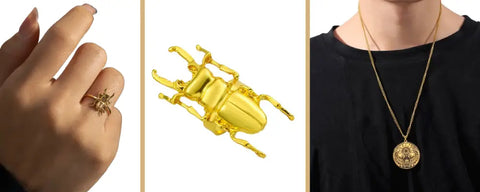
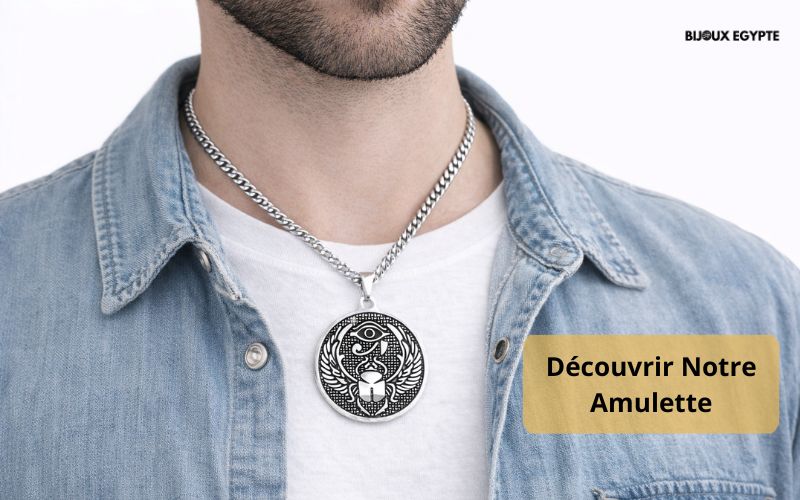
The scarab retains a strong symbolic dimension in contemporary culture. It is present in museum collections around the world and inspires modern jewelry.
Its image immediately evokes ancient Egypt and its mystery. This universal recognition contributes to the enduring power of the symbol.
It responds to a timeless quest: that of rebirth and Protection. In a world in constant flux, this symbol reassures with its millennial stability.
It represents a rare historical continuity, capable of crossing civilizations without losing its deep meaning.
The scarab also embodies a timeless aesthetic. Its symmetrical and balanced form appeals to contemporary designers. Minimalist yet charged with meaning, it integrates well into both classic and modern styles.
This versatility explains its growing popularity in accessories and decorative objects.
For many, wearing a scarab means asserting a connection to history, a desire for transformation, a search for balance, and a symbolic protection.
It remains a powerful archetype of resilience, capable of bridging past and present while offering a spiritual dimension that is discreet yet deeply rooted.
The scarab in Egyptian society: daily uses and social dimension
Beyond its religious and funerary significance, the scarab held a tangible place in the social organization of ancient Egypt.
It was not reserved solely for the elite or sacred contexts, but circulated widely among different layers of the population. Archaeological excavations have unearthed scarabs in homes, workshops, and commercial contexts, attesting to their everyday use.
Some served as administrative seals to seal jars, contracts, or goods, playing a key role in economic exchanges.
The scarab also played a part in personal identity. Engraved with the name of its owner or a protective formula, it became a social and symbolic marker.
In some cases, it reflected status, function, or belonging to an institution. Diplomatic scarabs, found outside of Egypt, also bear witness to international relations and cultural exchanges with the Near East.
Thus, the scarab was not just a spiritual symbol, but an object integrated into political, economic, and social realities. This versatility partly explains its exceptional longevity and its importance in Egyptian history.
The legacy of the Egyptian scarab in modern culture and spirituality
The influence of the Egyptian scarab did not end with the fall of the pharaohs. Over the centuries, this symbol has traversed eras to integrate into different cultures and spiritual movements.
Rediscovered during the major archaeological campaigns of the 19th century, it became a popular motif in Western art, fashion, and jewelry. Its ancient aesthetic is appealing, but it is above all its symbolic weight that allows it to endure.
In contemporary spiritual approaches, the scarab is often interpreted as an emblem of personal transformation.
It is associated with the ability to overcome hardships, to be reborn after a difficult period, and to regain inner balance. Some see it as a symbol of energetic protection, others as a constant reminder of the natural cycle of life.
The scarab also appears in literature, cinema, and popular culture, where it embodies the mystery and wisdom of ancient Egypt.
This continuous presence proves that its message remains universal. A millennial legacy turned timeless, the scarab retains a symbolic strength capable of dialoguing with modern sensibilities while honoring its ancestral roots.
FAQ about the Egyptian Scarab: Symbol of Renewal and Protection
For centuries, the Egyptian scarab has sparked many questions, both about its spiritual meaning and its role in pharaonic civilization.
A powerful symbol of renewal and protection, it occupies a central place in the beliefs, funerary rites, and sacred art of ancient Egypt.
Its presence in tombs, temples, and jewelry naturally raises questions about its exact function and symbolic reach.
Even today, the scarab continues to intrigue historians, Egyptology enthusiasts, and lovers of ancient symbols. Many seek to understand its connection to the solar cycle, its association with deities, and its place in the daily life of the Egyptians.
Others wonder about its modern use in jewelry and the meaning it can hold in a contemporary context.
This FAQ section on the Egyptian Scarab: Symbol of Renewal and Protection gathers the most frequently asked questions to provide precise and accessible clarifications.
It allows for a better grasp of the cultural and spiritual richness of this millennial symbol, which remains meaningful today.
What is the meaning of the scarab in ancient Egypt?
The scarab symbolizes rebirth, the solar cycle, and protection. It is associated with the god Khepri, representing the rising sun. It embodies the constant renewal of life.
Why were scarabs placed on mummies?
The heart scarab protected the deceased during judgment in the afterlife. It prevented the heart from testifying against them. It promoted a positive rebirth.
Is the scarab a good luck charm?
Yes, in antiquity, it was considered a protective amulet. Even today, it is perceived as a symbol of luck and spiritual protection.
What is the difference between a scarab and a heart scarab?
The classic scarab could serve as an amulet or seal. The heart scarab was specifically intended for funerary rites. It bore sacred inscriptions.
Can we wear scarab jewelry today?
Yes, it is often worn as a symbol of renewal and protection. It can accompany a period of change or mark a new beginning.
What materials were used to make scarabs?
The Egyptians used faience, steatite, basalt, and various semi-precious stones. Scarabs could be glazed or engraved.
Is the Egyptian scarab linked to a specific god?
Yes, the scarab is primarily associated with the solar god Khepri. It represents the rising sun and creation renewed each day. This association reinforces its symbolism of rebirth and perpetual transformation.
What does a scarab symbolize in a dream?
In modern symbolic interpretation, dreaming of a scarab can evoke renewal, personal evolution, or the end of a cycle. It can also represent protection and inner strength in the face of change. The meaning varies according to the context of the dream.
Is the scarab a symbol of luck?
Yes, the scarab is often considered a good luck charm. In antiquity, it was worn as a protective amulet. Even today, it symbolizes luck, prosperity, and spiritual protection.
Why is the scarab often blue?
The color blue, common in faience scarabs, symbolizes water, the sky, and regeneration. It is linked to the Nile and fertility. This hue reinforced the sacred and protective dimension of the object.
Conclusion on the Egyptian Scarab: Symbol of Renewal and Protection
The Egyptian scarab is much more than a simple motif inherited from antiquity: it is the profound expression of a worldview based on cycles, transformation, and balance.
Through its connection with the rising sun, funerary rites, and daily protective practices, it embodies a clear answer to the central question of this article: why has the scarab become a symbol of renewal and protection?
Because it represents, in Egyptian thought, the ability of life to constantly regenerate itself and that of the human being to endure hardships under divine protection.
Both a talisman, a solar emblem, and an art object, the scarab synthesizes essential notions such as rebirth, continuity, and inner strength.
Its image reassures, inspires, and connects the individual to a millennial tradition. Even today, it retains this dual dimension: historical and spiritual.
The scarab thus remains a universal symbol, carrying hope, resilience, and lasting protection through time.