
The Eye of Horus is one of the most iconic symbols of ancient Egypt. Associated with the god Horus, it represents protection, healing, and balance in pharaonic culture. Present in temples, frescoes, and amulets, this symbol occupies a central place in the art and spirituality of ancient Egypt.
Mythological origin of the Eye of Horus
In Egyptian mythology, the Eye of Horus is directly linked to the legendary battle between Horus and Seth. Horus is the son of the god Osiris and the goddess Isis, two central deities in the Egyptian religion. After the assassination of Osiris by Seth, Horus decides to avenge his father and restore order to the world. This mythological conflict symbolizes the eternal struggle between order and chaos.
During this battle, Horus loses his left eye, often associated with the moon in Egyptian symbolism. This loss represents a moment of cosmic imbalance. However, the god Thoth intervenes to restore the wounded eye, thereby returning it to its power and integrity.
The healing of the eye transforms this symbol into a sign of rebirth and protection. The Egyptians interpreted this event as proof that order and harmony can always be restored after a period of chaos.
This mythological story explains why the Eye of Horus became such an important symbol in Egyptian religion and art. Artists often depicted this symbol to recall the victory of order over disorder and to invoke divine protection.

The battle between Horus and Seth
The battle between Horus and Seth is one of the most famous tales in Egyptian mythology and represents the confrontation between order and chaos. Seth is associated with storms, the desert, and destructive forces, while Horus embodies justice and divine royalty. This opposition symbolizes the fragile balance of the world.
In artistic representations, Horus often appears in the form of a falcon fighting Seth. These scenes are carved into temples and monuments to recall the victory of order over chaotic forces. They also served to legitimize the power of the pharaohs.
The restoration of the Eye by Thoth
After the battle, the god Thoth intervenes to restore Horus's lost eye. Thoth is the deity of wisdom, writing, and knowledge in the Egyptian religion. His ability to heal the eye symbolizes the return to cosmic harmony.
This restoration gives rise to the symbol called the Wadjet, which means "intact eye" or "restored eye." In Egyptian art and religion, this eye becomes a powerful talisman of protection.
The healing of the eye reinforces the idea that wisdom and knowledge allow for the restoration of the world's balance.

The Eye of Horus as a sacred symbol
In Egyptian civilization, the Eye of Horus was considered a sacred symbol endowed with powerful spiritual powers. Egyptians believed this sign had the ability to protect individuals from the forces of evil and bring healing. This belief explains why the symbol appears in many religious objects and rituals.
The Eye of Horus was often worn in the form of an amulet. Artisans used various materials such as faience, gold, or precious stones to craft these protective objects. Each material held symbolic meaning related to spirituality and protection.
In the religious thought of ancient Egypt, this symbol also represented the balance between various forces of the universe. It was associated with the moon, divine vision, and the ability to perceive cosmic order.
Temples and sacred places also used this symbol as a protective element. Priests engraved the Eye of Horus on walls and ritual objects to invoke divine protection.
Thanks to these beliefs, the Eye of Horus became one of the most powerful and widespread symbols of Egyptian art.
Religious meaning of the symbol
In the Egyptian religion, the Eye of Horus held several important spiritual meanings. Above all, it represented divine protection and the ability to repel negative forces. Egyptians believed this symbol could protect both the living and the dead.
It was also associated with healing and regeneration. The restoration of the eye by Thoth symbolizes the world's capacity to regain balance after a period of chaos.
This symbol also represents clairvoyance and divine wisdom.
The Eye of Horus in religious rituals
In religious rituals, the Eye of Horus was used to protect temples and sacred places. Priests performed ceremonies where this symbol played a central role.
In funerary rites, the eye was placed on sarcophagi or mummies to ensure the protection of the deceased in the afterlife. Funerary texts also mention this symbol as a source of spiritual protection.
These practices demonstrate the religious importance of the symbol in Egyptian culture.

Representations of the Eye of Horus in Egyptian art
The Eye of Horus occupies an essential place in the art of ancient Egypt. This symbol appears in many artistic forms, including wall frescoes, sculptures, ritual objects, and jewelry. Egyptian artists used this motif to convey religious and symbolic messages.
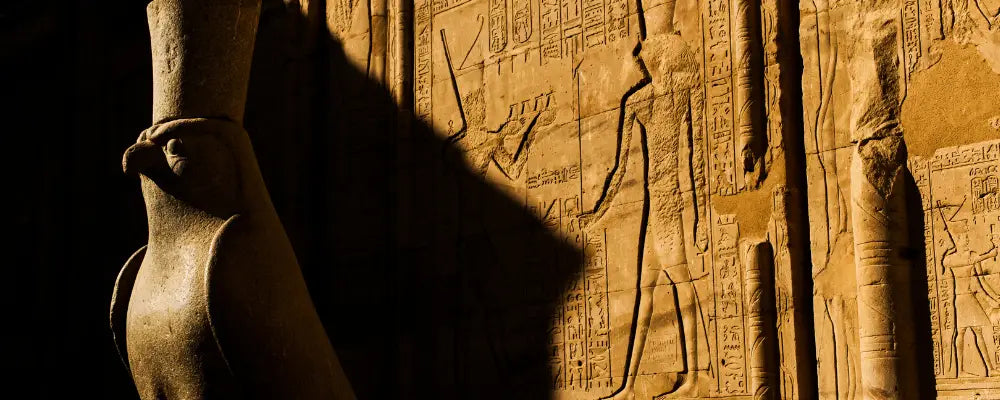
In temples, the Eye of Horus was often engraved in reliefs sculpted on the walls. The function of these images was to protect sacred places and invoke divine presence. Wall frescoes also depicted this symbol in mythological or religious scenes.
Egyptian artists adhered to strict rules of proportion and style. The Eye of Horus was depicted with precise lines and a stylized form that is easily recognizable.
This symbol also appeared on funerary objects intended to accompany the deceased into the afterlife. Sarcophagi and mummy wrappings were sometimes decorated with this protective motif.
Thanks to these numerous representations, the Eye of Horus became one of the most iconic elements of Egyptian iconography.
The Eye of Horus in frescoes and reliefs
In the temples and tombs of ancient Egypt, wall frescoes frequently depict the Eye of Horus. Artists used natural pigments derived from minerals to create colorful and durable images that could withstand time. These paintings often decorated the walls of sanctuaries and burial chambers.
These frescoes told mythological tales or represented religious scenes linked to the gods. The Eye of Horus appeared therein as a protective symbol, observing the sacred places and watching over the deceased. Today, these works allow archaeologists to better understand the beliefs and religious symbolism of ancient Egypt.
Sculptures and statues representing Horus
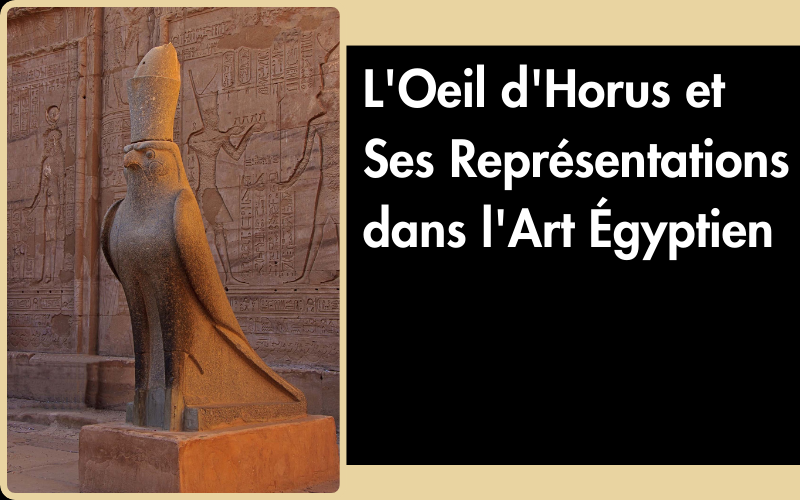
Egyptian sculptures often represent the god Horus in the form of a majestic falcon or a man with a falcon's head. This sacred animal symbolizes divine power, protection, and the celestial vision of the god. Statues of Horus were often placed in temples to recall the protective presence of the deity.
In some sculptures or ritual objects, the Eye of Horus appears as an engraved or sculpted symbol. These works were installed in sanctuaries or near altars dedicated to the gods. They bear witness to the importance of Horus and his symbol in the religious art of ancient Egypt.

The Eye of Horus in jewelry and amulets
Jewelry held an important place in the society of ancient Egypt. Among the symbols most used in jewelry is the Eye of Horus, considered a powerful talisman of protection. Egyptians believed that wearing this symbol allowed one to benefit from the protection of the gods.
Artisans crafted these amulets using various materials such as gold, faience, or precious stones. Each material held a specific meaning related to spirituality and protection.
These pieces of jewelry were worn by the living but also placed in tombs to accompany the deceased into the afterlife. Archaeologists have found numerous amulets in Egyptian burials.
The Eye of Horus also appears in necklaces, bracelets, and rings from the ancient era. These objects were sometimes given as gifts or used during religious ceremonies.
Thanks to its distinctive aesthetic and its spiritual significance, this symbol became a major element of Egyptian craftsmanship and decorative art.
Materials used for amulets
Egyptian artisans used several materials to craft amulets representing the Eye of Horus. Each material held symbolic meaning related to religious beliefs.
The most commonly used were blue faience, a symbol of protection and regeneration, as well as lapis lazuli, associated with the divine world. Gold represented eternity and the power of the gods.
These materials gave the amulets a spiritual and aesthetic dimension.
Amulets in funerary rites
In funerary rites, amulets representing the Eye of Horus were placed on mummies to ensure the protection of the deceased. Priests recited sacred formulas during their placement.
These objects were intended to protect the body and soul during the journey to the afterlife. The Eye of Horus also served to repel evil spirits.
This practice shows the importance of the symbol in Egyptian funerary beliefs.

The Eye of Horus and Egyptian mathematics
The Eye of Horus did not only hold religious significance. It was also used in the field of mathematics. Egyptians associated different parts of the symbol with specific fractions used in calculations.
This system of fractions was used by scribes to measure quantities of grain, liquids, or agricultural land. Each part of the eye corresponded to a precise fraction.
This mathematical use shows that the Egyptians often associated religious symbols with scientific concepts. The Eye of Horus thus becomes a fascinating example of the union between spirituality and knowledge.
The papyri recovered by archaeologists show that this system was widely used in economic and administrative activities.
The Eye of Horus therefore illustrates the Egyptians' ability to integrate scientific concepts into their religious symbolism.
The fractions associated with the Eye of Horus
In the mathematical system of ancient Egypt, each part of the Eye of Horus corresponded to a fraction used in daily calculations. This symbol therefore also served as a practical tool for scribes and administrators.
The main fractions associated with the symbol were:
1/2
1/4
1/8
1/16
1/32
1/64
Each graphic element of the eye represented a precise value used to measure quantities of grain, liquids, or merchandise. Thanks to this ingenious system, scribes could perform precise calculations in trade, agriculture, and resource management.
Use by scribes
Egyptian scribes used this system of fractions in their daily administrative and economic activities. They had to calculate taxes, agricultural harvests, and food distributions intended for the populations and temples. Their role was essential to ensuring the proper organization of the kingdom.
The mathematical papyri discovered by archaeologists show that this system based on the Eye of Horus was widely used in land management. This symbol thus becomes a fascinating example connecting science, religion, and administration in Egyptian civilization.

FAQ on the Eye of Horus and its Representations in Egyptian Art
The Eye of Horus is one of the most iconic symbols of ancient Egypt and continues to raise many questions today. Present in temples, frescoes, jewelry, and funerary objects, this symbol possesses a profound meaning linked to the mythology, protection, and spirituality of the ancient Egyptians.
Over the centuries, the Eye of Horus has become an essential motif in Egyptian art. It is found in sculptures, amulets, sarcophagi, and numerous artifacts kept in museums around the world. This constant presence testifies to the religious and symbolic importance that the Egyptians attributed to this protective sign.
Many people wish to understand the origin of this symbol, its exact meaning in Egyptian mythology, or even the difference between the Eye of Horus and other similar symbols. To better clarify these questions, here are the answers to the most frequent inquiries about the Eye of Horus and its representations in Egyptian art.

What does the Eye of Horus mean?
The Eye of Horus symbolizes protection, healing, and rebirth in Egyptian culture. It is linked to the restoration of the god Horus's eye after his battle against Seth. The Egyptians believed that this symbol could protect the living and the dead against negative forces.
What is the difference between the Eye of Horus and the Eye of Ra?
The Eye of Horus is associated with healing and protection, while the Eye of Ra represents the destructive power of the sun and the divine protection of the sun god.
Why is this symbol present in tombs?
The Egyptians believed that the Eye of Horus protected the deceased in the afterlife and ensured their safety during the journey to the world of the dead.
Where can one see the Eye of Horus today?
One can observe this symbol in numerous museums, in Egyptian temples, and in collections of ancient objects.
Is the Eye of Horus still used today?
Yes, this symbol still appears in jewelry, tattoos, and certain modern spiritual practices.

Conclusion on the Eye of Horus and its Representations in Egyptian Art
The Eye of Horus remains one of the most iconic symbols of ancient Egypt and continues to fascinate historians, archaeologists, and enthusiasts of ancient culture. Its mythological origin, linked to the battle between Horus and Seth, gives it a profound meaning associated with protection, healing, and the restoration of cosmic balance.
The numerous representations of this symbol in Egyptian art show its importance in the religious and cultural life of the Egyptians. It is found in temples, wall frescoes, sculptures, jewelry, and amulets. Each representation reflects a spiritual and symbolic dimension essential to the understanding of Egyptian civilization.
Beyond its religious significance, the Eye of Horus also illustrates the ingenuity of the Egyptians in integrating scientific concepts such as mathematical fractions. This unique blend of spirituality, art, and science testifies to the advanced level of this civilization.
Even today, this symbol continues to inspire art, jewelry, and popular culture, proof that the legacy of ancient Egypt remains deeply anchored in our collective imagination.