

The question of why Egyptian gods had animal heads still fascinates historians and enthusiasts of ancient Egypt today.
These hybrid representations were neither a coincidence nor a matter of simple artistic aesthetics. They translated a profound symbolic vision of the world, in which the animal embodied natural and divine forces.
A symbolic language at the heart of Egyptian religion
The animal heads of Egyptian deities constituted a truly structured and coherent visual language. In a society where hieroglyphic writing was mastered primarily by scribes and priests, imagery played a central role in the transmission of religious beliefs.
Associating a god with a specific animal made it possible to immediately express their essential attributes without resorting to long explanations. The falcon symbolized height and celestial sovereignty, while the jackal evoked the necropolis and the protection of the dead.
The Egyptians observed nature closely and attributed specific qualities to animals linked to their behavior, their strength, or their environment.
These characteristics were then transposed into the religious realm to build a clear and codified representation. Thus, the animal head was not a decorative mask, but the visible expression of a specific and recognizable divine power.
This system was based on several principles:
-
careful observation of animal behavior
-
symbolic association between natural quality and divine function
-
hybrid representation to unite human strength and animal power
Thanks to this precise iconography, even illiterate believers could identify the deities and understand their roles.
This symbolic language made theology accessible, educational, and deeply rooted in Egyptian visual culture.

Animals as incarnations of natural forces
In Egyptian thought, the world was structured by invisible forces that governed the cosmos and maintained universal balance.
Animals were perceived as concrete manifestations of these natural powers acting within the world order. Their behavior, their habitat, and their specific capabilities inspired respect and admiration.
Associating a deity with an animal therefore amounted to recognizing that this specific energy was at work in the universe.
The lion represented the burning and destructive power of the sun, the scarab symbolized the perpetual cycle of rebirth, and the ibis embodied reflection and wisdom.
These correspondences were not the result of an arbitrary imagination, but of an attentive observation of natural cycles and the qualities inherent to each species. The Egyptians saw these animals as models revealing the organization of the world.
Animals notably embodied:
-
the fertility of lands irrigated by the Nile
-
protection against chaos and hostile forces
-
the cyclical rebirth linked to the seasons
-
royal strength and authority
The animal head thus translated the integration of the natural world into Egyptian spirituality, affirming that nature itself was a bearer of the sacred.
Hybrid figures: union of the human and the divine
Egyptian gods were often represented in a hybrid form: a human body topped with a distinct animal head. This combination was not a simple artistic choice intended to surprise, but a true theological synthesis.
The human body expressed consciousness, speech, and the ability to intervene in the world of men. The animal head, for its part, embodied instinctive, cosmic, and transcendent power.
This union made it possible to illustrate the dual nature of the divine: close to man in its bodily form, yet superior in its symbolic animal dimension. It made the deity identifiable while emphasizing its grandeur and mystery.
The Egyptians perceived in this hybridity a harmony between human reason and natural energy, a reflection of the sought-after universal balance.
This representation allowed for:
-
connecting heaven and earth in a single image
-
expressing the fundamental cosmic balance
-
symbolizing the mastery of natural forces
-
affirming divine transcendence
The animal head thus became a powerful theological tool, capable of expressing the complexity of the sacred visually.

Horus, Anubis, Hathor: precise and codified symbols
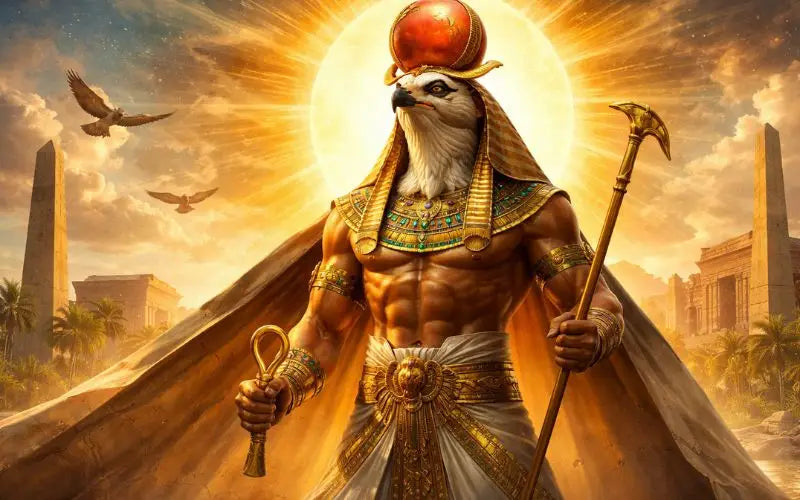
Each deity possessed a strictly codified iconography, transmitted with rigor over the centuries. Horus, with a falcon head, represented celestial royalty and the protection of the sovereign.
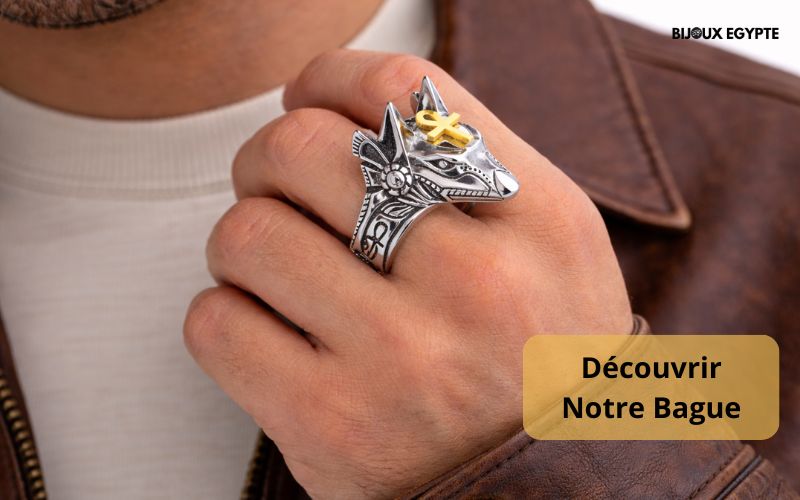
Anubis, with a jackal head, was associated with funerary rites and the passage to the afterlife. Hathor, often depicted with bovine attributes, embodied motherhood, joy, and fertility.
These choices followed a clear and coherent symbolic logic. Animals were observed in their natural environment and then associated with specific religious functions.
This stable correspondence allowed the faithful to immediately identify the deity represented on a fresco, a statue, or an amulet. Visual coherence reinforced the solidity of the religious system.
The main functions of these symbols were:
-
to identify the deity immediately
-
to recall their specific powers
-
to transmit mythological stories
-
to structure religious practice
Thanks to this strict codification, the animal head became a powerful and universal distinctive sign. It ensured the clarity of the religious message and consolidated cultural unity across the entire Egyptian territory.

A belief system rooted in daily life
Animal symbolism was not limited to temples or official representations. It deeply permeated the daily life of the Egyptians, from the countryside to the great cities.
Sacred animals were raised in sanctuaries, protected by priests, and sometimes mummified after their death. Some cults paid direct homage to specific species considered as divine manifestations.
This constant presence reinforced the link between spirituality and concrete reality. Peasants, craftsmen, and priests shared a common vision of the world where every creature possessed a sacred dimension and a symbolic role.
Respect for animals was thus woven into daily gestures and social practices.
This influence was found in:
-
agriculture and the observation of seasonal cycles
-
rituals of domestic protection
-
amulets and talismans worn in daily life
-
religious education passed on to children
The animal head was therefore not a theoretical abstraction, but the living reflection of a society where nature, religion, and culture formed an inseparable whole.
Animals as spiritual mediators
The Egyptians considered animals to be privileged intermediaries between the visible world and the invisible dimensions of the sacred. Their instinct, their keen perception of the environment, and their adaptation to natural cycles conferred upon them a special status.
By endowing the gods with animal heads, religion recognized this capacity to embody and transmit spiritual forces. The animal thus became a symbolic bridge between man and the divine.
Certain animals were raised in dedicated sanctuaries and benefited from strict sacred treatment. They received specific care and participated in religious ceremonies, temporarily embodying the presence of a deity.
This proximity reinforced the idea that the divine could manifest itself in the living. The boundary between nature and spirituality was therefore intentionally permeable.
Their spiritual role included:
-
the protection of sacred sites
-
participation in ceremonial rituals
-
the symbolization of cosmic cycles
-
the transmission of divine blessings
The animal head thus materialized the connection between the human and divine worlds, by giving a concrete form to invisible and transcendent realities.

Transmission of myths and collective memory
Animal representations played a fundamental role in the transmission of myths and sacred stories. In wall frescoes, monumental statues, and hieroglyphic inscriptions, the animal head allowed for immediate identification of the deity concerned.
This visual clarity facilitated the understanding of religious stories and reinforced collective learning. The image became a durable educational medium.
Children and adults alike could recognize the gods through their distinctive animal attributes.
This immediate recognition ensured strong cultural continuity, even as traditions evolved over the dynasties. The stability of the iconography helped maintain the religious unity of the kingdom.
This system guaranteed:
-
immediate recognition of deities
-
effective intergenerational transmission
-
durable religious coherence
-
a strong shared cultural identity
Animal iconography thus constituted a powerful tool of collective memory, engraved in stone and anchored in the Egyptian imagination.

A universal and timeless reach

The evolution of animal representations through the dynasties
Representations of animal-headed gods were not frozen in time. They evolved over the dynasties, depending on political, cultural, and religious changes.
Some deities gained importance, while others saw their iconography transformed or simplified. This evolution reflects the adaptability of Egyptian religion in the face of historical shifts.
In the New Kingdom, for example, some deities were associated with one another to form religious syncretisms. A god could thus combine several animal attributes in order to express expanded power.
These fusions allowed for the unification of local cults under a broader religious authority. Iconography thus became a tool for spiritual and political unification.
One can also observe:
-
regional variations in the representation of deities
-
the appearance of new hybrid forms depending on the era
-
stylistic simplification during certain late periods
-
the influence of external contacts on certain symbols
This capacity for adaptation shows that animal symbolism was not static. It remained coherent while evolving, ensuring the continuity of beliefs in a changing historical context.
FAQ on Why did Egyptian gods have animal heads?
Did the Egyptians believe their gods were actually animals?
No, the animal heads were symbolic. They represented specific qualities attributed to the deities.
Why is Horus depicted with a falcon head?
The falcon symbolizes height and celestial dominion. It corresponds to Horus's royal and protective role.
Were animals sacred in ancient Egypt?
Yes, certain species were considered sacred and protected in sanctuaries.
Did all gods have an animal head?
No, some deities were depicted in human or entirely animal form.
Why does this iconography still fascinate us today?
Because it combines visual power with symbolic depth, linking nature and spirituality.