

The question of why the pyramids had a triangular shape has intrigued historians and enthusiasts for centuries. This triangular form is not coincidental and continues to spark debate and analysis.
Exploring this architecture means diving into the heart of Egyptian civilization, its beliefs, its ambitions, and its worldview.
An architectural answer to a monumental challenge
The construction of the pyramids represented a colossal challenge for ancient Egypt. Without modern machinery or reinforced concrete, the builders had to design a structure capable of supporting millions of stone blocks while ensuring absolute long-term stability.
The triangular shape emerged as a remarkably effective solution, as it allowed for a natural downward distribution of force toward the base.
Unlike vertical walls subject to significant lateral pressure, the sloped faces absorb and redirect loads into the ground.
This geometry limits internal cracks and reduces the risk of gradual subsidence. As height increases, mass decreases, which strengthens the structural integrity of the whole.
Stability relies on three fundamental principles: a very wide base, a gradual reduction in volume, and a particularly low center of gravity.
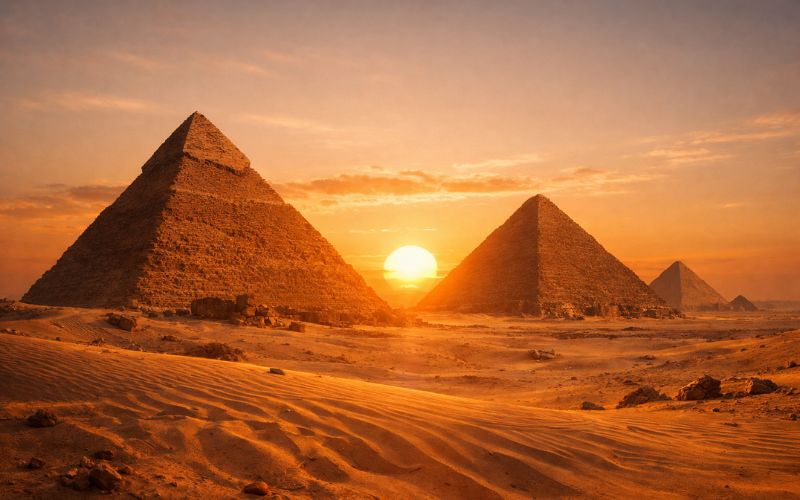
This combination gives the building exceptional resistance to minor earthquakes, desert winds, and the erosion of time. The famous Great Pyramid of Giza perfectly illustrates this construction logic.
Its monumentality is not only impressive, it demonstrates a deep understanding of physical laws, making the triangular shape a rational choice before even being a spiritual one.
The technical mastery of Egyptian builders
The triangular shape did not only meet a requirement for final stability; it also contributed to the very organization of the construction site. Designing a pyramid involved rigorous planning, exceptional human coordination, and precise anticipation of technical constraints.
Pyramidal geometry offered a clear framework, facilitating the methodical progression of the work.
Egyptian architects mastered alignment, leveling, and orientation with surprising precision for the time. Every step of the elevation was designed to maintain the general balance of the structure.
The gradual reduction of the surface area as the height increased reduced the pressure exerted on lower levels, which secured the entire project.
Geometric coherence also made it possible to optimize resource management, whether in terms of materials, time, or manpower.
This rational organization limited waste and strengthened collective efficiency.
The triangular shape thus integrated into a global vision of the site, where architecture, empirical mathematics, and social discipline converged toward a common goal: to erect a durable, stable monument worthy of royal eternity.
Use of ramps and logistics
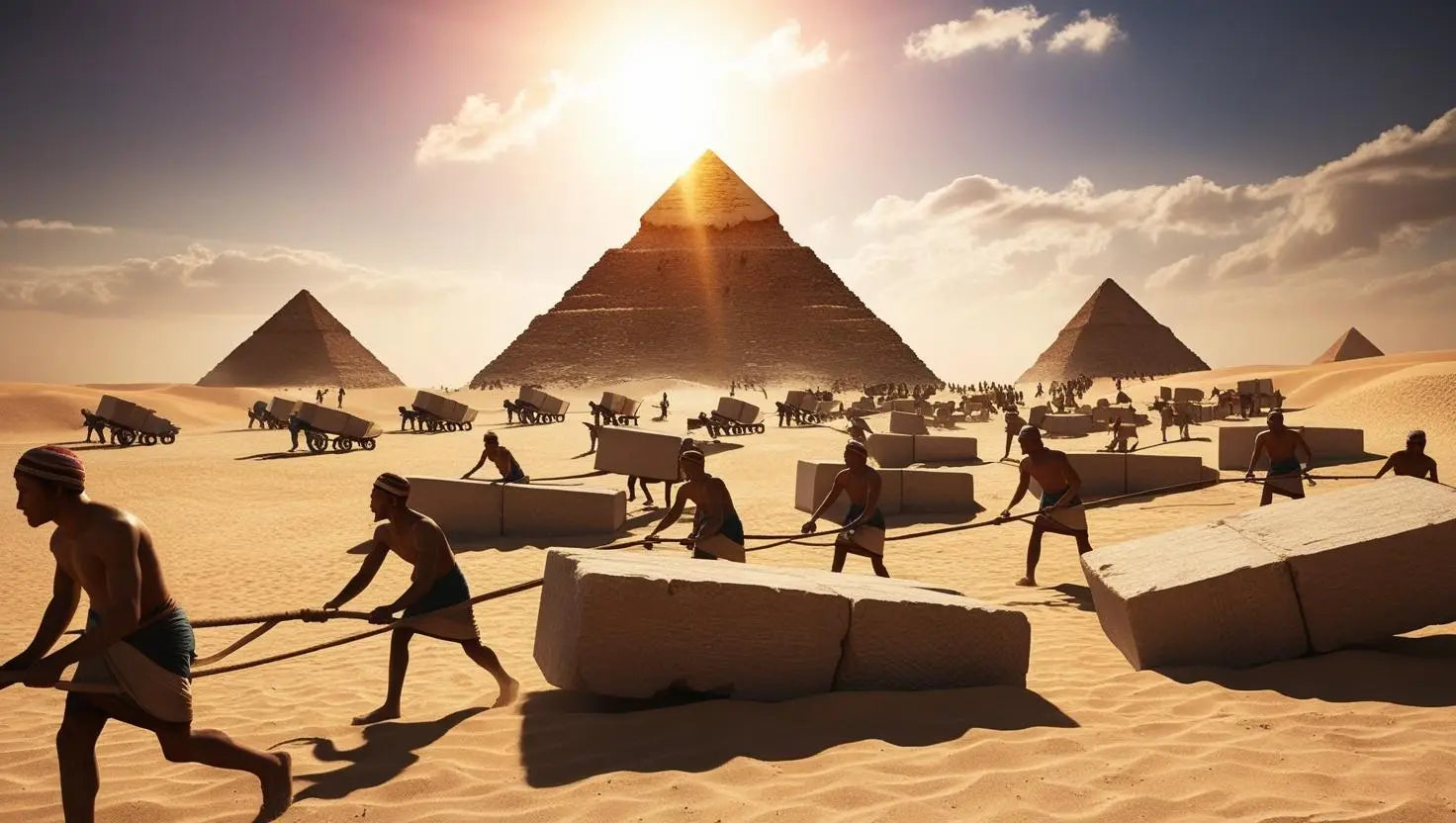
Ramps played an essential role. Their incline was adapted to the final slope of the pyramid. As the structure rose, access became more complex, but the triangular geometry limited abrupt changes in angle.
This geometric coherence optimized block transport. It allowed for fluid organization of collective work.
The triangular shape thus integrated into a global strategy of monumental construction.
A powerful solar symbolism
Beyond engineering, the pyramid embodies a major religious dimension that fully illuminates the choice of the triangular shape.
In Egyptian thought, the universe is structured by divine forces, and the sun occupies a central place in this cosmic balance.
The ascending silhouette of the pyramid visually evoked a ray of light connecting the sky to the earth, materializing the permanent presence of the sun in the kingdom.
The god Ra dominated this worldview. As the source of light, life, and order, he ensured the stability of the cosmos. The pharaoh, perceived as his earthly representative, maintained a sacred bond with this celestial power.
The pyramid thus became a point of convergence between political authority and divine energy.
This interpretation is supported by several architectural and ritual elements:
- Orientation towards the east and west
- Initial coating in brilliant white limestone
- Summit point called a pyramidion
The whole produced a spectacular visual effect under the desert sun.
The triangular shape therefore translated a coherent solar theology, inscribing the monument in a permanent dialogue between light, royal power, and eternity.
A representation of the ascension to the sky
The triangular geometry also symbolized the gradual elevation of the royal soul toward the celestial realm. In Egyptian religion, death was not an end, but a transformation.
The pharaoh, as a sacralized being, had to join the divine world in order to maintain cosmic balance after his earthly existence.
The pyramid materialized this passage. Its base anchored in the ground represented the world of the living, while its summit pointed toward the celestial sphere.
This vertical dynamic gave the monument an initiatory, almost ritual dimension. The visual ascent toward the sky expressed the continuity between earthly life and divine existence.
This conception was articulated around several fundamental beliefs:
- The ka (vital energy)
- The ba (mobile personality)
- The akh (glorified spirit)
The pyramid served as a mediator between these invisible dimensions. It provided an architectural framework for the spiritual transition of the sovereign.
The triangular shape thus became a concrete representation of ascension, inscribing the monument in a logic of immortality and cosmic permanence.
The soul and immortality
These elements had to be preserved after death to ensure the immortality of the sovereign. The pyramid served as a transition between the earthly world and the celestial realm.
Its architecture ritually accompanied the transformation of the pharaoh. Its point turned toward the sky symbolized the elevation to the divine.
The triangular shape thus embodied immortality and the hope of an eternal ascension.
Architecture turned toward the stars
Some internal chambers are aligned with stars linked to the imperishable constellations. These conduits, symbolic rather than functional, ritually linked the pharaoh to the eternal stars.
This celestial orientation reinforced the idea of a cosmic journey after death.
The pyramid thus surpassed the simple tomb to become a spiritual device inscribed in the universal order, whose triangular geometry accentuated the elevation toward infinity.

The evolution of pyramidal forms
The pyramid did not immediately appear in its perfect triangular form as we know it today. It resulted from a long process of architectural experimentation conducted over several generations.
The builders of ancient Egypt gradually refined their techniques, testing different solutions before reaching an optimal balance between stability, symbolism, and monumentality.
Initially, mastabas dominated the funerary landscape. These rectangular structures with inclined walls served as tombs for the elite. Their relatively simple design constituted a first step toward more ambitious architecture.
Over time, the desire to raise royal burials further reflected a growing aspiration for verticality and monumentality.
The evolution toward taller and more complex forms responded as much to technical challenges as to a transformation of religious beliefs.
The search for a sleeker silhouette reflected a new way of conceiving the link between the earth and the sky. This architectural progression is part of a context of continuous innovation, marked by improvements in methods for cutting, transporting, and assembling blocks.
The culmination of this process gave rise to the smooth pyramid, the ultimate symbol of geometric mastery and royal ambition.

Stability against time and climate
The pyramids have endured more than 4,500 years of history, surviving sandstorms, extreme thermal variations, and human transformations of the landscape.
Their exceptional longevity is largely due to their geometric design. The triangular shape plays a decisive role in this resistance by effectively distributing natural forces across the entire structure.
The inclined faces reduce the direct impact of violent desert winds. Rather than presenting a vertical surface exposed to lateral pressure, the pyramid deflects air currents upward, thereby limiting destructive turbulence.
Sand, pushed by storms, slides along the slopes without accumulating dangerously at the base. Furthermore, the compact structure limits water infiltration, which is rare but can be intense during exceptional rainfall.
Three factors explain this remarkable resistance:
- Compact geometry
- Massive materials (limestone, granite)
- Arid climate
The combination of these elements creates a nearly monolithic structural coherence. The triangular shape acts as a natural rampart against progressive erosion.
It transforms the edifice into a stable and dense mass, capable of resisting the centuries without any major alteration to its overall balance.

A political and cosmic affirmation
The pyramid is not limited to a funerary or spiritual function; it also constitutes a monumental political statement.
Through its scale and visibility, it manifests the pharaoh's capacity to mobilize the territory, human resources, and technical expertise of the kingdom. In a highly hierarchical society, such a project reflected the central authority and administrative cohesion of the state.
Its impressive size conveyed economic prosperity and perfectly structured social organization. It demonstrated that the sovereign held control over time, space, and collective labor. More than just a building, the pyramid embodied the permanence of royal power beyond earthly life.
In Egyptian thought, maintaining the order of Maat was an essential mission of the pharaoh. The monument materialized this order against chaos, affirming the stability of the kingdom under their reign.
Through its pure geometric silhouette, the edifice stood as a visual landmark dominating the horizon.
This ascending architecture inscribed lasting royal authority into the landscape and symbolically linked the earthly sphere to celestial dimensions, thereby consolidating the pharaoh's role as a mediator between humans and cosmic forces.
Symbol of absolute power
Building a pyramid required an exceptional mobilization of the kingdom's resources:
- Thousands of workers
- Centralized organization
- Planning over several decades
This construction project required precise logistics and strong authority.
The coordination of quarries and transport revealed the power of the state. Visible for miles, the pyramid affirmed the pharaoh's supremacy and their role as an intermediary between humans and the gods.
Expression of universal harmony
The pyramid is precisely oriented toward the four cardinal points, testifying to advanced celestial observation. This alignment was highly symbolic and inscribed the monument within the cosmic order.
Each face corresponded to a sacred direction.
Its triangular geometry symbolically linked earth to sky. The whole structure materialized the balance between nature, the divine, and royal power, embodying universal harmony.
What modern archaeology says
Contemporary research confirms the exceptional structural intelligence of the triangular shape adopted by the ancient Egyptians.
Engineering and architectural studies show that a pyramid supports mechanical stress much better than a vertical building of the same height, notably due to the downward distribution of loads toward a widened base.
Computer-assisted structural analyses have allowed for the modeling of internal forces exerted by millions of stacked blocks.
Numerical simulations demonstrate excellent pressure distribution and a remarkable absorption capacity against micro-movements of the ground.
The spontaneous collapse of such a structure is extremely unlikely, except in the event of major base alteration. This robustness partly explains the spectacular preservation of the pyramids despite the millennia.
Furthermore, archaeologists emphasize the persistent importance of solar symbolism in funerary texts and hieroglyphic inscriptions. Ritual formulas frequently evoke the luminous ascension of the pharaoh toward the sky.
The pyramid's triangle thus appears as a coherent synthesis between technical performance and religious vision. It is neither purely practical nor exclusively spiritual: it embodies the deep unity of ancient Egyptian thought.

FAQ on Why did pyramids have a triangular shape?
The question "Why did pyramids have a triangular shape?" sparks many inquiries, both among history enthusiasts and internet users curious to understand the mysteries of ancient Egypt.
Behind this iconic shape lies a fascinating combination of architectural logic, religious beliefs, and political ambitions.
The pyramid is not just an impressive monument: it is the culmination of complex thinking regarding stability, eternity, and the link between earth and sky.
Over the centuries, researchers, archaeologists, and engineers have analyzed this structure from different angles to decrypt its multiple meanings.
The triangular geometry appears today as a synthesis between technical performance and spiritual symbolism.
Understanding this shape means exploring how ancient Egyptians conceived the order of the world, the place of the pharaoh, and the survival of the soul after death.
The following questions help clarify the essential points related to this unique architecture and provide clear answers to the most frequent inquiries on this fascinating subject.
Why are the pyramids triangular?
The triangular shape ensures maximum stability by distributing weight toward the base. It also possesses a religious significance linked to the sun and the pharaoh's ascension to the sky.
Was the triangular shape purely symbolic?
No. It first responded to structural constraints. Solar and cosmic symbolism was integrated into this architectural logic.
Why are the pyramids still standing?
Thanks to their wide base, low center of gravity, and durable materials. The desert climate also limited erosion.
Do all pyramids have the same shape?
No. The earliest ones were stepped. The smooth triangular shape developed gradually until it reached geometric perfection.
Do the pyramids represent the sun's rays?
Many experts believe that their slanted faces symbolize the solar rays associated with the god Ra.
Were the pyramids used only as tombs?
They were primarily royal tombs, but also political and religious symbols.
Who invented the triangular shape?
It resulted from a gradual architectural evolution, perfected under the first pharaohs of the Old Kingdom.

Conclusion: Why did the pyramids have a triangular shape?
So, why did the pyramids have a triangular shape? Because this geometry was the most complete response to the physical constraints, political ambitions, and religious beliefs of ancient Egypt.
Technically, the triangular shape guaranteed exceptional stability, capable of supporting millions of stone blocks and withstanding centuries, winds, and climatic variations.
It represented the most reliable architectural solution for building tall, massive, and durable structures.
But this shape was not limited to engineering. It also reflected a spiritual vision of the world. The pyramid symbolized the pharaoh's ascension to the sky, his union with the sun, and his integration into the cosmic order.
Its ascending silhouette materialized the passage from earth to the divine, embodying royal immortality.
Finally, it asserted the power of the State and the ruler's mastery over chaos. The triangular shape thus concentrated stability, elevation, and harmony.
It was neither a coincidence nor a simple aesthetic choice, but the perfect expression of a civilization where technique, religion, and power were one.