

The hieroglyphs carved onto the temples and tombs of ancient Egypt constitute a true open-air library. Far from being mere decorations, these monumental inscriptions convey essential religious, political, and funerary messages.
Understanding inscribed monuments provides access to the profound thoughts of a fascinating civilization. Each sculpted wall thus becomes a narrative frozen in stone.
A sacred script at the heart of Egyptian civilization
Hieroglyphs are not just a decorative script: they are considered a sacred script, called "medu netjer," literally the words of the gods.
In ancient Egypt, writing meant bringing words to life and fixing a truth in time. Carving a text on a temple or tomb was never trivial: it ensured eternal permanence for the inscribed message and guaranteed its spiritual efficacy.
This script combines several types of signs: phonetic, ideograms, and determinatives. Each hieroglyph can represent a sound, a word, or a complete idea depending on its placement and its association with other signs.
Comprehension therefore depends on the grammatical and symbolic context. Priests and scribes mastered this complex art after years of rigorous training within schools attached to the temples.
On monuments, texts are often arranged with great symmetry, integrated into sculpted reliefs, and conceived in harmony with the sacred architecture. The writing thus contributes to the overall aesthetics of the building.
It becomes an element that is simultaneously religious, artistic, intellectual, and political, structuring the visual space as much as the message conveyed.
Hieroglyphs are therefore a fundamental pillar of Egyptian civilization. They translate the intimate relationship between writing, power, collective memory, and spirituality.
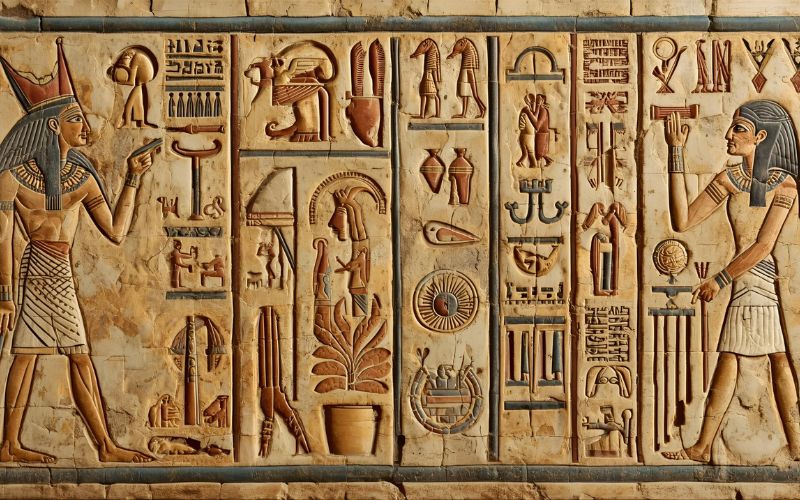
Religious and mythological narratives carved in stone
Egyptian temples were designed as sacred spaces where architecture and writing formed an inseparable whole.
The walls served as a medium for narrating the world, structured around the divine forces that governed the universe. Each inscription contributed to the affirmation of a stable cosmic order, essential for the prosperity of the kingdom.
These texts inscribed in stone were not mere symbolic narration: they materialized a worldview based on balance, justice, and universal harmony.
Monumental carving allowed these stories to be inscribed over time, at the very heart of the sanctuaries. The sculpted religious scenes were organized according to a precise logic, following the temple's spaces and the ritual path.
The further one advanced into the most sacred areas, the more complex and theologically elaborate the inscriptions became. This spatial hierarchy reflected the increasing depth of the divine mystery.
Thus, the mythological narratives carved on the monuments were not just ancient stories. They constituted an ideological and spiritual framework that structured Egyptian society, constantly reminding everyone of the place of humans, gods, and the sovereign in the universal order.
Royal cartouches and the legitimation of power
Among the most iconic inscriptions are the royal cartouches. A cartouche is an oval shape surrounding the pharaoh's name, generally preceded by official titles.
This symbol protects the name and asserts his divine authority within the sacred space of the monument. Framing the name meant symbolically isolating it from the chaos outside and inscribing it into eternity.
The royal name was not just for administrative identification. It possessed fundamental spiritual and political value.
Inscribing the cartouche on a pylon, stele, or statue guaranteed the sovereign's enduring presence in collective memory.
For modern researchers, these inscriptions are essential markers for establishing dynastic succession and identifying periods of reign.
The texts carved in the temples also describe military victories, major architectural works, and the offerings made by the pharaoh for the benefit of the sanctuaries. They present the king in a codified posture, receiving or transmitting divine power.
These inscriptions are therefore true instruments of political affirmation. They recall that the pharaoh acts as the guarantor of order and the supreme mediator between the earthly world and the sacred realm.
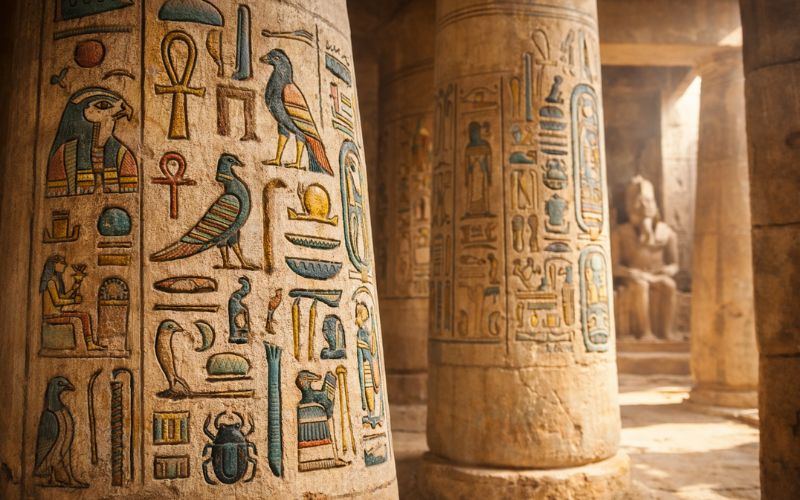
Daily life immortalized on funerary monuments
Private tombs offer another type of narrative carved in stone, more intimate and centered on the individual. Unlike temples dedicated to deities and sovereigns, burials highlight the earthly existence of high officials, artisans, or notables.
The walls become a personal narrative space where the activities, family relationships, and social status of the deceased are represented. These inscriptions and reliefs constitute genuine testimonies regarding the economic and social organization of the time.
Funerary decoration was not intended solely to embellish the tomb. It responded to a precise conception of the afterlife, where the continuity of existence depended on the preservation of the identity and functions performed on earth.
The scenes represented were carefully chosen to evoke prosperity, abundance, and stability.
The hieroglyphs accompanying these images specify the names, titles, and formulas necessary for the recognition of the deceased in the other world.
Funerary monuments thus become spaces of individual memory, but also precious sources for understanding social structures. Writing ensures the transmission of the name and the symbolic permanence of the person beyond death.
Funerary rites and the Book of the Dead
Funerary hieroglyphs also include excerpts from the Book of the Dead, a collection of magical formulas intended to guide and protect the soul.
These texts notably describe the judgment of the heart before Osiris and the deities of the divine tribunal. Each inscription plays a protective role against the dangers of the invisible world.
Monuments thus become sacred gateways between the world of the living and that of the dead.
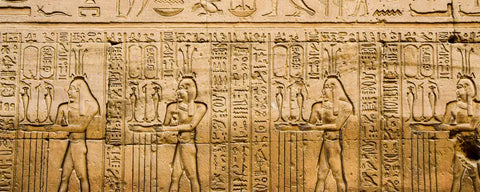
Monuments as tools for historical memory
Hieroglyphic inscriptions constitute a major historical source for understanding the political and institutional evolution of ancient Egypt.
Carved on temple walls, commemorative steles, or colossal statues, they record significant events intended to be transmitted to future generations.
These official texts recount military campaigns, treaties concluded with foreign powers, or solemn proclamations. They reflect the sovereigns' desire to fix their actions in time.
Certain steles commemorate specific victories and describe the context, the adversaries, and the consequences of the conflict. Temple walls display detailed scenes where the sovereign appears triumphant, accompanied by explanatory inscriptions.
Even if these accounts are sometimes oriented to valorize royal power, they remain precious sources for establishing a chronology and understanding the international relations of the era.
Hieroglyphs also mention architectural projects, the founding of sanctuaries, and important administrative decisions. Thanks to these documents carved in stone, historians can analyze economic, religious, and social transformations over several centuries.
Each monument thus acts as a lasting official archive, essential for reconstructing the pharaonic past.
How hieroglyphs were deciphered
For centuries, the meaning of hieroglyphs remained a mystery to European travelers and scholars. Following the gradual disappearance of their use at the end of antiquity, knowledge of this writing system was lost.
In the Middle Ages and the Renaissance, it was often thought that these were purely esoteric symbols, carrying secret philosophical meanings. This symbolist interpretation long hindered a true linguistic understanding of the system.
Decipherment thus marks a decisive step in the scientific study of ancient Egypt. It did not happen in a day, but resulted from patient comparisons, grammatical analyses, and successive work conducted by several European researchers.
Understanding the internal functioning of the writing system gradually revealed that it was a structured system, combining sounds and concepts.
Once the method was established, it became possible to translate inscriptions from temples, tombs, and stelae with rigor. Inscribed monuments then ceased to be mere decorative vestiges and became direct historical sources.
This breakthrough transformed Egyptology into a scientific discipline based on the study of original texts.
The Rosetta Stone
Discovered in 1799 by French soldiers in Egypt, the Rosetta Stone constitutes a major breakthrough in the understanding of hieroglyphs.
It presents the same decree inscribed in three distinct scripts: hieroglyphic, demotic, and ancient Greek. The Greek version, already understood by scholars, served as a point of comparison for analyzing the other texts.
This triple inscription allowed for the establishment of precise and progressive linguistic correspondences.
Champollion and the decisive breakthrough
In 1822, Jean-François Champollion demonstrated that hieroglyphs contain phonetic signs and are not purely symbolic. By studying royal cartouches, he identified sound correspondences, particularly for the names of foreign rulers.
This discovery paved the way for the methodical translation of monumental inscriptions. Thanks to this breakthrough, the monuments regained their voice, and the texts became scientifically interpretable.
Engraving techniques and text organization
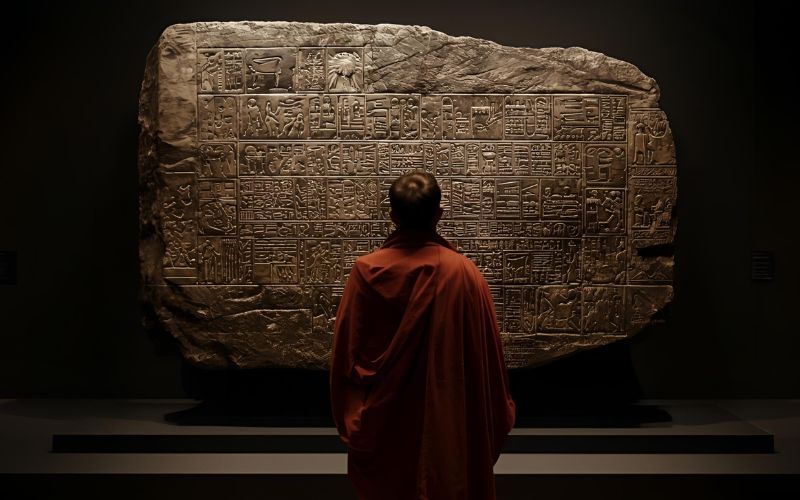
The execution of hieroglyphs on monuments required precise preparation and highly specialized craftsmanship. Before the final engraving, scribes would trace the signs in red or black ink on the stone to guide the artisans.
Sculptors would then intervene to carve or model the symbols with great precision, respecting traditional proportions.
Depending on the architectural context, the signs could be carved in sunk relief, in high relief, or in low relief, with each technique producing a specific visual effect under sunlight.
The orientation of the signs depended on the chosen reading direction. Hieroglyphs are read in the direction toward which human or animal figures are looking, which implies constant attention to iconographic details.
This flexibility allowed texts to be adapted to the constraints of wall surfaces.
Monumental inscriptions followed a strict organization. Vertical columns sometimes alternated with horizontal lines to integrate harmoniously with the architecture.
The writing thus became a structural element of the space, guiding the visitor's gaze and emphasizing the sacred nature of the site.
Why hieroglyphs still fascinate us today
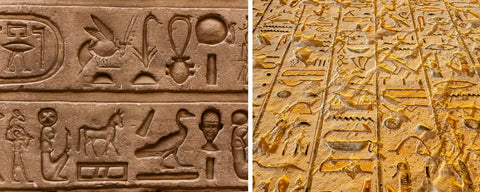
Hieroglyphs continue to captivate researchers, historians, and archaeology enthusiasts around the world. Their refined aesthetics, blending human figures, animals, and abstract symbols, intrigue as much as they amaze.
Each sign seems to tell a story and invites us to decipher a message from another time. This unique combination of art and writing largely explains their lasting power of attraction.
Beyond their visual appearance, hieroglyphs offer direct access to the thinking of a millennial civilization. They allow us to better understand the spirituality, political organization, collective beliefs, and worldview unique to ancient Egypt.
Each new archaeological excavation reveals new inscriptions that enrich our historical understanding and nuance previous interpretations.
Inscribed monuments create a tangible bridge between past and present. They remind us that writing constitutes a fundamental tool for memory and cultural transmission.
Studying these carvings means engaging in a dialogue with a vanished civilization while measuring its persistent influence on the contemporary imagination and the history of writing systems.
FAQ on Hieroglyphs carved on monuments: what do they say?
Hieroglyphs carved on Egyptian monuments raise many questions, both for history enthusiasts and for visitors discovering these inscriptions for the first time.
Their enigmatic appearance, mixing human figures, animals, and abstract symbols, is immediately intriguing and gives the impression of a complex coded language.
Yet, behind this monumental writing lie precise messages, organized according to strict rules and integrated into a highly structured religious, political, and cultural context.
Understanding what these inscriptions really tell us involves looking at their function, their location, and their role in ancient Egyptian society.
Hieroglyphs are not just decorative signs: they serve spiritual, memorial, and symbolic purposes. Their presence on a temple, tomb, or official stela is never a coincidence.
This FAQ section aims to clarify the most frequently asked questions regarding monumental hieroglyphs.
It provides simple and structured answers to better understand the historical and cultural significance of these texts carved in stone.
What do the hieroglyphs carved on temples mean?
They primarily describe religious rituals, hymns to the gods, and scenes where the pharaoh performs offerings. Their function is sacred and political. They affirm cosmic order and royal legitimacy.
Why are pharaohs' names in cartouches?
The cartouche symbolically protects the royal name. It guarantees its eternity and magical power. It also allows the sovereign to be precisely identified.
Do hieroglyphs tell of daily life?
Yes, especially in private tombs. Agricultural, artisanal, and family scenes can be seen there. These images ensure the symbolic survival of the deceased.
How do we read hieroglyphs?
We observe the direction of the figures. If they are looking to the right, we read from right to left. The signs can represent sounds or ideas.
Are all Egyptian monuments covered in hieroglyphs?
No, but temples, royal tombs, and official stelae often have them. Their presence depends on the monument's function.
What is the difference between hieroglyphic and demotic?
Hieroglyphic is a monumental and sacred script. Demotic is a simplified script used for administrative documents.
Do hieroglyphs have magical power?
In ancient Egyptian thought, yes. To write a word was to give it a real and effective existence.
Conclusion on Hieroglyphs carved on monuments: what do they say?
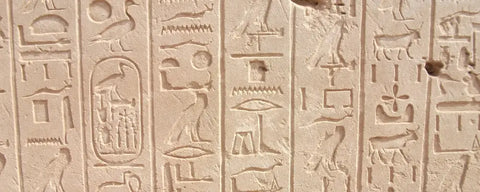
Hieroglyphs carved on monuments tell far more than isolated stories or simple religious formulas. They constitute a monumental language through which ancient Egypt expressed its worldview, its political organization, and its deep-seated beliefs.
On temples, they depict the relationships between the gods and the pharaoh, affirming cosmic order and the legitimacy of power. On funerary monuments, they preserve the identity of the deceased and ensure the continuity of their existence in the afterlife.
These inscriptions also recount historical events, major construction projects, and royal decisions, transforming stone walls into lasting archives.
Each hieroglyph contributes to a global narrative where religion, memory, and authority are closely linked. Nothing is left to chance: location, orientation, and content fulfill a precise intention.
Thus, hieroglyphs carved on monuments tell the story of a civilization that conceived of writing as a creative and eternal act.
They testify to a world where inscribing a word meant giving it a lasting existence, making Egyptian monuments true stone books spanning the millennia.