

Understanding the Mysteries of the Great Sphinx of Giza
The Great Sphinx of Giza has fascinated historians and enthusiasts of ancient Egypt for centuries. A colossal monument carved from the limestone of the Giza plateau, it embodies power, silence, and inquiry all at once.
Was it a simple guardian of the pyramids or a true divine enigma linked to solar beliefs? Its gaze, turned toward the east, seems to watch the horizon as if protecting an ancestral secret.
Exploring the mysteries of the Sphinx means delving into the heart of one of the greatest questions of antiquity.
Its monumental silhouette dominates the Egyptian desert and commands respect through its impressive proportions. Being both a human figure and an animal creature, the Sphinx defies simple classification and invites interpretation.
Its impassive, almost timeless expression gives the impression that it traverses the centuries without revealing its secrets. Every detail of its sculpture raises questions about the intentions of its creators and the symbolic reach of the work.
Understanding the mysteries of the Sphinx also implies analyzing its cultural, political, and religious context.
This monument cannot be dissociated from the civilization that saw it born. It represents far more than an architectural feat: it is a reflection of a worldview, a relationship with the sacred, and a conception of power deeply rooted in ancient Egypt.
The Origins of the Sphinx: Construction and Historical Context
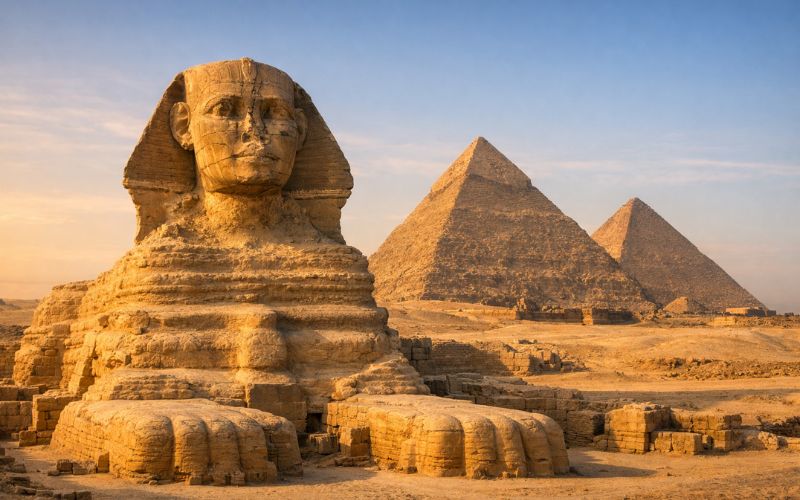
The Great Sphinx of Giza measures approximately 73 meters long and 20 meters high, making it one of the largest monolithic statues in the ancient world.
It is believed to have been carved during the reign of the Pharaoh Khafre, around 2500 B.C., during the Old Kingdom. Located near the Pyramid of Khafre, it is part of a vast royal funerary complex. Its construction testifies to remarkable technical mastery.
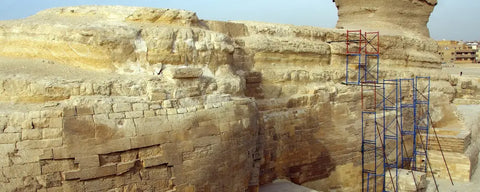
Archaeologists estimate that it was carved directly from a rock outcrop on the Giza plateau. This method explains certain irregularities visible on its body.
The face, often attributed to Khafre, would reinforce the idea of a direct link to royal power. The Sphinx would thus be a symbolic representation of the deified pharaoh.
However, some alternative theories suggest an older origin. Traces of erosion have fueled the hypothesis of a dating prior to the Old Kingdom.
This proposal remains controversial, but it contributes to the mysteries of the Sphinx. The majority of Egyptologists, however, maintain a classic dating linked to Khafre.
The Sphinx: Guardian of the Pyramids?
The idea that the Sphinx is a guardian of the pyramids is based on its strategic position facing the funerary complexes. Its lion body symbolizes power and protection.
In ancient Egypt, the lion was associated with solar strength and the defense of sacred places. The Sphinx could thus represent a protective entity watching over royal tombs.
Its presence at the symbolic entrance of the Giza complex suggests a function of ritual surveillance. In Egyptian thought, the funerary space was sacred and had to be protected against the forces of chaos.
The Sphinx would then embody a spiritual barrier intended to preserve the order established by the pharaoh. Its imposing stillness reinforces the idea of eternal vigilance, turned toward the horizon.
Beyond its posture, its integration into the overall architecture of the site bears witness to a desire for symbolic harmonization. Each monument on the plateau responds to a precise religious logic.
The Sphinx fits into this ensemble as a figure of sacred protection. The hypothesis of the guardian of the pyramids is therefore based on a coherent reading of the monumental landscape and the importance placed on spiritual defense in ancient Egyptian culture.
A Royal Symbol of Protection
The pharaoh was considered a living god, an intermediary between men and the deities. Associating his image with a lion reinforced his sacred authority.
The Sphinx would then become a monumental manifestation of royal power. Its imposing presence affirmed the sovereign's dominance even after his death.
Some reliefs and inscriptions suggest that the royal figure could be assimilated with protective animal forces.
The Sphinx would materialize this fusion between human sovereignty and mythical power. It would embody a permanent protection, carved into stone.
Solar Orientation and Cosmic Significance
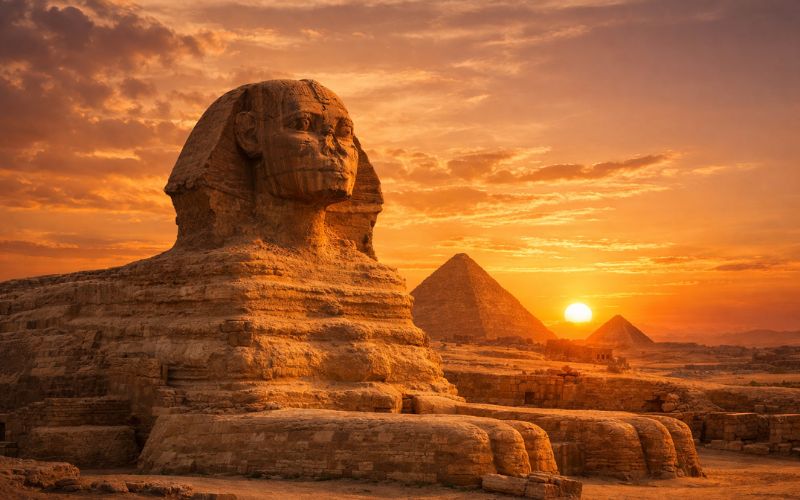
The Sphinx is oriented toward the east, in the direction of the sunrise. This orientation is likely not a coincidence.
The sun played a major role in Egyptian religion, particularly through the cult of Ra. The monument could be linked to the solar cycle and daily rebirth.
Several researchers believe that the Sphinx symbolizes the pharaoh assimilated as the solar god. Every morning, the reborn sun would reinforce the link between the sovereign and the cosmic order.
This celestial dimension accentuates the idea of a guardian that is not only earthly but also cosmic.
A Divine Enigma at the Heart of Egyptian Beliefs
Beyond any political or monumental reading, the Sphinx can be viewed as a true divine enigma carved in stone.
Its hybrid half-human, half-lion form is no accident: in Egyptian thought, composite beings conveyed complex spiritual realities. They embodied invisible forces, cosmic principles, or manifestations of the sacred.
The Sphinx would thus surpass a simple decorative function to become a symbolic representation of a higher order. It would not only protect a place but would express a conception of the world founded on the balance between power and intelligence.
This interpretation is part of a religious vision where every monument possesses a spiritual dimension. The Sphinx could reflect the fusion between the human and the divine, between matter and the cosmic principle.
Its monumental presence would translate a desire to inscribe into the landscape a sacred truth accessible only to those capable of understanding its deep meaning.
Thus, the divine enigma of the Sphinx would reside less in a hidden secret than in the symbolic richness it embodies within Egyptian beliefs.
The Symbolism of the Lion Body and Human Head
The lion evokes strength, dominance, and solar power. The human head symbolizes intelligence, wisdom, and divine consciousness.
This combination embodies the union between physical power and spiritual authority. The Sphinx thus becomes a perfect synthesis of sacred power.
This duality reinforces its mysterious nature. It is not a simple statue, but a metaphysical representation.
The mysteries of the Sphinx take on a philosophical dimension here. It could be a message carved into stone.
A Possible Initiatory Role
Some researchers suggest that the Sphinx could have played an initiatory role. In ancient Egypt, access to sacred knowledge was reserved for a religious elite.
The monument could symbolize a test of wisdom or a spiritual passage.
Although this hypothesis remains speculative, it fits into the esoteric tradition surrounding the Sphinx.
Its monumental silence fuels mystical interpretations. This dimension contributes strongly to its aura as a divine enigma.
The Unsolved Mysteries of the Sphinx
Despite more than a century of excavations and analyses, the Sphinx retains a significant portion of mystery. Several questions persist regarding its initial design and the modifications it may have undergone.
Some specialists question the proportions of the monument and any potential transformations carried out over time. These uncertainties still fuel passionate debates within the scientific community today.
The traces of alteration visible on the stone have led to different interpretations. Geological studies do not all agree on the precise origin of certain signs of wear.
Ancient climatic conditions, the action of wind, or other environmental factors are regularly mentioned. Each hypothesis opens the path for new research.
Other areas of uncertainty concern any potential structures buried near the monument. Geophysical explorations have been conducted to detect potential cavities, without definitive conclusions.
The absence of clear answers reinforces the appeal of the site. The mysteries of the Sphinx thus continue to fuel the collective imagination and stimulate global scientific interest.
Restorations and Preservation Throughout the Centuries
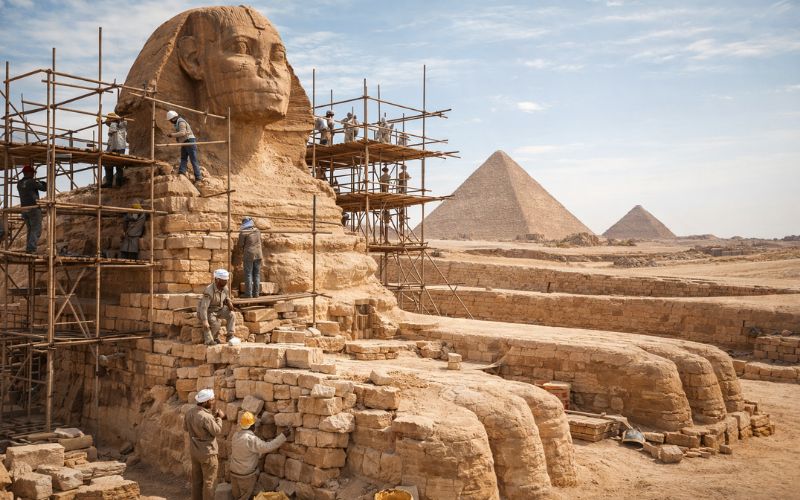
Throughout its millennial history, the Sphinx has experienced long periods of abandonment, burial by sand, and rediscovery. Exposed to natural elements, it has been weakened by wind, temperature variations, and the passage of time.
As early as antiquity, certain initiatives were undertaken to keep the monument visible and preserve its integrity. These interventions already bear witness to an ancient awareness of its symbolic and cultural value.
At different times, sovereigns and local authorities ordered consolidation work. Stone blocks were added to stabilize certain parts of the body.
Modern excavations have allowed for a better understanding of the internal structure of the monument and the techniques used during its sculpting. Each restoration campaign has provided new scientific data.
Today, the preservation of the Sphinx relies on in-depth geological, climatic, and structural studies. Specialists must limit the impact of tourism while protecting the fragile stone.
The balance between conservation, research, and public display represents a major challenge. Safeguarding the Sphinx means preserving a unique cultural heritage for future generations.
The Sphinx in the Collective Imagination
The Sphinx goes far beyond the scope of archaeology and historical studies. It has become a universal symbol of mystery, silence, and ancient wisdom.
In popular culture, it often embodies the riddle to be solved, the question without an immediate answer. Its impassive face and colossal body fuel the idea of a secret buried for millennia.
From literary works to contemporary films, the Sphinx appears as a timeless figure linked to hidden knowledge. It is frequently associated with tales of exploration, lost treasures, or vanished civilizations.
This image reinforces its status as a divine enigma in the modern imagination. It symbolizes both the fascination with Antiquity and the human quest for understanding.
Beyond fiction, its aura contributes significantly to Egypt's cultural appeal. The Sphinx has become a visual icon immediately recognizable throughout the world. It appears on posters, documentaries, and various artistic works.
Every year, millions of visitors come to contemplate this fascinating monument. Thus, the Sphinx remains a powerful bridge between ancient memory and contemporary imagination.
FAQ on The Mysteries of the Sphinx: Guardian of the Pyramids or Divine Enigma?
The Sphinx of Giza has sparked a multitude of questions for generations. An emblematic monument of ancient Egypt, it fascinates both researchers and the general public alike.
Its unique appearance, its antiquity, and its location at the heart of the Giza plateau fuel numerous hypotheses. The mysteries of the Sphinx continue to stir curiosity and inspire debates, analyses, and interpretations.
Certain questions frequently arise when discussing this stone colossus. They concern its origin, its meaning, its state of preservation, or even the secrets it might hold.
These inquiries demonstrate the constant interest in this unique monument, at the crossroads of history, religion, and archaeology.
Understanding the mysteries of the Sphinx involves examining historical data, scientific discoveries, and ancient traditions.
This FAQ section on The Mysteries of the Sphinx: Guardian of the Pyramids or Divine Enigma? gathers the most common questions to shed light on key points.
It allows for a clear and structured approach to the aspects most often sought by enthusiasts of ancient Egypt.
Who built the Sphinx of Giza?
The majority of Egyptologists attribute the construction of the Sphinx to the Pharaoh Khafre around 2500 BC. It is believed to be part of the royal funerary complex located on the Giza plateau.
Why does the Sphinx no longer have a nose?
The Sphinx's nose was likely destroyed in the Middle Ages. Historical documents indicate it was already missing well before the Napoleonic era.
Is the Sphinx older than the pyramids?
Some theories suggest so, but most specialists believe it dates to the same period as the pyramids of Giza.
What does the Sphinx symbolize?
It symbolizes power, protection, and divine wisdom. Its lion body and human head represent the union of strength and intelligence.
Does the Sphinx hide secret chambers?
No conclusive scientific evidence confirms the existence of secret chambers beneath the Sphinx, despite numerous speculations.
What is the exact size of the Sphinx of Giza?
The Sphinx is approximately 73 meters long and 20 meters high. Its width reaches nearly 19 meters at the paws. It is the largest monolithic statue of antiquity carved directly from natural bedrock.
Why is the Sphinx oriented toward the east?
The Sphinx is turned toward the rising sun, which strengthens its link to the Egyptian solar cult. This orientation symbolizes the daily rebirth of the sun and could reflect a spiritual connection with the god Ra.
Was the Sphinx originally painted?
Yes, traces of red, blue, and yellow pigments have been found on certain parts of the monument. This indicates that it was once fully painted, giving it a much more vibrant appearance than it has today.
Are there secret passages under the Sphinx?
Geophysical explorations have been conducted to detect potential cavities. Although some anomalies have been noted, no confirmed secret chamber has been officially discovered to date.
Why does the Sphinx's head appear smaller than its body?
Some researchers believe the head may have been resculpted at a later date, which would explain its proportions. Others believe it is simply an artistic choice linked to the structure of the original rock.
Conclusion on The Mysteries of the Sphinx: Guardian of the Pyramids or Divine Enigma?
So, is the Sphinx a guardian of the pyramids or a divine enigma? In reality, these two dimensions are not mutually exclusive. Archaeological data and the architectural context of the Giza plateau strongly support the hypothesis of a protective role.
Through its strategic position and its symbolism linked to royal power, the Sphinx clearly fits into the religious and funerary logic of the Old Kingdom. It can thus be understood as a sacred guardian watching over the pyramid complexes.
However, reducing the Sphinx to a simple protective function would be to ignore the richness of its symbolic reach.
Its hybrid form, its orientation, and its place in the Egyptian imagination give it a deeper spiritual dimension. It embodies a vision of power where strength, wisdom, and cosmic order are intimately linked.
This complexity explains why it remains a divine enigma to many researchers and enthusiasts.
Ultimately, the Sphinx represents both a monumental guardian and a sacred symbol charged with multiple meanings.
It is precisely this duality that still nourishes the mysteries of the Sphinx and its universal fascination today.