
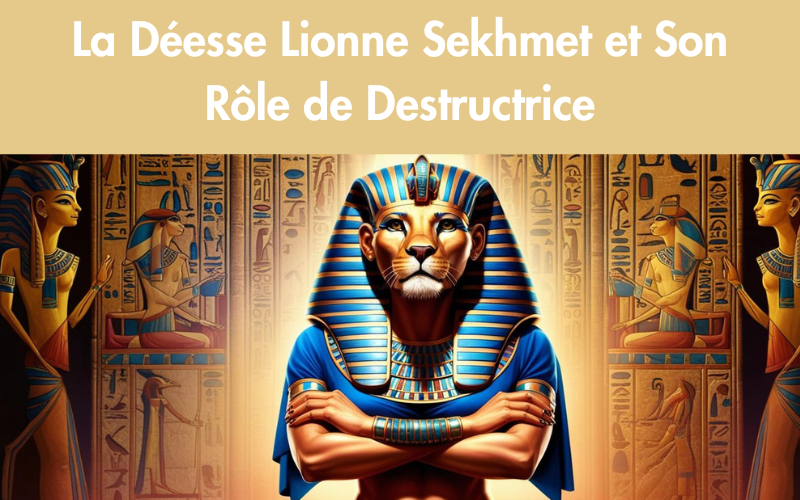
In Egyptian mythology, Sekhmet is one of the most feared and fascinating deities. This lioness goddess embodies destruction, war, and solar power.
Sent by the god Ra to punish rebellious humans, she represents the manifestation of divine wrath. Yet, behind this violence also lies a protective force essential to the world's balance.
Origin and Significance of Sekhmet in Egyptian Mythology
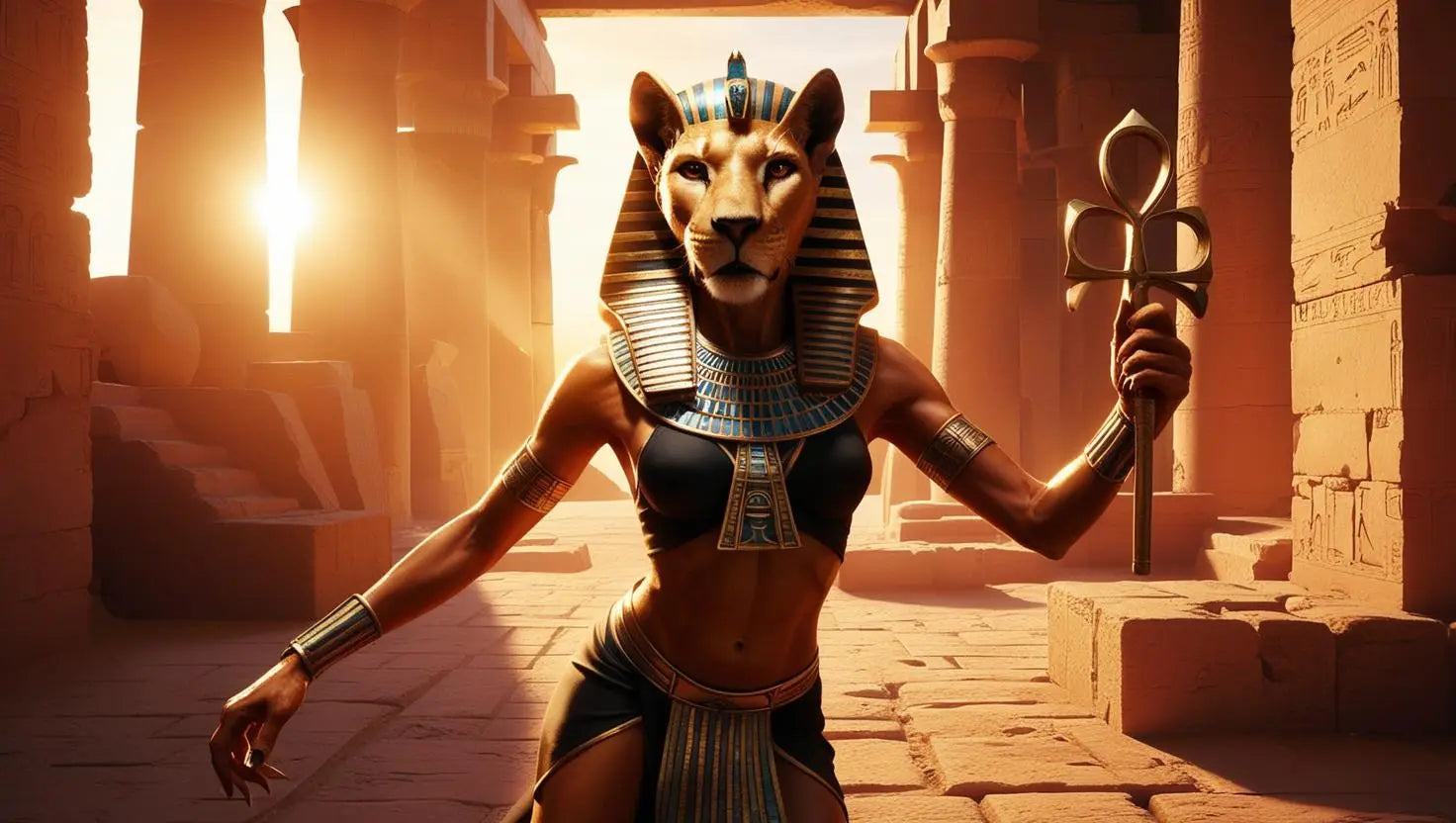
In the religion of ancient Egypt, the goddess Sekhmet occupies a unique place among the most powerful and feared deities. Her name means "the Mighty One," a term that perfectly reflects her role in Egyptian mythology. She is generally depicted with a woman's body and a lioness's head, symbols of power, domination, and ferocity. This animal appearance emphasizes the goddess's raw strength and indomitable nature.
Sekhmet is closely associated with the solar god Ra, of whom she is often considered the daughter or manifestation. She represents the destructive energy of the sun, capable of scorching the earth and annihilating the enemies of the gods. In the Egyptian religious worldview, this destruction is not solely negative. It is often perceived as a means to restore cosmic order when it is threatened.
Sekhmet's presence in myths shows that the Egyptian civilization perceived the world as a fragile balance between order and chaos. The goddess thus becomes a force capable of eliminating disruptive elements in order to preserve universal harmony.

The divine birth of Sekhmet
The mythological birth of Sekhmet is linked to the Eye of Ra, a symbol of protection and divine wrath. According to some accounts, the goddess was born directly from the eye of the solar god, sent to Earth to punish humans who had defied his authority.
This origin makes her a direct incarnation of divine will. The Eye of Ra is often considered a force capable of acting independently of the god. When it takes the form of Sekhmet, it becomes a destructive energy tasked with restoring order and protecting the authority of the gods.
A deity linked to cosmic balance

Sekhmet, the Incarnation of Divine Destruction
In the mythological accounts of ancient Egypt, Sekhmet is often described as the most fearsome manifestation of divine wrath. When humans forget their duties to the gods or threaten the cosmic balance, she is sent to restore order through destruction. This punitive function reflects a religious view in which deities actively work to maintain the harmony of the world and prevent chaos from spreading.
The lioness goddess is capable of sowing terror on the battlefield and annihilating the enemies of the gods. Her burning breath is sometimes compared to the overwhelming heat of the desert sun. This association with the sun reinforces her image as a destructive force capable of reducing all opposition to ashes. In certain symbolic representations, her gaze itself possesses a power capable of annihilating those who defy the divine order. The myths also show that Sekhmet's anger can become uncontrollable.
In some stories, even the gods fear the power of her rage. This dimension highlights the intensity of the force she represents in Egyptian mythology. She thus embodies the sacred violence necessary to purify the world, eliminate threats, and remind humans of the absolute power of the gods.

The Symbols of the Lioness Goddess Sekhmet
The lion, symbol of power
In the culture of ancient Egypt, the lion is a powerful symbol associated with strength, courage, and domination. By adopting the appearance of a lioness, Sekhmet embodies these qualities at a divine and fearsome level. The lioness is also a protective animal, capable of defending her territory with great ferocity.
This symbol therefore underscores the goddess's role as protector of the kingdom and cosmic order. Just as a lioness protects her offspring and territory, Sekhmet watches over to repel the forces of chaos and preserve the harmony of the world.
The solar disk and the uraeus

Sekhmet and Her Influence in Egyptian Religion

Sekhmet and Medicine in Ancient Egypt

The Modern Legacy of Sekhmet

FAQ about the Lioness Goddess Sekhmet and Her Role as Destroyer
The goddess Sekhmet holds a major place in the mythology of ancient Egypt. Known for her power, her warrior nature, and her role as a divine destroyer, she was both feared and deeply respected by the Egyptians. Myths, temples, and numerous artistic representations have helped shape the image of a deity capable of punishing the enemies of the gods while protecting the order of the world.
Through religious narratives and ancient traditions, Sekhmet appears as a force that is both destructive and protective. This duality explains why she was invoked in very different contexts, whether during battles, to defend the kingdom, or in rituals intended to heal illnesses and appease plagues. Priests, pharaohs, and the people attributed to her an immense power capable of influencing the destiny of the kingdom and the health of men.
The following questions provide a better understanding of the history, symbols, and importance of Sekhmet in Egyptian religion and ancient mythology.
Who is the goddess Sekhmet?
Sekhmet is a major deity of Egyptian mythology represented with the head of a lioness and the body of a woman. She embodies war, destruction, and the power of the sun. Daughter of the god Ra, she acts as the instrument of divine wrath when it is necessary to punish the enemies of the gods or to restore cosmic order.
Why is Sekhmet associated with destruction?
Sekhmet is sent by the god Ra to punish humanity when men threaten the order of the world. Her role is to eliminate the forces of chaos and restore cosmic balance. In Egyptian religious thought, destruction can be a necessary form of purification.
Is Sekhmet also a goddess of healing?
Yes, despite her reputation as a destructive goddess, Sekhmet is also associated with medicine and healing. Her priests were renowned for their medical knowledge and used natural remedies as well as religious rituals to heal the sick.
What is the most famous myth about Sekhmet?
The most famous myth tells how Sekhmet was sent by Ra to punish rebellious humanity. Her rage became so intense that the gods had to trick her by offering her red beer resembling blood to calm her fury.
What are the symbols of Sekhmet?
The symbols of Sekhmet include the lioness, the sun disk, and the uraeus cobra. These elements represent her power, her link to the god Ra, and her role as protector of royal power.
Where were Sekhmet's temples found?
Temples dedicated to Sekhmet were mainly located in important religious centers like Karnak, Memphis, and Luxor. These sanctuaries often contained numerous statues of the goddess.
Why was Sekhmet feared by the Egyptians?
The Egyptians feared Sekhmet because they believed that her anger could cause disasters, wars, or epidemics. They therefore organized rituals to appease her anger and protect the population.
Conclusion on the Lioness Goddess Sekhmet and Her Role as Destroyer
The goddess Sekhmet remains one of the most powerful and fascinating figures in Egyptian mythology. Her role as a destroyer illustrates the way the ancient Egyptians understood the balance of the world. For them, destruction was not simply a negative force, but a necessary means to eliminate chaos and restore cosmic harmony.
Sent by the god Ra to punish rebellious humans, Sekhmet embodies divine wrath and the power of the sun. However, her nature is not limited to violence. She is also a protector of the kingdom, an ally of the pharaohs, and a goddess associated with healing.
This duality between destruction and protection explains why she was both feared and venerated. The temples, rituals, and myths dedicated to Sekhmet show the importance of this goddess in the religion and culture of ancient Egypt.
Even today, her image continues to inspire artists, researchers, and history enthusiasts. Sekhmet remains a timeless symbol of power, transformation, and resilience.