

Egyptian style: an aesthetic serving order and status
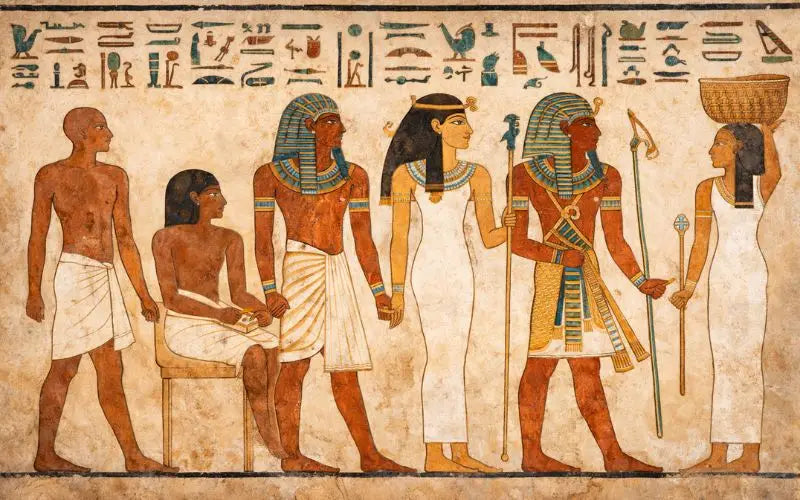
Style, in Ancient Egypt, was primarily a matter of social readability. Silhouettes, accessories, and the quality of materials quickly indicated a person's status: elite, priest, artisan, servant, or soldier. It was not merely a matter of individual preference: codes were shared, understood, and replicated, with variations depending on the period and region.
Egyptians favored a clear aesthetic: clean lines, symmetry, and balance. The body was highlighted without heaviness: fitted clothing, sheer linen, and controlled pleating. This apparent sobriety actually masked a taste for precision: a fold, a border, a shimmer, or a string of beads could make all the difference.
But beyond appearance, this aesthetic reflected a worldview structured by the idea of order. Visual harmony was not a simple decorative choice: it pointed to a broader conception of social and cosmic balance. Appearance thus became a visible extension of the stability sought within society. Presenting oneself in a groomed, proportional, and composed manner meant demonstrating one's integration into an organized system where every individual occupied a defined and recognized place.
Linen, the sovereign material: lightness, purity, and prestige
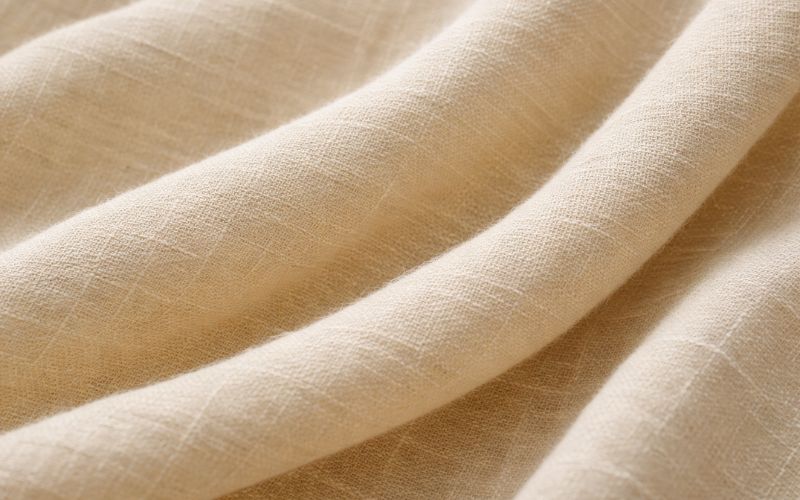
The foundation of the Egyptian wardrobe is linen. It was valued for its coolness in a hot climate, but also for its symbolic dimension: linen evokes cleanliness, clarity, and purity.
A well-maintained, luminous, and carefully worn fabric became a visible sign of respectability and self-mastery.
Workshops mastered weaving, bleaching, and softening, with highly varied degrees of fineness. Bright, regular, and fluid white linen was expensive and immediately signaled social status.
Quality could be seen at a glance: the fineness of the thread, the suppleness of the drape, lightness, and controlled transparency. The more the textile was worked, the more it reflected artisanal skill and the rank of the wearer.
Beyond its thermal comfort, linen structured the Egyptian aesthetic. It clung to the body's shapes, caught the light, and highlighted the silhouette without excess. Depending on its thickness and finish, it was adapted for both daily life and formal occasions.
Though a simple material in appearance, linen thus became a true cultural marker, combining functionality, symbolism, and social hierarchy.
Silhouettes and clothing: apparent simplicity, real precision
The Egyptian wardrobe might seem simple at first glance: little volume, few layers, clear lines, and direct shapes. Yet, this apparent sobriety was based on a set of precise rules.
The cut had to allow for movement while maintaining a stable and harmonious silhouette. Visual balance was essential: nothing was to appear excessive, disorderly, or improvised.
Proportions played a central role. The length of a garment, its fit, the sharpness of a pleat, or the regularity of the drape contributed to a controlled aesthetic.
This rigor was not merely aesthetic: it reflected a worldview where order and mastery were valued. Clothing thus became an extension of the behavior expected in society.
Social differentiation was read in the details rather than the complexity of shapes. The quality of the textile, the precision of the finishes, and the association with other elements of appearance refined the perception of status.
Even in the simplest contexts, the attention paid to one's attire revealed the importance placed on self-presentation in Ancient Egypt.
For men: from loincloths to more elaborate outfits
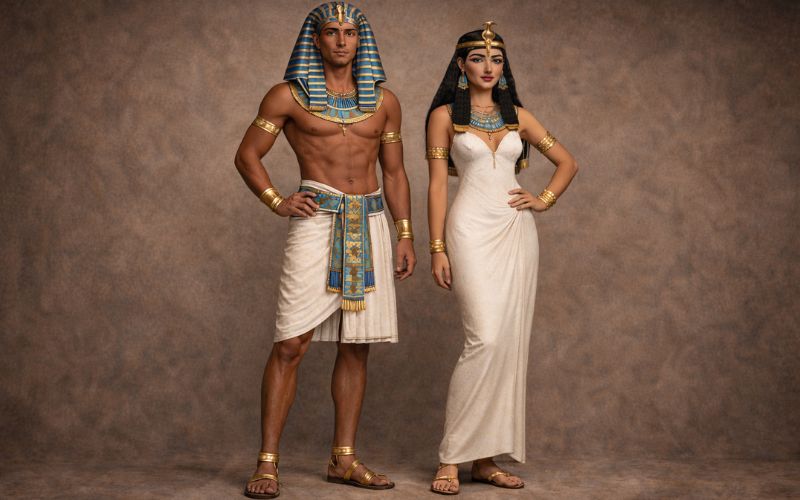
The iconic men's garment is the loincloth (kilt-style). Its length, shape, drape, and the quality of the linen signaled rank. Workers wore practical, shorter versions adapted to physical labor.
The elite adopted more structured variants, sometimes with a more defined front, more intricate pleating, or richer belts.
In certain official contexts, the attire became more presentable: the clothing did not just have a function, it had to represent the individual. The masculine style was no less groomed: it was simply more geometric, more sober, and more focused on posture and accessories.
For women: fitted dresses, straps, and drapes
Women's dresses were often long and fitted to the body, with straps. Refinement was found in the fineness of the fabric, the finishes, cleanliness, and especially the jewelry. In some periods, drapes, layering, and variations in cut enriched the silhouette without ever losing the logic of the line.
Feminine elegance in iconography is often associated with a calm posture, a controlled bearing, and jewelry that structured the upper body. Here again, style was not mere decoration; it was a complete construction.
Hairstyles, wigs, and beards: the architecture of the face
In the art of style in Ancient Egypt, hairstyle occupied a central place. It was not a simple aesthetic choice: it participated fully in the construction of social identity. The face was considered a surface of expression, and framing it correctly meant asserting one's status, self-mastery, and integration into the collective order.
The hairstyle structured proportions, balanced volumes, and reinforced the symmetry sought in the Egyptian aesthetic. Nothing was left to chance: length, density, and the regularity of lines contributed to producing an impression of stability and harmony. This visual rigor corresponded to a culture where appearance had to reflect the order of the world.
Beyond the hair itself, the attention paid to the head revealed a global concept of style. Care, sharpness, and consistency with the rest of the outfit were essential. The hairstyle engaged in a dialogue with jewelry, makeup, and clothing to form a balanced whole.
Thus, in Egyptian society, the architecture of the face became an immediately readable sign: it expressed rank, personal discipline, and the place occupied in the social hierarchy.
Wigs and braids: an art in its own right
Wigs, often highly elaborate, were common among the elite. They provided protection from the sun, allowed for simpler hygiene (frequent shaving), and, above all, offered a perfect, unchanging hairstyle.
They could be braided, curled, adorned, and accompanied by accessories.
Wearing a wig was not a disguise: it was a standard of refinement. It gave the face a sharp frame, comparable to architecture.
In privileged circles, the hairstyle was a signature.
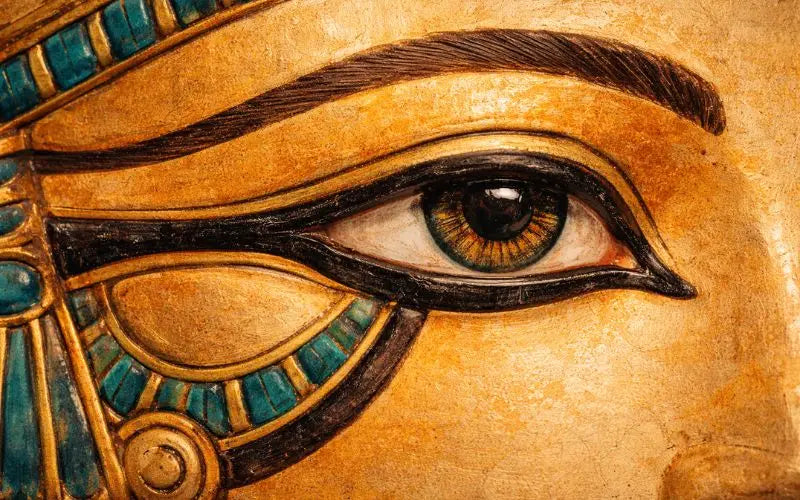
Makeup and cosmetics: beauty, health, and protection
Kohl: framing the gaze and visual intensity
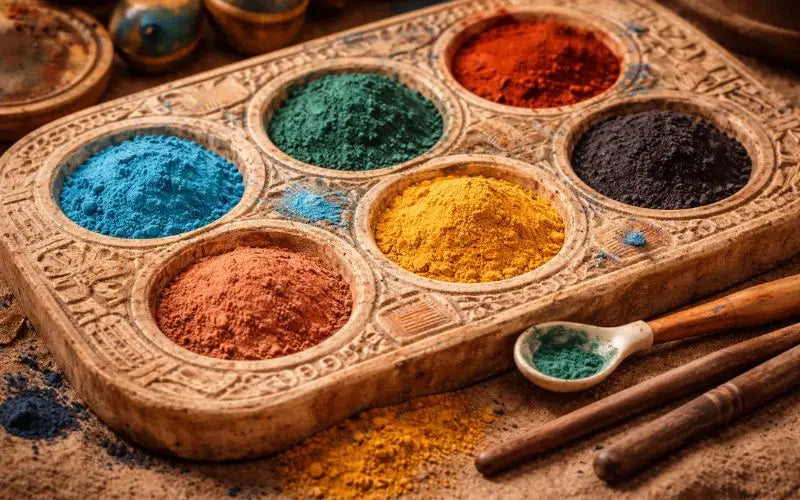
Colors, stones, and materials: a style that speaks in symbols
In the art of style in Ancient Egypt, color goes far beyond mere decorative function. It is part of a coherent visual system where each hue and each material contributes to a social and symbolic interpretation of appearance.
Egyptian aesthetics are based on sharp contrasts, thoughtful harmonies, and a constant quest for visual balance.
Chromatic choices convey values and intentions. Through materials and nuances, individuals could suggest their background, status, or a protective dimension. Appearance thus became a silent language, immediately understood within society.
Brilliance and light also play an essential role. Polished surfaces and vibrant effects catch the eye and reinforce one's presence. Whether precious or simple, all materials contribute to this structured visual construction.
In this logic, style is not a matter of mere personal taste: it expresses a vision of the world where color and material contribute to order and meaning.
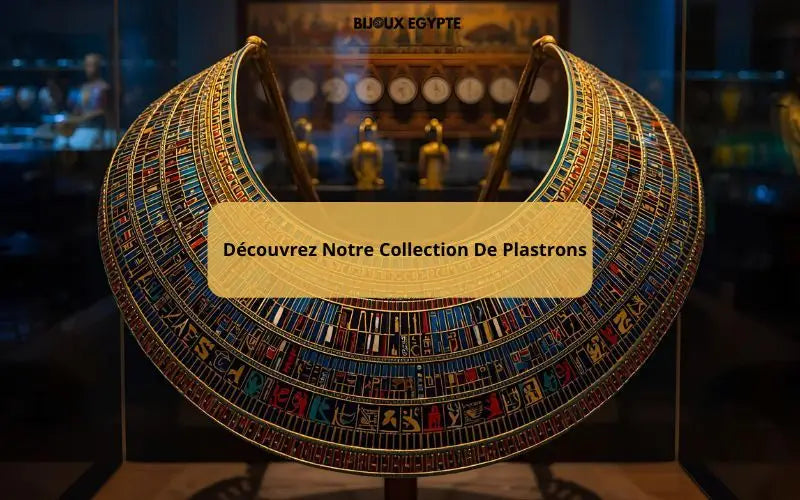
Perfume, cleanliness, gestures: style in everyday life
In the art of style in Ancient Egypt, appearance is not limited to clothing or accessories such as perfume: it is also based on daily discipline.
Body cleanliness, fabric maintenance, and attention to detail reflect social respect and self-control. Being well-groomed means asserting one's place in a structured society.
The hot climate requires regular routines: washing, protecting the skin, and keeping textiles in good condition. But these practices go beyond simple necessity.
They become visible markers of distinction. The quality of the products used and the attention paid to finishing touches signal a certain status.
Elegance is also read in one's attitude. Posture, gait, and bearing complete the appearance. Style is thus expressed in the coherence between clothing, gestures, and behavior.
From this perspective, daily life becomes a space for aesthetic expression. Care for the body and textiles reflects an essential value of Egyptian culture: order and mastery.
Style and art: why depictions seem so codified
Artistic depictions of Ancient Egypt often give the impression of strict uniformity. The silhouettes appear stable, balanced, and almost timeless.
However, this apparent rigidity corresponds to a precise aesthetic choice. The goal is not to faithfully reproduce every variation of reality, but to convey a clear, lasting, and meaningful image.
Egyptian art favors readability. Forms are simplified to be immediately understandable, and essential details are highlighted. This stylization allows for fixing an ideal image rather than an ephemeral moment.
Clothing, hairstyles, or posture become codified signs that express rank, function, or dignity.
This visual approach reinforces cultural coherence. Works seek to place individuals within a stable and harmonious order. The image does not just show a person: it represents their role and place in the world.
Thus, artistic codification does not limit style; it amplifies its symbolic scope. It transforms appearance into a lasting message, designed to endure through time.
Legacy: why Egyptian style still fascinates today
Egyptian style continues to captivate because it relies on a strong and immediately identifiable visual structure. Its effectiveness lies in a rare combination of formal clarity and symbolic depth.
This aesthetic does not depend on a passing trend: it is based on solid principles that are easy to recognize and reinterpret.
It combines, in particular, three major strengths:
-
graphic simplicity (clean lines, symmetry, balanced silhouettes)
-
symbolic power (colors, materials, and motifs rich with meaning)
-
immediate visual identity (highlighted eyes, structured jewelry, recognizable hairstyles)
This structured foundation allows for great adaptability. Contemporary designers can borrow a detail, a silhouette, or a contrast without losing the essence of the style. Fashion, jewelry, cinema, and design regularly draw inspiration from these strong visual codes.
What makes this heritage so enduring is its coherence. The art of style in Ancient Egypt does not juxtapose decorative elements: it builds a harmonious whole.
At once minimal and spectacular, sober and expressive, it offers a timeless aesthetic model capable of engaging with every era without ever losing its identity.
FAQ on the art of style in Ancient Egypt
The art of style in Ancient Egypt continues to spark curiosity and fascination. Behind the slender silhouettes represented in frescoes, the intense kohl-rimmed eyes, and the richly colored ornaments, lies a system of precise and deeply structured codes.
Every element of appearance—clothing, hairstyles, accessories, makeup—follows a social, climatic, and symbolic logic.
Understanding this aesthetic is not just about observing forms or materials, but about grasping how Egyptians conceived of the body in the public sphere.
Clothing expresses rank, the quality of linen indicates a social position, the presence of jewelry can signal a function or protection. Even the rituals of hygiene and self-care contribute to this visual construction.
The following questions help to clarify the more concrete aspects of this culture of style: raw materials, differences between men and women, daily uses, or aesthetic practices.
They offer simple reference points to better understand how, in Ancient Egypt, appearance was never trivial but always meaningful.
How did women dress in Ancient Egypt?
They often wore long, form-fitting linen dresses with straps and completed the outfit with jewelry and makeup.
How did men dress in Ancient Egypt?
They generally wore a loincloth or a linen skirt, the cut and quality of which varied according to social rank.
Did Egyptians wear sandals?
Yes, especially the wealthy, with sandals made of leather or plant fibers, while many went barefoot in their daily lives.
What was the main material used for clothing in Ancient Egypt?
Ancient Egyptians mainly used high-quality fine linen to make their clothes, a textile that was both light and resistant, ideal for the hot climate of the Nile Valley.
What is the origin of linen?
Linen is a plant that has been cultivated for millennia and used very early in history to create textile fibers.
Why did the Egyptians wear so much eye makeup?
Makeup highlighted the gaze and also served to protect the eyes from the sun, sand, and infections.