

Anubis is undoubtedly one of the most recognizable figures in Egyptian mythology. With his black jackal head and human body, he embodies the mystery and power of the world of the dead. Anubis, the god of necropolises and embalmers, played a central role in ancient Egyptian religion, particularly in funeral rites and the protection of the deceased.
Who is Anubis?
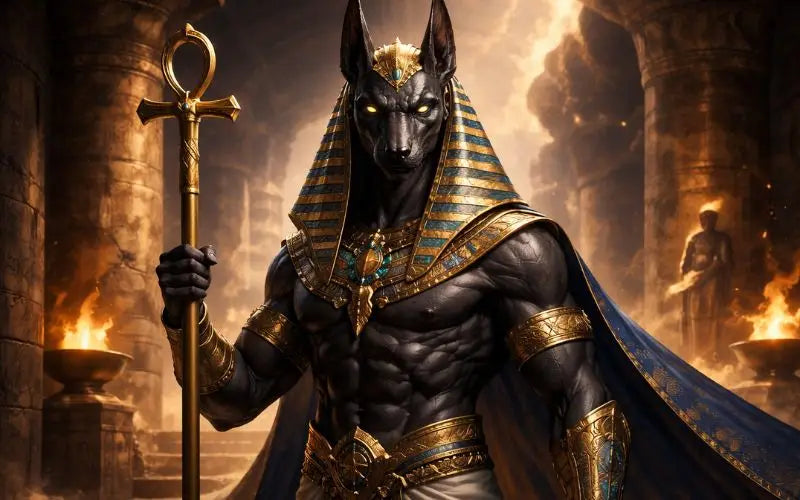
Anubis is a major deity in Egyptian mythology, associated with the dead, necropolises, and the protection of the deceased. He is often presented as the guide of souls and the guardian of tombs, charged with ensuring that the transition to the afterlife takes place in an orderly manner and according to the rites.
Contrary to a modern misconception, Anubis is not an "evil" god. On the contrary, his role is protective: he watches over those who leave the world of the living and ensures that their body and soul are not surrendered to chaos.
In a civilization where survival after death is an essential continuity, Anubis is a reassuring figure: he represents the mastery of the passage, spiritual security, and ritual justice.
The origins of Anubis
Anubis is one of the oldest gods in the Egyptian pantheon. His worship dates back a very long time, likely to the early dynasties. His ancient name, often transcribed as “Inpw” (Inpu), is linked to the idea of the sacred place of embalming.
Depending on the version, Anubis is sometimes described as the son of Nephthys and sometimes associated with Osiris, the god of resurrection. In some traditions, he can also be linked to Ra, the sun, which shows that his role extends beyond the mere funerary world.
What remains constant is his function: Anubis stands on the threshold. He does not belong entirely to the world of the living, nor entirely to the world of the dead. He is the guardian of the passage, the one who ensures that the deceased does not get lost.
The role of Anubis in funeral rites
In ancient Egypt, dying is not a brutal break. It is a process with specific stages. The body must be preserved, prayers must be recited, formulas must be respected, and the soul must be guided.
This is where Anubis becomes central. He is the god of embalmers, the one who supervises the mummification rites and who accompanies the soul toward the final judgment. His presence symbolizes a simple idea: a protected dead person is a dead person at peace.
Anubis and mummification
Mummification is one of the most famous rituals of ancient Egypt. It aims to preserve the body to allow the soul to continue its existence in the afterlife.
Anubis is often depicted watching over the body of the deceased, sometimes leaning over a mummy. This scene reminds us that mummification is not just a technique: it is a sacred act.
Embalmer-priests could wear an Anubis mask during the ceremony. This signifies that they were not acting as men, but as instruments of the god. It is a way of anchoring the rite in divine authority.
Anubis and the weighing of the heart
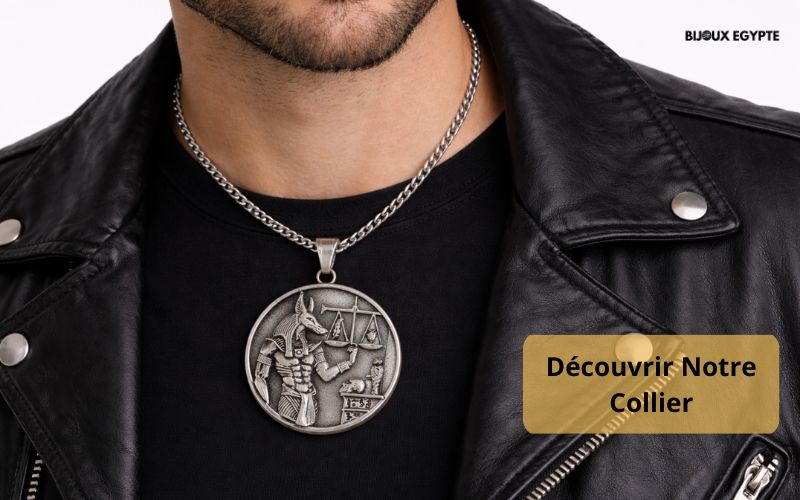
One of the most well-known scenes in Egyptian mythology is the weighing of the heart, also called psychostasy. In this judgment, the heart of the deceased is compared to the feather of Maat, a symbol of truth and balance.
The heart represents the conscience, memory, and past actions. If the heart is too heavy (burdened with sins), the soul is condemned. If the heart is just, the soul can access a form of paradise: the Field of Reeds.
Anubis is the one who supervises the scales. He ensures that everything is correct, that the weighing is fair, and that the judgment follows the sacred order. He embodies a very specific function here: to guarantee ritual justice.
Symbols and representations of Anubis
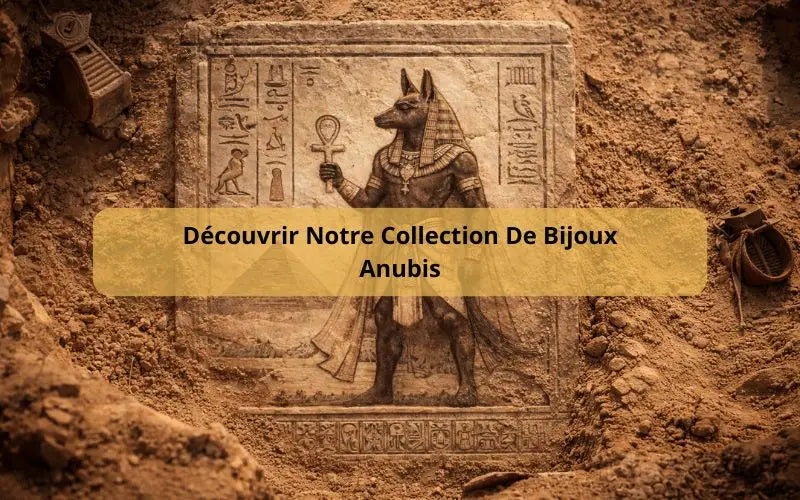
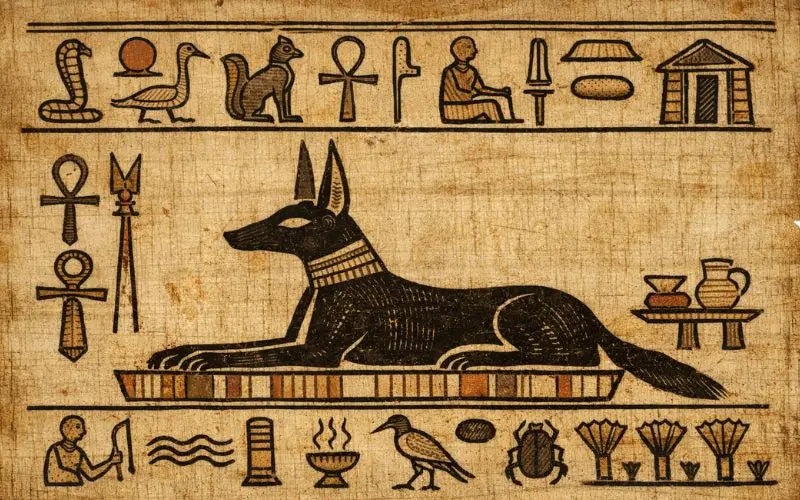
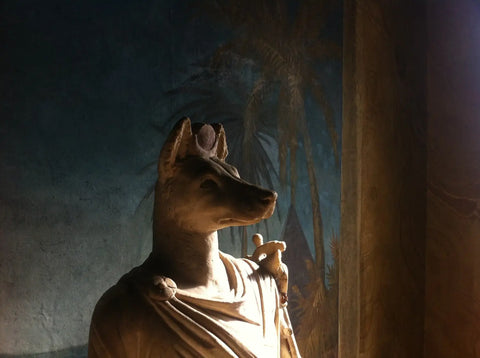
Anubis is easily identifiable in Egyptian art. He appears in two main forms: a reclining jackal or a jackal-headed man.
This representation was not chosen by chance. In ancient Egypt, every visual detail has a symbolic function. The form of Anubis is therefore a language.
Why is Anubis a black jackal?
The jackal was an animal found near desert areas and necropolises. This proximity to tombs explains, in part, why the Egyptians associated it with the funerary world.
But the most important aspect is the black color. In Egypt, black evokes two ideas at once: death and rebirth. The fertile black silt of the Nile brings the earth to life after the flood. Black therefore becomes a symbol of transformation.
Anubis embodies this duality: he is linked to death, but he protects continuity. He does not destroy; he secures the passage.
The attributes of Anubis
In some representations, Anubis holds a scepter, a symbol of divine authority. He can also be seen associated with ritual objects linked to mummification and funeral ceremonies.
He is also sometimes depicted in a guardian role, as if watching over a tomb. This reminds us that the Egyptians feared disorder: desecrations, looting, and breaking of the rite.
Anubis is therefore also a god of material protection: he defends the tomb, the body, and the spiritual passage.
Anubis in the culture of ancient Egypt
Anubis was worshipped throughout Egypt because death affected everyone: kings, nobles, artisans, and families. He was not a god reserved for an elite, but a widely shared religious presence.
Even when the cult of Osiris became dominant, Anubis retained an essential place. Osiris reigns over the afterlife, but Anubis remains the expert of rites and the protector of the passage.
In funerary texts, his presence is constant. He is the god who accompanies, who guides, who protects. He embodies a form of spiritual security in a civilization where the afterlife must be prepared.
Anubis today: fascination and legacy
Anubis still fascinates today because his image is powerful and immediately recognizable. He is found in films, video games, television series, and even in contemporary art.
Modern culture often presents him as a dark, mysterious, and almost threatening figure. Yet, in the Egyptian vision, Anubis is above all a protector.
His legacy comes from this: he represents the boundary, the passage, and the unknown. But he also represents a promise: that of an order that continues, even after death.
It is this combination of fear and protection that makes Anubis so striking, even millennia later.
FAQ about Anubis
Is Anubis the god of death?
Anubis is a god linked to the funerary world, but he is not "death" itself. He is above all the protector of the deceased, the guardian of tombs, and the guide of souls. In ancient Egypt, his role is to secure the passage to the afterlife and to ensure that rites are respected.
Why does Anubis have a jackal head?
The jackal lived near desert areas and necropolises, which naturally associated it with tombs. The Egyptians transformed this presence into a symbol: Anubis became the guardian of the dead. His jackal head represents vigilance, protection, and the boundary between two worlds.
What is the role of Anubis in mummification?
Anubis supervises mummification, an essential ritual for preserving the body. In Egyptian spirituality, the body is necessary for the soul's survival in the afterlife. Anubis is therefore considered the god of embalmers, the one who guarantees that everything is done correctly and according to the sacred order.
What is the weighing of the heart in Egyptian mythology?
The weighing of the heart is the judgment of the deceased: the heart is compared to the feather of Maat, a symbol of truth. If the heart is balanced, the soul can access the Field of Reeds. Anubis supervises this scene and ensures that the scales are fair, which makes him a guarantor of judgment.
What does the black color of Anubis symbolize?
Black symbolizes both death and rebirth. In Egypt, the black silt of the Nile represents fertility and renewal. Anubis, being black, therefore embodies an idea of transformation: death is not an end, but a passage toward another form of existence.
Is Anubis linked to Osiris?
Yes, Anubis is often linked to Osiris in myths. Osiris is the great god of resurrection and the afterlife, while Anubis plays a more technical and ritual role: protection, mummification, guidance, and judgment. The two deities are complementary in the Egyptian vision of death.