Egyptian hieroglyphs are among the most fascinating writing systems of antiquity. Used for more than three thousand years, they bear witness to the cultural and religious richness of ancient Egypt. Understanding their origin and how they work helps shed light on the organization and thought of this civilization.
The origin of hieroglyphs in ancient Egypt
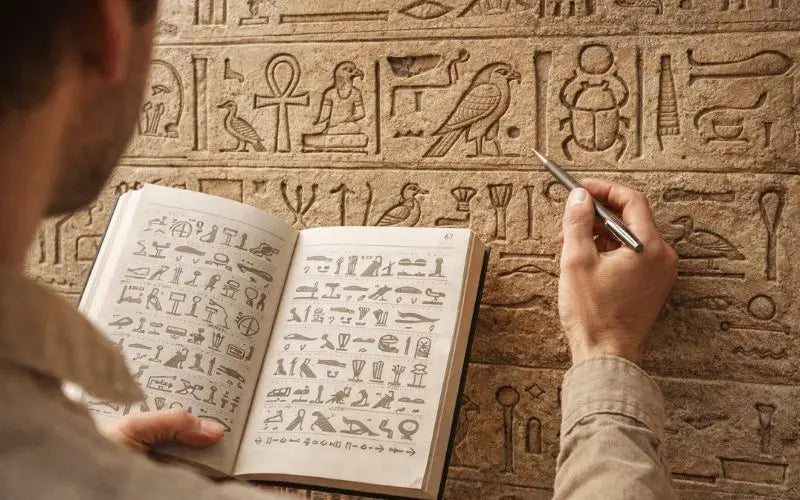
Hieroglyphs appeared towards the end of the 4th millennium BCE, a period corresponding to the formation of the first Egyptian kingdoms. The emergence of this writing is directly linked to the development of administration and the management of an increasingly vast territory. The first inscriptions were discovered on objects such as jars, seals, or labels used to identify products.
Initially, writing met a very concrete need: organizing agricultural production, controlling resources, and recording exchanges. The nascent state had to manage harvests, stocks, and taxes, which required a reliable system to store information.
With the consolidation of royal power, hieroglyphs also took on a political and symbolic dimension. Pharaohs used writing to assert their authority and inscribe their names on monuments. Temples and tombs thus became preferred supports for this monumental writing.
Over time, hieroglyphs evolved to adapt to linguistic and cultural changes. Their development testifies to the importance of writing in the structuring of Egyptian civilization.
The first hieroglyphic inscriptions
The first traces of hieroglyphs were discovered at archaeological sites dating from the first dynasties. These inscriptions are often short and simple, but they already show the foundations of the writing system. They appear mainly on objects used in administration or in funerary contexts.
These inscriptions often contain names of kings or symbols linked to power. They also serve to identify goods or places, which confirms the initial administrative role of writing. Archaeologists consider these documents a fundamental step in the evolution of writing systems in the ancient world.
How the hieroglyphic writing system works
Hieroglyphs are not an alphabet in the strict sense. They constitute a complex writing system that combines several types of signs to convey information. This organization makes the writing particularly rich and flexible, as the same symbol can have different functions depending on the context in which it is used.
Each sign can represent an object, a sound, or an idea. Scribes used these symbols strategically to construct words and sentences. This combination made it possible to express precise concepts while maintaining a strong visual dimension. Hieroglyphs were therefore both a written language and a system of symbols charged with meaning.
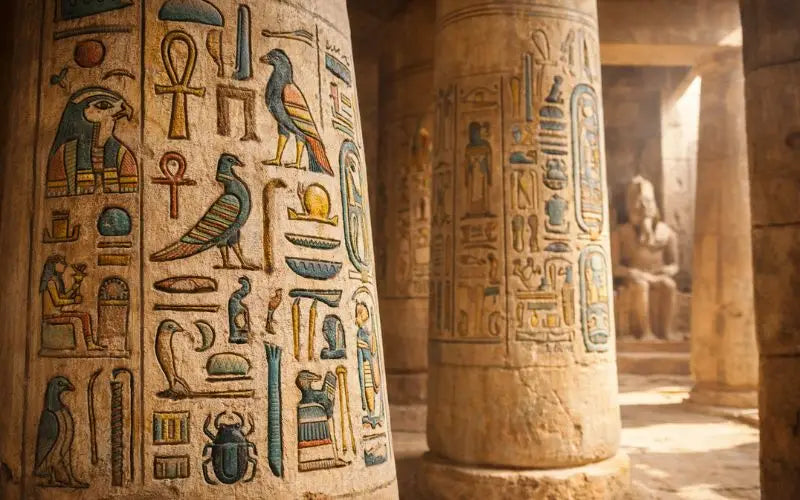
Hieroglyphs could be carved into stone or painted on the walls of temples and tombs. Their aesthetic appearance was also important, as the writing was an integral part of monumental decoration. Artisans sought to organize the signs harmoniously to create a balanced whole.
This writing was therefore both a linguistic, artistic, and symbolic tool, reflecting the worldview specific to Egyptian civilization.
The different categories of signs
The hieroglyphic system is based on three main categories of signs. Each plays a specific role in the construction of words and sentences.
Phonograms represent sounds. Some correspond to a single sound, while others can represent two or three sounds combined.
Ideograms directly represent an object or an idea. For example, a symbol representing the sun can mean the word sun or light.
Determinatives are not pronounced. They serve to specify the meaning of the word and to avoid confusion between terms with the same pronunciation.
Thanks to this combination, hieroglyphic writing could express complex concepts with great precision.
The sacred dimension of hieroglyphs
In Egyptian civilization, writing possessed a very important spiritual dimension. Hieroglyphs were considered a sacred language capable of connecting humans to the gods and the invisible world. This perception explains why they appear very often in temples, religious monuments, and tombs. Writing was not just used to convey a message, but also to perform a religious act.
The walls of temples and tombs are filled with inscriptions intended to honor the deities or protect the deceased. Funerary texts describe, for example, the soul's journey into the afterlife and the rituals necessary to reach eternal life. These inscriptions symbolically guided the deceased in their passage to the world of the dead.
The Egyptians believed that words possessed real power. Inscribing a name, a prayer, or a magic formula on stone made these words permanent and effective.
This belief explains the care taken in carving hieroglyphs. Each sign had to be represented precisely in order to preserve its symbolic and religious value in rituals.
Writing as symbolic power
In ancient Egypt, writing meant giving lasting existence to an idea or a person. The names of the pharaohs were often surrounded by a cartouche, an oval symbol that highlighted their royal status.
Inscriptions carved on monuments recounted military victories, temple construction, or offerings made to the gods. They served to reinforce the sovereign's authority and transmit their memory to future generations.
This relationship between writing and power shows the importance of hieroglyphs in the construction of the political and religious identity of ancient Egypt.
The role of scribes in Egyptian society
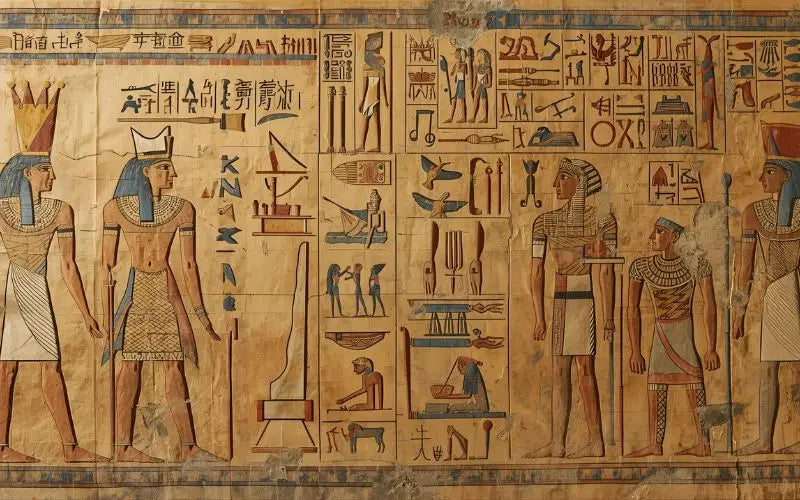
Scribes occupied an essential place in the organization of Egyptian society. They were responsible for drafting administrative documents, religious texts, and the kingdom's official archives. Their ability to master hieroglyphic writing gave them a privileged status and placed them among the intellectual elites of the era.
The training of a scribe was long and demanding. Students had to learn to recognize and use several hundred signs, which required a great memory and many years of practice. This education often took place in schools attached to temples or the administration.
Scribes worked for royal power, religious institutions, or local authorities. They drafted harvest registers, contracts, accounts, and various documents necessary for the functioning of the state.
Thanks to their work, important information could be preserved and transmitted through the generations. Scribes thus played a fundamental role in the management of the kingdom and in the preservation of the knowledge of ancient Egypt.
The scribe's tools
Scribes used several instruments to write on different materials. Papyrus was the most common material for administrative and literary documents.
Their equipment generally included a palette containing two types of ink: black for the main text and red for headings or important indications.
They also used a sharpened reed that served as a brush. Scribes often carried their tools in a small case that allowed them to write easily while traveling.
These simple instruments were, however, sufficient to produce complex documents essential to the functioning of the state.
The different forms of Egyptian writing
Over the centuries, the Egyptians developed several forms of writing adapted for different uses. Hieroglyphs remain the most well-known form today, particularly thanks to the monuments and temples where they are carved. However, they only represent one part of the writing system used in Egyptian civilization.
Hieroglyphs were mainly reserved for monumental and religious inscriptions. Their detailed and artistic form made them difficult to use for everyday documents or for quick writing. They were therefore primarily used in temples, tombs, and official monuments.
For administrative tasks and religious texts copied onto papyrus, scribes used hieratic script. This simplified version of hieroglyphs allowed for faster writing while maintaining the principles of the original system.
Later, an even more cursive script appeared: demotic. Used for contracts, letters, and accounts, it gradually became the most common script in the daily life of the late periods of ancient Egypt.
Differences between hieroglyphs, hieratic, and demotic
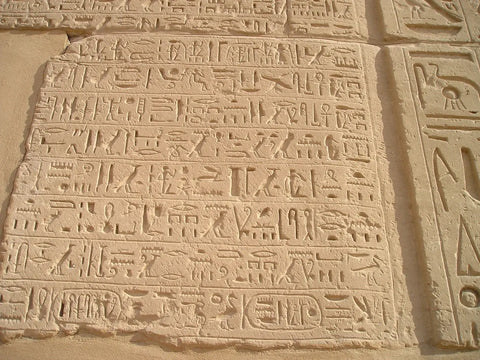
Each of the three Egyptian forms of writing has specific characteristics. Hieroglyphs are visually detailed and used primarily on monuments.
Hieratic script is more cursive and adapted to documents written on papyrus. It allowed scribes to work more quickly.
Demotic is even more simplified and became the dominant administrative script in the late periods. It is widely used in commercial exchanges and legal documents.
These different forms show the evolution of writing according to the practical needs of society.
The decipherment of hieroglyphs
For many centuries, hieroglyphs remained misunderstood. After their usage disappeared in antiquity, knowledge of this script was gradually lost. European scholars then thought it was a purely symbolic or mystical system, used to convey religious or philosophical ideas rather than sounds.
The situation changed in the early 19th century thanks to a major archaeological discovery. In 1799, during the French expedition to Egypt, soldiers discovered the famous Rosetta Stone. This stele contains the same text written in three systems: ancient Greek, demotic, and hieroglyphic. As Greek was already known to researchers, it became an essential reference for comparing the inscriptions.
The French linguist Jean-François Champollion finally managed to demonstrate that hieroglyphs represent both sounds and ideas. In 1822, he officially announced the decipherment of the writing system. This discovery opened a new era for the study of ancient Egypt and finally made it possible to read the texts left by this civilization.
The role of the Rosetta Stone
The Rosetta Stone constitutes an exceptional document for researchers. It contains three versions of the same text, which allows for the comparison of different writing systems.
By analyzing royal names surrounded by cartouches, Champollion identified several correspondences between signs and sounds. This linguistic method gradually allowed him to understand how the writing worked.
The Rosetta Stone thus became the key that opened the door to the scientific study of hieroglyphs and the birth of modern Egyptology.
FAQ on Egyptian Hieroglyphs: History and Origins
Egyptian hieroglyphs still spark many questions today. This ancient script, used for more than three millennia, remains one of the most famous symbols of the civilization of ancient Egypt. Its complexity, unique visual aspect, and close link to religion and political power explain why it continues to fascinate researchers, history enthusiasts, and museum visitors.
Despite numerous archaeological discoveries and the progress of Egyptology, certain questions come up regularly. Internet users often seek to understand how this writing really worked, how many symbols existed, or how scholars managed to decipher it after centuries of oblivion. Hieroglyphs sometimes seem mysterious because they combine linguistic, artistic, and symbolic elements in the same system.
This FAQ section on Egyptian Hieroglyphs: History and Origins answers the most frequent questions. It helps clarify some essential points about this fascinating script and provides simple explanations for questions often asked by readers interested in the history and culture of ancient Egypt.
Are hieroglyphs an alphabet?
No. Hieroglyphs are not a classic alphabet. They constitute a mixed writing system that combines signs representing sounds, objects, and ideas.
How many hieroglyphic signs exist?
Researchers have identified several hundred hieroglyphic signs. Depending on the period of Egyptian history, their number can exceed 700 different symbols.
How to read hieroglyphs?
Hieroglyphs can be read from right to left or left to right. The direction of reading depends on the orientation of the characters or animals represented in the signs.
Who deciphered hieroglyphs?
Hieroglyphs were deciphered in 1822 by Jean-François Champollion. His work was based on the study of the Rosetta Stone.
Why were hieroglyphs used in tombs?
Hieroglyphs in tombs had a religious role. They contained texts intended to protect the deceased and to guide their soul in the afterlife.
What were Egyptian hieroglyphs used for?
Hieroglyphs were used to write religious, administrative, and political texts. They were carved on temples, monuments, and tombs to transmit important messages and preserve the memory of the pharaohs.
When were hieroglyphs invented?
Hieroglyphs appeared around 3300 to 3000 BC, at the end of the Predynastic period. They are among the first writing systems developed in history.
Why did hieroglyphs disappear?
Hieroglyphs gradually disappeared starting from the Roman era. With the expansion of Christianity and the abandonment of traditional temples, this script ceased to be used and knowledge of it was lost.
What is the difference between hieroglyphs and hieratic?
Hieroglyphs are the monumental script used on temples and monuments. Hieratic is a simplified and cursive version used by scribes to write more quickly on papyrus.
Can we learn to read hieroglyphs today?
Yes. Hieroglyphs can be studied thanks to the work of Egyptologists. Learning methods and specialized books allow one to understand the basics of this ancient script today.
Conclusion on Egyptian Hieroglyphs: History and Origins
Egyptian hieroglyphs constitute one of the most impressive writing systems in human history. Their appearance is closely linked to the formation of the Egyptian state and the need to organize a complex administration. Over the centuries, this script evolved to adapt to the political, cultural, and linguistic transformations of Egyptian civilization.
Beyond their practical function, hieroglyphs possessed a very strong symbolic and religious dimension. They served to honor the gods, protect the deceased, and inscribe the exploits of the pharaohs in the collective memory. Their visual beauty and complex structure bear witness to the level of sophistication reached by ancient Egypt.
The decipherment carried out in the 19th century made it possible to bring this ancient language back to life. Thanks to this discovery, historians and archaeologists can now read the inscriptions left by the Egyptians and better understand their worldview.
Hieroglyphs continue to fascinate researchers and history enthusiasts alike. They represent an exceptional cultural heritage that allows us to explore one of the most influential civilizations of antiquity.