
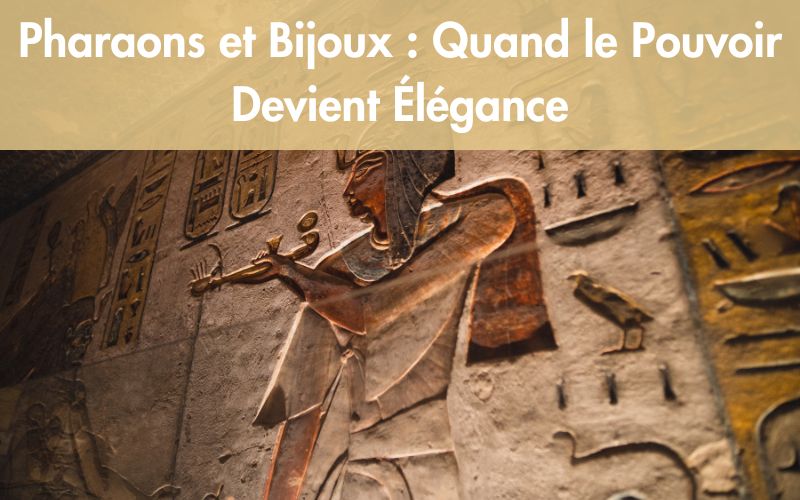
Ancient Egypt is one of the most fascinating civilizations in history. The pharaohs embodied divine power and wore jewelry that symbolized their authority and connection to the gods. Necklaces, rings, and amulets formed a true spiritual and political armor.
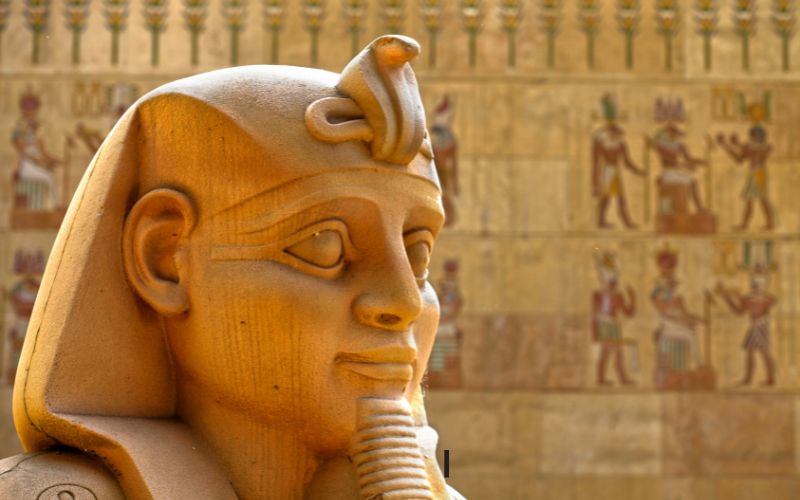
The sacred role of jewelry in Egyptian royalty
In ancient Egypt, jewelry was much more than just decorative accessories. It represented a symbolic language used to express the power and divine dimension of the pharaohs. The sovereign was not merely a political leader: he embodied the cosmic order decreed by the gods. Royal ornaments therefore played a part in constructing this sacred image.
Jewelry was present in almost all depictions of the pharaoh. On statues, frescoes, or bas-reliefs, the sovereign often appears covered in necklaces, bracelets, and pectorals. These elements reinforced the impression of majesty and reminded the people that the king possessed divine authority.
Royal adornments also had a religious function. Certain amulets were intended to protect the pharaoh against the forces of chaos and ensure the balance of the kingdom. In Egyptian religion, every symbol possessed real power.
Thus, wearing a piece of jewelry was never trivial. Each piece was designed to affirm the sovereign's status and strengthen his bond with the deities. The jewelry thus became a true political and spiritual instrument.
Jewelry as a symbol of power
Pharaohs used jewelry to display their authority and wealth. The finery impressed their subjects and served as a reminder that the sovereign held exceptional power. The precious materials and imposing forms contributed to this image of grandeur.
Broad necklaces, called pectorals, were particularly important. They covered the chest and often depicted mythological scenes. These objects served just as much to impress as they did to symbolically protect the king.
Jewelry as spiritual protection
Amulets occupied an essential place in royal jewelry. They were meant to protect the pharaoh against visible and invisible dangers. The symbols engraved on these pieces of jewelry held precise religious significance.
Among the most common protections:
-
pendants representing deities
-
rings engraved with sacred symbols
-
protective scarabs
-
amulets linked to eternal life
These objects accompanied the pharaoh throughout his life and were often placed in his tomb.

Precious materials used in pharaonic jewelry
Artisans of ancient Egypt used materials carefully chosen for their beauty as well as for their religious symbolism. Gold was considered the most precious metal in Egyptian culture. The Egyptians viewed it as the flesh of the gods, an eternal material that did not tarnish and represented divine perfection. This is why it held a central place in jewelry intended for pharaohs and members of the royal family.
Thanks to mines located in Nubia, the kingdom possessed significant gold reserves. This wealth enabled the development of particularly refined and sophisticated jewelry. Artisans shaped the metal using advanced techniques such as hammering, engraving, soldering, and the inlaying of colored stones.
Precious stones also played an essential role in jewelry design. Colors possessed a particular significance linked to mythology and religious beliefs.
Artisans often combined several materials in order to strengthen the symbolic power of a piece of jewelry. This combination of colors and metals gave rise to pieces of great aesthetic and spiritual richness.
Sacred stones and their meanings
Precious stones were selected for their symbolic virtues. In Egyptian thought, colors possessed a very strong religious significance.
Among the most widely used stones:
-
lapis lazuli: symbol of royalty and the sky
-
turquoise: protection and rebirth
-
carnelian: solar energy and vitality
-
green feldspar: renewal and fertility
These stones were often inlaid into gold to create impressive color contrasts.
Gold, divine metal
Gold occupied a central place in Egyptian jewelry. Its brilliance recalled the sun and eternity. Pharaohs wore this metal to show their closeness to the gods.
Artisans mastered complex techniques that allowed them to work with gold with great finesse. They could create decorated plates, twisted wire, or delicate inlays. These pieces still demonstrate the extraordinary craftsmanship of Egyptian artisans today.

Mythical symbols found in Egyptian jewelry
The jewelry of the pharaohs was distinguished by the richness of its symbols and its strong spiritual dimension. Each motif possessed a precise meaning in Egyptian religion and was carefully chosen by artisans and priests. The artisans engraved or sculpted these signs to bring protection, luck, and power to the sovereign. These depictions did not serve merely as decorative ornaments: they were considered true talismans capable of acting upon the spiritual world.
The symbols appeared on almost all finery: rings, necklaces, pectorals, or bracelets. Their presence transformed the item into a truly sacred object. The Egyptians believed that these depictions possessed real power capable of influencing destiny, repelling the forces of chaos, and protecting the one who wore them.
The symbols also served to recall the bond between the pharaoh and the deities. By wearing these motifs, the sovereign affirmed his role as an intermediary between gods and men.
Even today, these symbols remain among the most recognizable elements of Egyptian culture and continue to inspire art, jewelry, and popular culture.

The Ankh cross and eternal life
The Ankh cross represents eternal life and is one of the most important symbols of ancient Egypt. This sign appears frequently in Egyptian art, temple frescoes, and royal jewelry.
Its distinctive shape evokes life and the balance between the earthly world and the divine world. Pharaohs often wore Ankh pendants during religious ceremonies. This cross served as a reminder that their power was linked to the vital force granted by the gods and also symbolized the immortality of the soul.
The Eye of Horus and protection
The Eye of Horus is one of the most famous protective symbols of ancient Egypt. It represents vigilance, healing, and divine protection in Egyptian mythology. This symbol is linked to the god Horus, whose eye was said to have been restored after a mythical battle.
Jewelry bearing this motif was intended to ward off evil forces. Rings, necklaces, and amulets adorned with this eye often accompanied the pharaohs in their daily lives.
The scarab and rebirth
The scarab symbolizes rebirth and the eternal cycle of the sun in Egyptian culture. In mythology, this insect is associated with the god Khepri, who represents the rising sun and daily renewal.
The Egyptians observed the scarab rolling a ball of earth, a symbol of the sun's movement across the sky. Sculpted scarabs were often mounted as rings or pendants and also accompanied pharaohs in their tombs to ensure their rebirth in the afterlife.

The exceptional art of Egyptian craftsmen
The creation of royal jewelry required remarkable know-how and great technical precision. Egyptian craftsmen were capable of producing pieces of impressive artistic finesse, combining aesthetics, symbolism, and exceptional quality. Their work was based on complex techniques passed down from generation to generation, often within specialized workshops.
Royal workshops brought together experts in working with precious metals and decorative stones. These craftsmen created pieces intended for the pharaoh, the royal family, and the temples. Each piece of jewelry was designed with particular attention to detail, from the conception of the motif to the final assembly. The decorations often represented religious symbols, sacred animals, or protective hieroglyphs.
Archaeological discoveries reveal the extraordinary mastery of these craftsmen. The jewelry found in royal tombs, notably that of Tutankhamun, exhibits delicate inlays and engravings of great refinement.
These works testify to a craft tradition that was highly advanced for its time. They prove that ancient Egypt already possessed a sophisticated and particularly refined art of jewelry-making.
Manufacturing techniques
Craftsmen used several techniques to make the royal finery intended for pharaohs and members of the court. These methods made it possible to create solid, refined, and richly decorative jewelry.
Among the main techniques:
-
hammering gold plates
-
inlaying precious stones
-
engraving sacred symbols
-
filigree and twisting gold wire
These processes required great precision, many years of apprenticeship, and perfect mastery of working with precious metals.
Royal workshops
Specialized workshops worked under the direct authority of the palace or the great temples of the kingdom. They were responsible for producing jewelry intended for the pharaoh, the royal family, and sometimes the most important priests.
Artisans transmitted their knowledge there to subsequent generations through a long apprenticeship. This structured organization allowed for the preservation of traditional techniques and ensured exceptional quality in the manufacture of royal jewelry.

The legacy of pharaonic jewelry in modern jewelry-making
Jewelry inspired by ancient Egypt continues to influence contemporary fashion and jewelry design around the world. Since the rediscovery of royal tombs in the 19th and 20th centuries, interest in this fascinating civilization has grown steadily, attracting historians, artists, and designers.
The discovery of Tutankhamun's tomb in 1922 significantly marked the history of jewelry. The treasures found, composed of richly decorated necklaces, rings, and pectorals, revealed the exceptional refinement of Egyptian art to the whole world. These pieces have inspired many designers who have reinterpreted certain visual elements in modern collections.
Geometric shapes, vibrant colors, and sacred symbols have thus been adapted to contemporary styles. Even today, jewelry inspired by ancient Egypt attracts with its mystery and elegance.
This fascination is explained by the cultural richness of these objects. Pharaonic jewelry embodies power, spirituality, and a timeless aesthetic that traverses the centuries without losing its symbolic power.
A timeless style
Creations inspired by ancient Egypt possess an immediately recognizable aesthetic. Geometric lines, color contrasts, and sacred symbols give rise to a style that is both powerful and elegant.
Symmetrical shapes, the use of gold, and colored stones directly recall the jewelry worn by pharaohs. This timeless aesthetic explains why Egyptian motifs continue to inspire contemporary designers and jewelry enthusiasts around the world.
Ever-popular symbols
Several Egyptian symbols remain very present in current jewelry and continue to fascinate history and spirituality enthusiasts. Among the most popular motifs are:
-
Ankh pendants
-
scarab rings
-
Eye of Horus necklaces
-
hieroglyphic bracelets
These symbols possess a strong cultural and mystical dimension. They allow modern creations to connect to the millennial legacy of ancient Egypt while maintaining an elegant aesthetic charged with meaning.
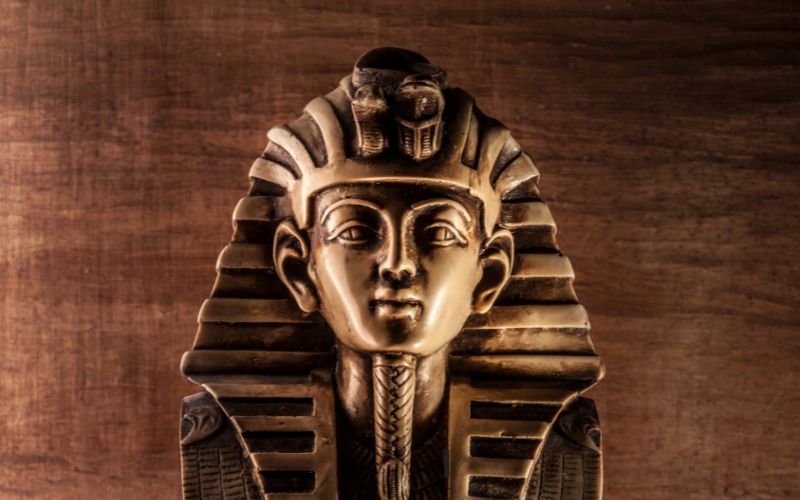
FAQ on Pharaohs and Jewelry: When Power Becomes Elegance
Jewelry held an essential place in the civilization of Ancient Egypt. For the pharaohs, these precious objects were not merely ornaments intended to display wealth or royal prestige. They also represented powerful symbols linked to religion, spiritual protection, and divine authority. Each ring, necklace, or amulet possessed a particular meaning that reflected the deep beliefs of this fascinating civilization.
Through archaeological discoveries, researchers have highlighted the importance of jewelry in the daily life and funerary rites of Egyptian sovereigns. The treasures found in royal tombs, notably that of Tutankhamun, testify to the artistic and symbolic richness of these objects. These pieces also reveal the central role of artisans and religious symbols in the creation of these adornments.
Even today, jewelry inspired by Ancient Egypt continues to spark curiosity and admiration. The most frequent questions surrounding the pharaohs and their jewelry allow for a better understanding of their meaning, function, and place in history.

Why did the pharaohs wear so much jewelry?
The pharaohs wore jewelry to show their power and their connection to the gods. The adornments also represented spiritual protection against the forces of chaos.
What jewelry did the pharaohs wear?
Egyptian sovereigns wore broad necklaces, pectorals, bracelets, rings, and amulets. Each piece of jewelry possessed a religious meaning.
Which stone was most used?
Lapis lazuli was highly prized for its blue color, which was associated with the sky and royalty.
What does the scarab symbolize?
The scarab represents rebirth and the eternal cycle of the sun.
Was jewelry buried with the pharaohs?
Yes, jewelry accompanied the pharaohs in their tombs to protect their souls in the afterlife.
Did the pharaohs wear their jewelry every day?
The pharaohs wore certain pieces of jewelry daily, such as rings or amulets. The most imposing adornments were reserved for ceremonies and important events.
What is the meaning of the Ankh cross in Egyptian jewelry?
The Ankh cross symbolizes eternal life. It was often worn as a pendant to represent divine protection and the immortality of the soul.
Did the queens of Egypt wear the same jewelry as the pharaohs?
The queens also wore necklaces, bracelets, and diadems. Their jewelry was similar to that of the pharaohs but adapted to their royal role.
Why was gold so important in Egyptian jewelry?
Gold represented the flesh of the gods and eternity. This is why it was widely used in the jewelry of the pharaohs.
Where can one see the pharaohs' jewelry today?
Pharaonic jewelry can be seen in several museums, notably at the Grand Egyptian Museum in Cairo.
Conclusion on Pharaohs and Jewelry: When Power Becomes Elegance
Jewelry from Ancient Egypt perfectly illustrates the fusion of power, spirituality, and art. For the pharaohs, these objects were never simple decorative ornaments. They represented a symbolic language that allowed them to assert their divine status and their authority over the kingdom.
Through gold, precious stones, and sacred symbols, each piece of jewelry embodied a deeply religious worldview. Amulets protected the sovereign, pectorals recalled founding myths, and rings bore the symbols of the gods.
Archaeological discoveries show that these creations were also true technical masterpieces. Egyptian artisans were already mastering manufacturing methods that were extremely advanced for their time.
Even today, jewelry inspired by Ancient Egypt continues to fascinate. It testifies to a civilization that placed immense importance on symbolism, beauty, and eternity. The adornments of the pharaohs thus remain one of the most impressive and elegant legacies in human history.